- Says “Emerging technologies reshaping military strategy, Urges officers to prepare for rapidly changing warfare, technology-driven military ops”
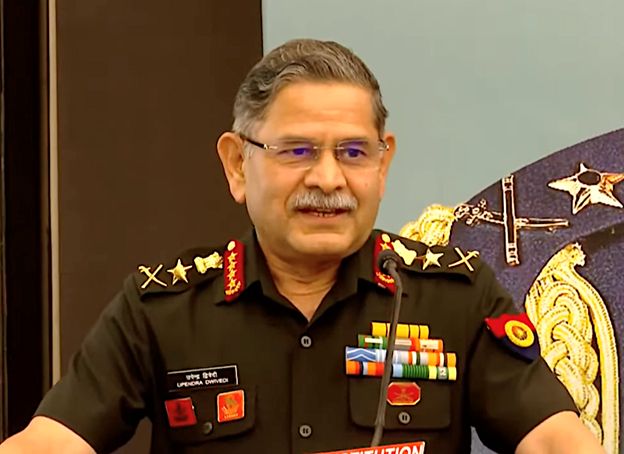
Pune : Reviewing the passing-out parade of the 150th course at the National Defence Academy (NDA) in Pune on Saturday, Chief of Army Staff General Upendra Dwivedi reaffirmed the Army’s commitment to safeguarding national security.
Addressing the passing out parade General Dwivedi declared that the Indian Armed Forces remain fully prepared to launch the next phase of ‘Operation Sindoor 2.0’ if necessary, noting that the operation remains active to prepare for future contingencies.
“There is a temporary cessation of hostilities at present, but all three services are preparing thoroughly for the next phase if the need arises,” he said.
Operation Sindoor was launched in May 2025 following the April 22 Pahalgam terror attack that killed 26 people. It involved Indian strikes on nine terrorist camps inside Pakistan and Pakistan-occupied Kashmir, leading to a four-day skirmish that ended after Pakistan’s DGMO requested a ceasefire.
General Dwivedi emphasized that the rapidly changing nature of warfare now extends beyond traditional battlefields. “Modern warfare is no longer confined to land, sea and air. Space, cyber and cognitive domains are becoming equally significant,” he said.
He noted that advanced surveillance has made battlefields highly transparent, complicating operational planning. “Today, almost every movement can be observed by the adversary. This requires greater caution in deployment, employment of forces and protection of troops as well as civilians living in border areas,” he said.
The Army Chief highlighted the critical role of AI, automation, and faster decision-making in modern conflicts, urging the 355 graduating cadets to adapt to these evolving technological changes.
Regarding the government’s plan for integrated theatre commands, General Dwivedi confirmed that progress is underway, and a detailed report has been submitted to the Defence Minister. Under this system, service chiefs will manage force preparedness while theatre commanders handle joint operations. He expressed confidence that these commands could become operational within two to three years if a consensus is reached. Finally, he highlighted ongoing modernization efforts under the “Decade of Transformation” initiative to make the force more agile and technology-driven.