- Livelihood fears trigger chakka jam; commuters face severe disruption
- District routes proposal still under consideration: Govt
Srinagar, April 20: Commuters across the Kashmir Valley were left stranded on Monday as private transport services came to a standstill following a Valley-wide chakka jam called by transporters protesting the proposed expansion of Smart City electric bus services into other districts.
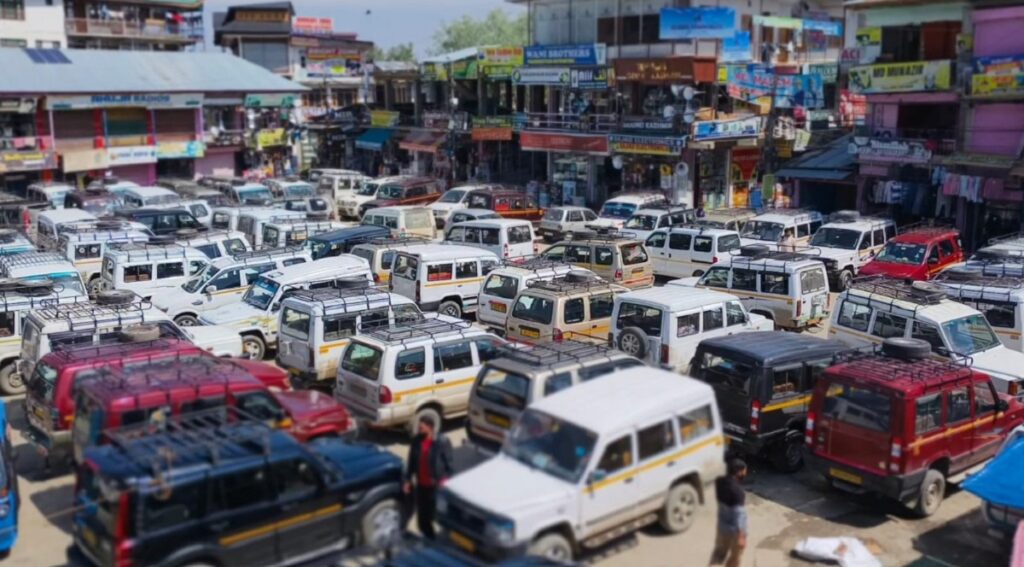
The shutdown, enforced by the All Jammu and Kashmir Transporters’ Welfare Association, led to the suspension of private buses, mini-buses, and inter-district cabs across major routes, severely disrupting daily life.
Thousands of passengers, including office-goers, students, patients, and daily wage earners, were seen waiting at bus stops and transit points from Srinagar to Kupwara, Baramulla, Pulwama, Anantnag, and other districts, with little or no transport available for hours.
Imtiyaz Ahmad Malik, a stranded commuter at Parimpora, said that he works in Sirnagar and had to return to Kupwara, but there is no bus or any cab available since morning.
“People are suffering. There are elderly passengers and students stuck here. The government should have made alternative arrangements before things reached this stage,” he said.
Another commuter, Shazia Bano, a college student from Mirgund Pattan, said that people are not against development, but why should common people suffer like this?”
“Both sides need to sit together and find a solution. We cannot be stuck like this every time there is a dispute,” she added.
Officials confirmed that while private transport remained off the roads, government buses and auto-rickshaws continued to operate in limited capacity, though they were unable to meet the heavy passenger demand.
In several areas, passengers reported overcrowding and increased waiting times, while some also complained of higher fares charged by available transport.
The protest has been triggered by the government’s proposal to expand the Smart City electric bus service beyond Srinagar and Jammu to other districts of the Union Territory. Transporters argue that the move threatens their livelihood and could render thousands of private operators jobless.
Shabir Ahmad Matta, president of the transporters’ association, told Kashmir Horizon that this was a peaceful but firm protest against the proposed expansion of Smart City buses into district routes.
“We are not against development, but we cannot allow policies that directly affect the livelihood of thousands of families. We have repeatedly requested the government to engage with us, but our concerns have not been addressed,” he said.
Matta urged Lieutenant Governor Manoj Sinha and Chief Minister Omar Abdullah to intervene.
“We appeal to the highest authorities to stop this expansion plan. Recently, we were told that around 200 more buses are being considered for deployment. This will directly impact existing transport routes in places like Pulwama, Sopore and Kangan. Where will our people go if our work is taken away?” he asked.
Matta said they have made our position clear. If the government does not engage with us, we will have no option but to intensify our agitation.
“Transporters are open to dialogue but will not accept unilateral decisions. “We are ready for talks at any level, but our livelihood concerns must be respected,” he said.
According to transporters, the fear stems from the possibility that government-run electric buses, once expanded into rural and semi-urban routes, could replace existing private services that have operated for decades.
Meanwhile, transport officials, however, said the expansion is part of a broader mobility improvement plan under the Smart City initiative aimed at strengthening eco-friendly public transport and improving last-mile connectivity.
A senior transport department official, wishing anonymity, said the proposal is still under consideration and no final rollout has been implemented in district routes.
“The aim is to improve connectivity, especially in areas where transport availability is limited. However, stakeholder consultation is part of the process, and no decision will be taken without dialogue,” he said.
The Smart City electric bus service was launched in Jammu and Kashmir in November 2023, with 100 electric buses each introduced in Srinagar and Jammu, along with free travel for women.
Despite these assurances, the strike caused widespread disruption throughout the day. Government buses operated on select routes, but the absence of private transport, the backbone of inter-district mobility in Kashmir, left large sections of the population struggling to travel.