
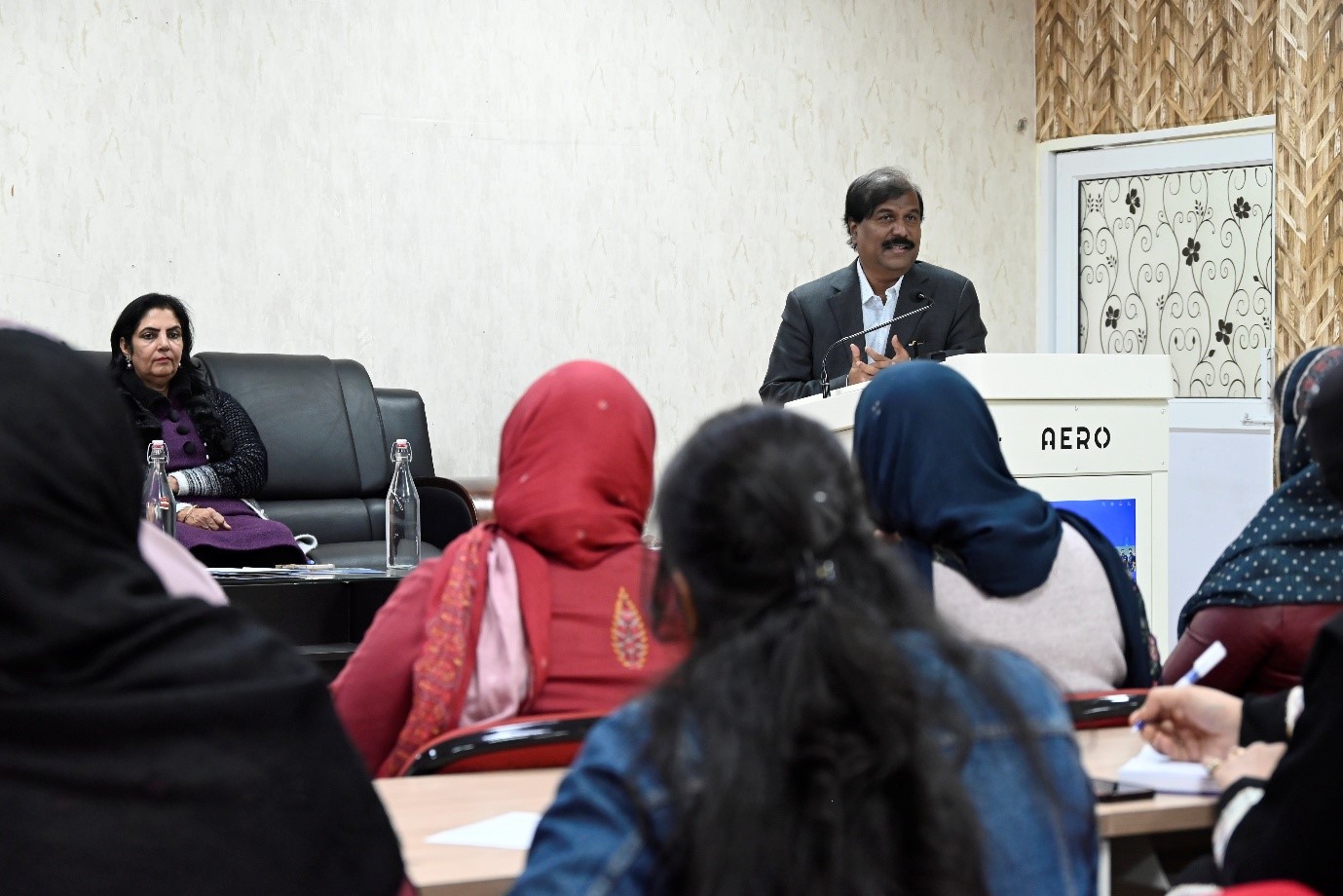
Gandrbal :Central University of Kashmir (CUKashmir) today organized a comprehensive and engaging panel discussion on “Women’s Reservation Bill (Naari Shakti Vandan Adhiniyam 2023) for Gender Equity and Justice,” bringing together a large number of academicians, policy analysts, research scholars and students to deliberate upon the transformative potential of the landmark legislation.
The event was attended by Vice-Chancellor Prof. A. Ravinder Nath, Registrar Dr. Nisar Ahmad Mir, and various academic professionals, who discussed the significance of the Women’s Reservation Bill in India. Speaking on the occasion Vice Chancellor Prof. A. Ravinder Nath emphasized that while Indian traditions celebrate women as symbols of strength and knowledge, this cultural recognition has not translated into real empowerment in public life. He articulated that the Women’s Reservation Bill aims to bridge the gap between cultural ideals and political realities by institutionalizing women’s participation in legislative bodies. Registrar Dr. Nisar Ahmad Mir highlighted the ongoing gender disparities in social, economic, and political spheres, asserting that legislative measures like the Women’s Reservation Bill are crucial for addressing these inequalities. He noted that empowering women can have a transformative effect on society, particularly in alleviating poverty and improving educational and economic outcomes. Prof. Vandana Mishra presented a unique viewpoint, suggesting that women should focus on recognizing their inherent strengths rather than merely seeking equality. She argued that women’s leadership qualities can significantly enhance governance and that their political participation would lead to a transformative shift in political discourse. Dr. Sri Devi Y. described the Naari Shakti Vandan Adhiniyam as a historic initiative to rectify the underrepresentation of women in legislative bodies, pointing out that women’s representation in Parliament has been disproportionately low despite their significant population. She advocated for the proposed 33 percent reservation as essential for fostering meaningful participation and influence in decision-making. Lt. Dr. Salma Khan provided a historical context for the Women’s Reservation Bill, noting its inception in 1996 and the challenges it faced over the years. She acknowledged the success of women’s reservation at the grassroots level through constitutional amendments that enhanced women’s roles in local governance. The discussions led by Dr. Nusrat Jabeen, Dr. Gulafroz Jan, Dr. Mir Insha Farooq, Dr. Himabindu, and Dr. Sakina Akhter underscored the potential of the Bill to improve governance by making it more inclusive and responsive to issues such as gender-based violence and social justice. They also addressed the structural and cultural barriers that the legislation aims to dismantle, including patriarchal norms and limited political opportunities for women.