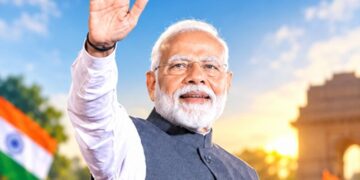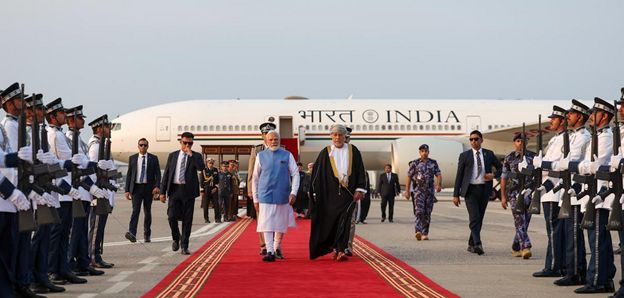
“Prime Minister Narendra Modi was conferred with the Order of Oman, the Sultanate’s highest civilian honour, by Sultan Haitham bin Tarik during his visit marking 70 years of India–Oman diplomatic relations. The award recognises Modi’s role in strengthening bilateral ties and reflects the growing strategic trust between the two nations.”
Mohammad Irfan
This week, India and Oman elevated their seven-decade-old relationship into a new strategic and economic orbit with the signing of a Comprehensive Economic Partnership Agreement (CEPA), as Prime Minister Narendra Modi held extensive talks with Sultan Haitham bin Tarik in Muscat. The agreement, inked during Modi’s two-day visit marking the 70th anniversary of diplomatic relations, represents far more than a conventional free trade pact. It signals India’s deepening engagement with the Gulf at a time of global economic realignment, geopolitical uncertainty, and intensified competition over supply chains, energy security, and regional influence. The CEPA, signed by India’s Commerce and Industry Minister Piyush Goyal and Oman’s Minister of Commerce, Industry and Investment Promotion Qais bin Mohammed Al Yousef, is expected to reshape trade flows, unlock new investment corridors, and anchor India’s long-term strategic presence in the Arabian Sea and the wider Indian Ocean region.
Beyond Trade| Strategic Depth In The Gulf: While free trade agreements are often judged by tariff schedules and trade volumes, the India–Oman CEPA must be read in a broader strategic context. Oman occupies a unique geopolitical position astride the Strait of Hormuz, through which nearly a fifth of the world’s oil flows. Unlike many regional actors, Muscat has historically pursued a policy of strategic autonomy, balancing relations with competing powers while maintaining stability in a volatile neighbourhood. For India, Oman has long been a quiet but reliable partner—from access to the Duqm port for the Indian Navy to cooperation in maritime security and counter-piracy. The CEPA adds an economic spine to this strategic partnership, ensuring that defence and diplomatic ties are reinforced by robust commercial interdependence. As Ministry of External Affairs spokesperson Randhir Jaiswal noted, the agreement marks a “new chapter” in bilateral ties, one that integrates trade, security, technology, and people-to-people relations into a single strategic framework.
Economic Rationale| Diversification, Resilience: India–Oman bilateral trade stood at approximately USD 10.5 billion in 2024–25, with India exporting goods worth USD 4 billion and importing USD 6.54 billion. India’s imports are heavily skewed towards petroleum products and urea, which together account for over 70 per cent of the total. Other imports include polymers, pet coke, gypsum, chemicals, and aluminium. On the export side, India supplies Oman with a diversified basket that includes minerals, iron and steel, cereals, electrical machinery, ships and floating structures, textiles, tea, coffee, spices, and processed food items. The CEPA seeks to correct structural imbalances while expanding the scope of trade into non-traditional and future-oriented sectors such as renewable energy, green hydrogen, digital services, agri-tech, pharmaceuticals, and advanced manufacturing. At a time when global supply chains are being reconfigured due to geopolitical tensions, pandemics, and climate risks, the agreement aims to enhance supply chain resilience and trade diversification for both countries.
Oman’s Economic Transformation| India’s Opportunity: Oman is in the midst of an ambitious economic transition under Vision 2040, which aims to reduce dependence on hydrocarbons, expand private-sector participation, and position the Sultanate as a logistics, manufacturing, and green energy hub. India’s fast-growing economy, large market, and competitive manufacturing base align well with these objectives. Indian companies already have a strong footprint in Oman across sectors such as steel, power, fertilisers, textiles, and information technology. The CEPA is expected to encourage greater Indian investment in Omani special economic zones, particularly in Duqm, Sohar, and Salalah, while facilitating Omani investments into India’s infrastructure, logistics, and energy sectors. Crucially, this is Oman’s first FTA in nearly two decades and only its second with an individual country—underscoring the strategic trust Muscat places in New Delhi.
India’s Expanding Trade Architecture: The India–Oman CEPA fits neatly into India’s broader trade strategy, which has seen a renewed push towards high-quality bilateral and plurilateral agreements. Over the past five years, India has signed FTAs with Mauritius (2021), the UAE (2022), Australia (2022), EFTA (2024), and the UK (2025). Unlike earlier trade agreements that were often criticised for limited gains, this new generation of FTAs reflects a more calibrated approach—balancing market access with safeguards for domestic industry while focusing on value chains, services trade, and investment facilitation. Oman’s importance is further magnified by the fact that India already has a CEPA with the UAE, another key GCC member. Together, these agreements lay the groundwork for a future India–GCC trade framework, something both sides have discussed intermittently but never fully realised.
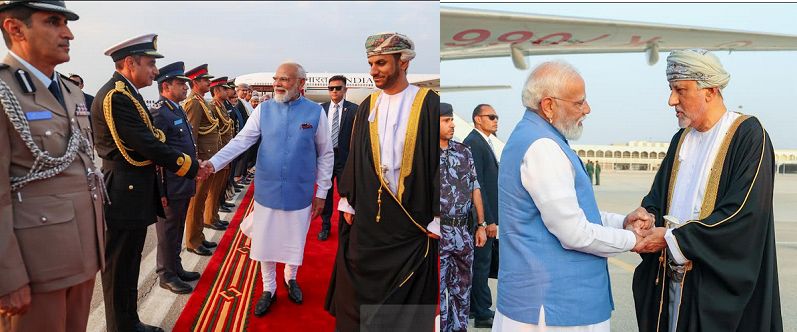
Political Symbolism, Diplomatic Momentum: Prime Minister Modi’s visit carried strong symbolic resonance. It was his second visit to Oman and came at a time when India is actively reasserting its role as a leading voice of the Global South. The warm welcome accorded to Modi at Al Baraka Palace and his conferment with the Order of Oman, the Sultanate’s highest civilian honour, reflected the high level of political goodwill. The award places Modi among a select group of global leaders and adds to his growing list of international honours, reinforcing India’s diplomatic stature in West Asia and Africa—a region that featured prominently in his three-nation tour that also included Ethiopia and Jordan.
Diaspora As A Strategic Asset: One of the defining features of India–Omani relations is the Indian diaspora, estimated at over 700,000. Addressing students and community members at the ‘Maitri Parv’ event, Modi described them as the “biggest custodians” of the centuries-old ties between the two nations. Indian schools in Oman, which are celebrating 50 years of their establishment, stand as enduring symbols of cultural and educational exchange. Modi’s emphasis on youth, innovation, and knowledge reflects a recognition that the next phase of bilateral relations will be driven as much by human capital as by state-to-state engagement.
Technology, Space, Future Agenda: The talks between Modi and Sultan Haitham extended beyond trade into emerging domains such as artificial intelligence, digital learning, innovation partnerships, and space cooperation. India’s collaboration with Oman in space science, including the India–Oman Space Portal developed by ISRO, signals a shift towards knowledge-intensive cooperation. For Oman, partnering with India offers access to cost-effective technological solutions and capacity-building. For India, it reinforces its image as not merely a market, but a provider of scalable development models—from digital public infrastructure to affordable healthcare and space applications.
Maritime Security, Regional Stability: The strategic geography of Oman gives the partnership an unmistakable security dimension. Both countries share concerns about maritime security, piracy, and regional instability in the Indian Ocean and the Gulf. Over the years, India and Oman have conducted joint naval exercises and defence exchanges, and these ties are expected to deepen as economic engagement grows. In an era marked by great-power rivalry and uncertainty in West Asia, India’s relationship with Oman exemplifies a balanced, non-disruptive approach—one that prioritises stability, dialogue, and mutual benefit.
CEPA And Global South Narrative: Modi’s remarks in Oman echoed themes he articulated earlier in Ethiopia about the Global South shaping its own destiny. The India–Oman CEPA can be seen as a practical manifestation of this vision—demonstrating how developing economies can craft partnerships that promote growth without dependency. At a time when protectionism is resurging in parts of the world, the agreement sends a signal that open, rules-based trade, tailored to national priorities, remains a viable pathway to shared prosperity.
PM Modi Conferred With Oman’s Highest Civilian Honour: Prime Minister Narendra Modi was conferred with the Order of Oman, the Sultanate’s highest civilian award, by Sultan Haitham bin Tarik in Muscat, in recognition of his significant contribution to strengthening India–Oman relations. The honour was bestowed during Modi’s two-day visit to Oman, which coincided with the 70th anniversary of diplomatic ties between the two countries. The award adds to PM Modi’s list of over 28 top civilian honours received from foreign nations and underscores the growing depth of the India–Oman strategic partnership spanning trade, energy, defence, and people-to-people ties. Despite its promise, the CEPA will not be without challenges. Implementation will be key—particularly in addressing non-tariff barriers, regulatory alignment, and awareness among small and medium enterprises. Both sides will need to ensure that the benefits of the agreement are broad-based, reaching farmers, MSMEs, and start-ups, not just large corporations. Moreover, global economic headwinds—from slowing growth to geopolitical shocks—could test the resilience of new trade frameworks. Sustained political commitment and institutional coordination will therefore be critical.
“During the visit, India and Oman also signed the Comprehensive Economic Partnership Agreement (CEPA), aimed at boosting trade, investment, and cooperation across key sectors. The agreement adds fresh momentum to the India–Oman strategic partnership and reinforces their shared commitment to long-term economic growth and regional stability.”
A Partnership Reimagined: Seventy years after establishing diplomatic relations, India and Oman have reimagined their partnership for the 21st century. The CEPA, backed by strong political will and strategic convergence, positions the relationship on a future-ready footing—one that integrates economics, security, technology, and people-to-people ties. As Prime Minister Modi put it during his Oman visit, “21st-century India takes big decisions, takes them swiftly, and delivers results in a time-bound manner.” The India–Oman CEPA is one such decision—bold in ambition, strategic in intent, and potentially transformative in impact. Whether it ultimately reshapes the economic and strategic landscape of the Gulf–India corridor will depend on execution. But there is little doubt that with this agreement, New Delhi and Muscat have signalled their intent to walk together into a more interconnected and uncertain future—as partners, not merely trading counterparts.
Kashmir Horizon View: The conferring of the Order of Oman on Prime Minister Narendra Modi and the signing of the India–Oman Comprehensive Economic Partnership Agreement (CEPA) mark a defining moment in the evolution of bilateral relations. However, these milestones are not endpoints; rather, they serve as a foundation for a more ambitious and future-oriented partnership. The way forward lies in translating political goodwill and strategic intent into sustained, measurable outcomes that benefit both nations and their peoples. First, the effective implementation of the CEPA will be crucial. Both sides must ensure that tariff reductions, rules of origin, and regulatory facilitation are executed smoothly to enable businesses—especially MSMEs and start-ups—to fully utilise the agreement. Establishing joint monitoring mechanisms, regular stakeholder consultations, and digital trade facilitation platforms can help prevent procedural bottlenecks and ensure that the agreement delivers tangible gains in employment, exports, and investment. Second, India and Oman should deepen cooperation in energy transition and green growth. While hydrocarbons will remain important in the near term, both countries share a strategic interest in renewable energy, green hydrogen, and clean technologies. India’s experience in scaling solar and wind energy, combined with Oman’s geographic advantages and investment capacity, offers scope for joint projects that align with global climate commitments and long-term energy security. Third, the partnership must expand in technology-driven and knowledge-based sectors. Collaboration in artificial intelligence, fintech, digital public infrastructure, space applications, and skill development can make the relationship future-ready. Enhanced academic exchanges, joint research centres, and innovation incubators would strengthen human capital linkages, particularly among youth. Fourth, maritime security and regional stability should remain central pillars of cooperation. Given Oman’s strategic location near the Strait of Hormuz and India’s role as a net security provider in the Indian Ocean Region, closer defence coordination, joint naval exercises, and information-sharing mechanisms will contribute to secure sea lanes and regional peace. Finally, the Indian diaspora in Oman should continue to be leveraged as a bridge of trust and continuity. Protecting their welfare, expanding educational and cultural exchanges, and encouraging diaspora-led entrepreneurship will reinforce people-to-people ties that underpin long-term strategic relations.
(“Team Kashmir Horizon” is committed to continuous improvement and invites feedback and suggestions from readers and its followers on social media sites. Reader insights are considered vital for enhancing content quality and empowering the community. The team encourages open communication and values the thoughts and ideas of its audience, believing that such input will enable them to serve the public more effectively. The initiative aims to ensure that readers have the best possible experience with “Kashmir Horizon”. Interested individuals can reach out to us via email at [email protected].)