“Government will introduce a stringent anti-paper leak law in Parliament, establish fast-track courts for speedy disposal of examination fraud cases and further strengthen the legal framework to deter organised examination malpractices…”
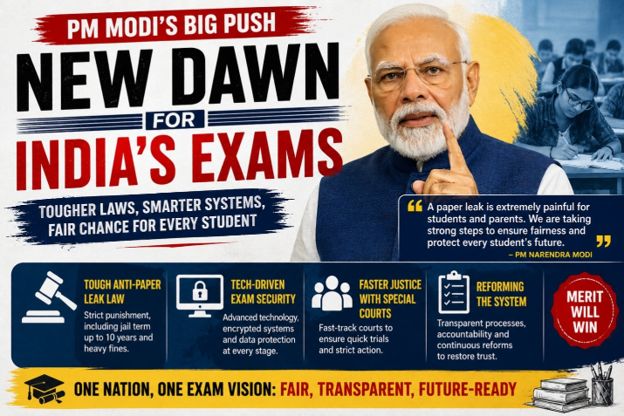
India’s examination system is poised for one of its most significant reforms in recent years as the Union Government has announced a comprehensive set of measures aimed at strengthening transparency, accountability and public confidence in competitive examinations. With millions of students preparing every year for national-level entrance and recruitment examinations, the Centre’s latest initiatives seek to build a more secure, technology-driven and student-centric examination ecosystem. Prime Minister Narendra Modi, addressing the nation through a video message, announced that the government will introduce a stringent anti-paper leak law in Parliament, establish fast-track courts for speedy disposal of examination fraud cases and further strengthen the legal framework to deter organised examination malpractices. The proposed legislation, already approved by the Union Cabinet, is expected to be introduced during the ongoing session of Parliament. The announcement comes as part of the government’s broader commitment to ensuring that the aspirations of students remain protected and that merit continues to be the defining principle of India’s education system.
Students’ Future The Government’s Highest Priority: Prime Minister Modi said that every competitive examination represents years of dedication, sacrifice and hard work by students and their families. He noted that the dreams of millions of young Indians should never be compromised and reaffirmed the government’s commitment to safeguarding their academic future. Calling examination integrity essential for nation-building, the Prime Minister observed that paper leaks create anxiety among students and parents. He emphasised that ensuring fairness in examinations is not merely an administrative responsibility but a national commitment towards empowering India’s youth. He said that immediately after irregularities came to light, the government’s foremost priority was to ensure that students did not lose an academic year and that the examination process continued with minimum disruption.
Swift Action To Protect Academic Calendar: The Prime Minister highlighted the coordinated response initiated by the Government of India after the irregularities surfaced. According to him, the Centre moved quickly to ensure that the examination process remained uninterrupted while maintaining the confidence of students. The government coordinated with multiple ministries, state governments, district administrations and various agencies to successfully organise the re-examination for over 20 lakh students. This large-scale exercise demonstrated the government’s emphasis on continuity in education while protecting the interests of students. The successful conduct of the examination ensured that admissions to medical colleges could proceed without significant delay, allowing students to continue pursuing their academic goals. Officials described the effort as an example of cooperative governance, where institutions across different levels worked together to ensure the smooth conduct of one of India’s largest entrance examinations.
A Stronger Legal Framework: One of the key highlights of the Prime Minister’s announcement is the proposed legislation aimed at strengthening legal action against examination-related offences. Prime Minister Modi revealed that immediately after reviewing the situation, he instructed concerned departments to prepare a comprehensive proposal incorporating provisions for fast-track courts and stringent punishment for those attempting to compromise examination integrity. The Departments worked continuously to prepare the draft, which was later approved by the Union Cabinet. According to the Prime Minister, the proposed legislation will be introduced in Parliament during the ongoing session, reflecting the government’s commitment to introducing institutional reforms that reinforce transparency and accountability. The proposed law is expected to create a stronger legal deterrent while ensuring that cases involving examination malpractice are addressed through a faster judicial process.
Fast-Track Courts For Timely Justice: The proposal to establish fast-track courts marks another important reform in strengthening the examination ecosystem. The Government believes that timely investigation and speedy judicial proceedings can significantly improve confidence among students while ensuring swift accountability. By creating a dedicated mechanism for handling such cases, authorities hope to reduce procedural delays and strengthen enforcement. Education experts believe that timely adjudication can reinforce public confidence and send a strong message regarding the importance of maintaining examination integrity.
Technology To Drive Future Reforms: Alongside legislative measures, the Centre has also announced a major technological transition. Beginning next year, NEET-UG will be conducted in Computer-Based Test (CBT) mode. The shift reflects the government’s broader digital transformation agenda across education and public administration. Technology-driven examinations are expected to enhance operational efficiency, improve security and create a more streamlined examination process. Computer-based testing has already become the preferred model for several national-level competitive examinations because of its ability to improve examination management while ensuring greater standardisation. The transition also aligns with India’s rapidly expanding digital infrastructure and increasing use of technology across education.
Building A Future-Ready Examination System: Officials believe that the combination of legal safeguards and digital innovation will contribute towards creating a future-ready examination framework. Modern examination systems increasingly rely on secure digital infrastructure, encrypted question management, enhanced monitoring systems and technology-enabled administration. By integrating these elements into major entrance examinations, India aims to further strengthen transparency while improving administrative efficiency. The reforms also reflect the country’s broader efforts to modernise public institutions through technology-driven governance.
Public Participation In Policy Making: Prime Minister Modi expressed gratitude to students, parents, teachers and citizens for their constructive suggestions after he announced plans for a stricter anti-paper leak law. He said the overwhelming response demonstrated the country’s collective commitment towards strengthening educational institutions. According to him, public participation has contributed meaningfully to shaping the proposed legislation. The Government views this collaborative approach as an important element of democratic policymaking where citizens actively contribute ideas for institutional reforms.
Education The Foundation Of Viksit Bharat: The Prime Minister reiterated that education remains central to India’s long-term development vision. He observed that the country’s demographic strength can be transformed into national progress only when students receive equal opportunities based on merit. According to him, every deserving student should have complete confidence that hard work alone determines success in competitive examinations. The latest reforms therefore seek to reinforce trust in institutions while creating an educational environment that rewards talent and perseverance.
Commitment To Continuous Improvement: The Government has repeatedly emphasised that examination systems should evolve with changing technological and administrative requirements. Continuous review of procedures, adoption of digital innovations and stronger institutional coordination form an important part of this approach. Officials say examination reforms will remain an ongoing process designed to meet the expectations of students while strengthening administrative efficiency. The latest announcements represent another step towards that long-term objective.
Leadership, Accountability: The developments also witnessed Union Education Minister Dharmendra Pradhan submitting his resignation to Prime Minister Narendra Modi. In his resignation letter, Pradhan reaffirmed his commitment to education and expressed gratitude for the opportunity to serve under the Prime Minister’s leadership. He noted that throughout the developments, the government’s principal objective remained protecting students’ academic future and ensuring that deserving candidates were able to continue their educational journey. Pradhan also highlighted the successful coordination between the Centre, state governments and various institutions during the conduct of the re-examination.
Parliament to Deliberate On Landmark Bill: With Cabinet approval already secured, attention now shifts to Parliament where the proposed anti-paper leak legislation will be introduced. The Government has indicated that every effort will be made to secure early passage of the Bill. If enacted, the legislation is expected to strengthen India’s legal framework relating to examination integrity while complementing broader administrative and technological reforms. Observers believe the proposed law could become an important milestone in India’s evolving education governance framework.
Reforms Beyond Legislation : Experts note that stronger laws are most effective when combined with institutional strengthening. The Government’s broader reform agenda includes improving examination processes, expanding digital infrastructure, enhancing coordination among agencies and promoting transparency across every stage of examination management. Together, these initiatives aim to build a system that inspires confidence among students while maintaining the highest standards of fairness. The reforms also complement India’s larger digital governance initiatives that seek to improve efficiency across public institutions.
“The emphasis on fairness, transparency and institutional strengthening reflects the Centre’s commitment to ensuring that every deserving student receives equal opportunity..…”
Hope And Confidence For Students: For millions of aspirants preparing for competitive examinations, the government’s announcements carry a message of reassurance. The emphasis on fairness, transparency and institutional strengthening reflects the Centre’s commitment to ensuring that every deserving student receives equal opportunity. Students across the country invest years of effort preparing for competitive examinations. The latest reforms seek to reinforce confidence that merit and dedication remain the guiding principles of India’s education system.
Towards A Stronger Educational Future: As India continues its journey towards becoming a global knowledge economy, strengthening educational institutions remains one of the country’s foremost priorities. A transparent and credible examination system forms the foundation of higher education, professional opportunities and national development. The Government’s latest initiatives demonstrate a comprehensive approach that combines legislative action, technological advancement, administrative coordination and public participation. With Parliament set to deliberate on the proposed legislation and the transition towards computer-based examinations already announced, India’s examination ecosystem appears poised for a new phase of modernisation. The reforms represent not only an effort to strengthen examination security but also a broader commitment to empowering young Indians through a system built on fairness, transparency and excellence. For millions of students pursuing their aspirations, these initiatives signal a continued focus on creating opportunities where success is determined by talent, dedication and hard work. As the reforms move from policy to implementation, they have the potential to further strengthen public confidence in India’s examination system while supporting the nation’s vision of building an education sector that is resilient, inclusive and globally competitive.
Kashmir Horizon View: The Centre’s proposed reforms present an opportunity to further strengthen India’s examination ecosystem by combining legislative measures with institutional innovation and technological advancement. As the country conducts some of the world’s largest competitive examinations every year, continuous improvement in examination management will be essential to meet the expectations of millions of students and parents. The proposed anti-paper leak legislation, coupled with fast-track courts, has the potential to reinforce accountability while ensuring timely resolution of cases related to examination malpractice. A dedicated legal framework can provide greater certainty and strengthen confidence among students that examination integrity remains a national priority. Once enacted, its effective implementation through coordinated efforts between investigating agencies, examination authorities and the judiciary will be equally important. Technology will continue to play a transformative role in the next phase of examination reforms. The planned transition of NEET-UG to a Computer-Based Test (CBT) mode reflects the government’s commitment to modernising the examination process. Expanding secure digital infrastructure, enhancing cybersecurity measures, strengthening encrypted question management systems and adopting advanced monitoring technologies can further improve transparency and operational efficiency. At the same time, ensuring adequate testing centres, reliable internet connectivity and digital accessibility across rural and remote regions will help guarantee equal opportunities for every aspirant. Capacity building within examination agencies will also remain a key component of long-term reform. Regular training of officials, periodic security audits, adoption of global best practices and stronger coordination among central and state institutions can contribute to creating a more resilient examination ecosystem. Continuous review of procedures will enable authorities to respond effectively to emerging challenges while maintaining high standards of fairness. Equally important is maintaining open communication with students and parents. Timely dissemination of accurate information, transparent examination schedules and responsive grievance-redressal mechanisms can further enhance public confidence. Constructive engagement with educational institutions, teachers, experts and student communities will allow policymakers to refine reforms based on practical experience and evolving requirements. The broader objective extends beyond preventing irregularities. The vision is to build an examination system that rewards merit, encourages innovation and reflects the aspirations of a young and ambitious nation. As India moves towards becoming a global knowledge economy, a credible, transparent and technology-enabled examination framework will remain one of the strongest pillars supporting educational excellence and human resource development. With legislative reforms, digital transformation, institutional strengthening and collaborative governance moving together, India has an opportunity to create a future-ready examination system that inspires confidence among students, supports excellence in education and contributes to the country’s long-term development goals. If implemented effectively, these initiatives can further strengthen public trust while ensuring that talent, dedication and hard work continue to remain the defining factors of success for generations of students.
(“Team Kashmir Horizon” is committed to continuous improvement and invites feedback and suggestions from readers and its followers on social media sites. Reader insights are considered vital for enhancing content quality and empowering the community. The team encourages open communication and values the thoughts and ideas of its audience, believing that such input will enable them to serve the public more effectively. The initiative aims to ensure that readers have the best possible experience with “Kashmir Horizon”. Interested individuals can reach out to us via email at [email protected].)