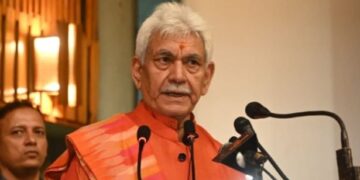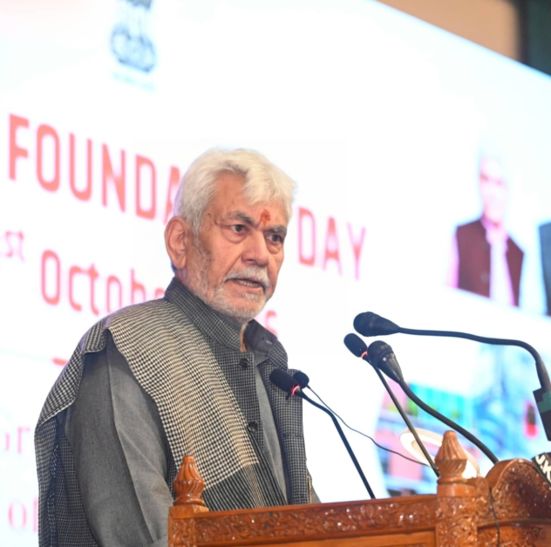
“Today is not merely a date; it is a milestone that changed the direction of history and strengthened the spirit of national integration, equality and inclusive development,” the Lieutenant Governor said..…”
Mohammad Irfan
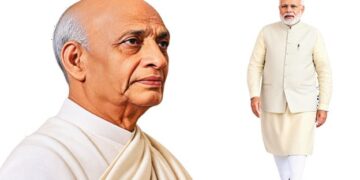
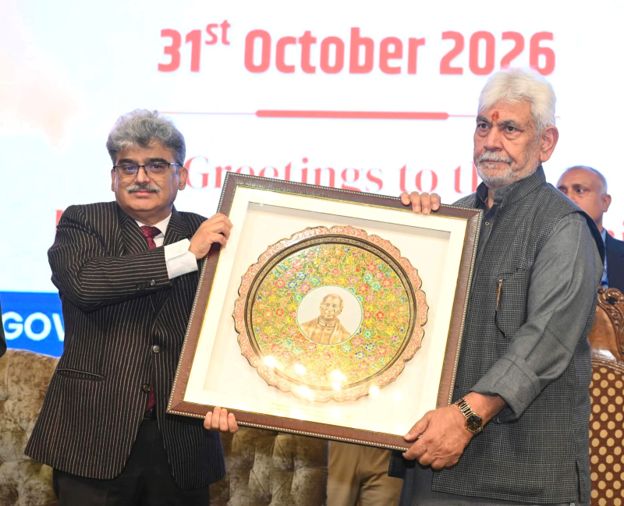 The Eight years after Jammu and Kashmir was reorganised as a Union Territory, the region is witnessing a significant phase of institutional, economic and social transition, with the administration placing peace, development, democratic participation and inclusive governance at the centre of its future roadmap. The eighth Jammu and Kashmir Union Territory Foundation Day, coinciding with the birth anniversary of Sardar Vallabhbhai Patel, provided an occasion to reflect on the political and administrative changes since 2019, assess the progress achieved across different sectors and renew the commitment towards building a peaceful, prosperous and self-reliant Jammu and Kashmir. Addressing the Foundation Day gathering in Srinagar on Saturday, Lieutenant Governor Manoj Sinha described the developments since the abrogation of Article 370 as a defining phase in the region’s history, asserting that the transformation has opened new avenues for equality, democratic participation and development. His address sought to place the journey of Jammu and Kashmir within the larger framework of national integration, institutional accountability and the aspirations of its people, while outlining a vision in which economic opportunities, social harmony and peace become the defining features of the region’s future. “Today is not merely a date; it is a milestone that changed the direction of history and strengthened the spirit of national integration, equality and inclusive development,” the Lieutenant Governor said.The Foundation Day, he observed, was particularly significant as it coincided with the birth anniversary of Sardar Patel, whose contribution to the integration of princely states continues to symbolise national unity and institutional strength. The occasion also brought into focus the contribution of different sections of society, including farmers, teachers, scholars, writers, artists, artisans, traders, workers, security personnel, women and youth, whose collective efforts remain central to Jammu and Kashmir’s development journey.
A Changing Development Narrative: One of the principal themes emerging from the Lieutenant Governor’s address was the transition from a security-dominated narrative towards a broader development-oriented vision. For decades, Jammu and Kashmir’s developmental potential was affected by political uncertainty, militancy, separatist violence and disruptions to normal economic activity. The consequences were visible across sectors, particularly tourism, education, trade, investment and employment. The Government’s current emphasis, as articulated by Sinha, is to create conditions in which development can become a continuous process rather than remain vulnerable to periodic disruptions. “Article 370 abrogation gave ordinary citizens freedom from fear and access to rights denied for decades. Jammu Kashmir has emerged as a model of peace, development and good governance,” he said. The Lieutenant Governor argued that the changes introduced after 2019 have expanded the scope of governance and brought greater emphasis on equal access to rights, public services and opportunities. The significance of this transition, however, extends beyond administrative restructuring. Its long-term success will depend on how effectively the institutional changes translate into tangible improvements in people’s everyday lives, particularly in terms of employment, education, healthcare, infrastructure and economic security. The emphasis on inclusive development is therefore particularly relevant for a region where geographical diversity, rural dependence and uneven access to opportunities require a governance model responsive to local needs.
Security Gains And The Foundations Of Normalcy: Security remained a central component of the Lieutenant Governor’s address, with Sinha highlighting what he described as a major transformation in the security environment of Jammu and Kashmir. He maintained that sustained action against terrorism, separatist networks and organised violence had helped restore normal life and created a more favourable environment for economic and social activity. “We did not buy peace, we established peace. Zero-tolerance policy crippled terror networks and restored normal life across Jammu Kashmir,” he said. Referring to the security situation, Sinha stated that more than 780 terrorists had been eliminated since 2020, while local recruitment into militant organisations had ended and stone-pelting incidents had been brought to an end. The Lieutenant Governor described these developments as a historic security transformation, asserting that terrorism and separatist violence could no longer dictate the region’s social and political environment. The significance of improved security, as highlighted in the address, lies in its relationship with other aspects of development. A stable environment is essential for educational institutions to function without disruption, businesses to operate confidently, tourists to travel, investors to assess opportunities and young people to pursue their aspirations. Peace, therefore, is not merely a law-and-order objective but a prerequisite for sustained economic growth and social stability. At the same time, the long-term consolidation of peace requires continued institutional engagement, public confidence, effective policing, justice delivery and opportunities for young people. Lt Governor Sinha also drew attention to the administration’s action against narco-terrorism, describing drug trafficking as a serious challenge to the region’s social fabric and security environment.
Democracy And Grassroots Participation: Another important aspect of the Foundation Day address was the emphasis on strengthening democratic institutions and encouraging public participation in governance. LG Sinha said that the implementation of grassroots democratic institutions and the conduct of Assembly elections had strengthened public participation and accountability.
The restoration of elected political processes and the functioning of democratic institutions remain important elements of Jammu and Kashmir’s evolving governance framework. The region’s political journey has undergone substantial changes since 2019, and the conduct of Assembly elections marked an important development in the restoration of an elected government. The challenge ahead is to ensure that democratic participation becomes increasingly meaningful at every level, from local governance institutions to the Assembly, enabling citizens to influence decisions affecting their communities. Effective governance cannot be measured exclusively through administrative efficiency or infrastructure creation. It also depends on the responsiveness of institutions, transparency in decision-making, accountability of public representatives and the ability of citizens to seek redressal. Lt Governor Sinha underlined this aspect by observing that unity must be sustained through justice and public trust.”Public trust must be won not merely by promises, but by deeds. Justice and accountability are the strongest foundations of unity,” he said.
Development Must Reach Every Household: The Lieutenant Governor also emphasised that the real measure of transformation would be determined by the extent to which development reaches people who have historically remained outside the mainstream of economic opportunities. The focus on inclusive growth reflects the need to bridge the development gap between urban centres and remote rural areas, improve public infrastructure and strengthen access to essential services. Jammu and Kashmir’s geographical conditions present both opportunities and challenges. While the Valley’s tourism potential, Jammu’s expanding economic activity and the region’s agricultural resources offer considerable possibilities, remote and mountainous districts require sustained investment in connectivity, healthcare, education and livelihood generation. The Government’s development priorities, as outlined by Sinha, include employment generation, youth empowerment, strengthening agriculture and allied sectors, improving healthcare and education, environmental sustainability, tourism development, women’s empowerment and transparent governance. These priorities reflect the need to move towards a diversified economy capable of generating sustainable employment rather than depending on a limited number of traditional sectors. The agricultural economy, in particular, remains central to the livelihood of a substantial section of the population. Horticulture, particularly apple cultivation, saffron, walnuts and other high-value crops, provides considerable economic potential.
“Tourism also has a multiplier effect on the wider economy, benefiting transport operators, hotel owners, houseboat operators, artisans, handicraft manufacturers, traders, guides and small businesses…..…..”
Tourism And The Economic Potential Of Peace: Tourism remains among the most promising sectors in Jammu and Kashmir’s economy. The region’s natural beauty, cultural heritage, religious destinations, adventure tourism opportunities and traditional hospitality provide a strong foundation for attracting visitors from across the country and abroad. A peaceful and stable environment is essential for sustaining this potential. Improved connectivity, better accommodation facilities, tourist infrastructure and diversified tourism products can help expand the sector beyond established destinations. The development of lesser-known tourist locations, promotion of winter tourism, adventure activities and eco-tourism can generate new livelihood opportunities for local communities. Tourism also has a multiplier effect on the wider economy, benefiting transport operators, hotel owners, houseboat operators, artisans, handicraft manufacturers, traders, guides and small businesses. The Lieutenant Governor’s emphasis on peace and economic growth reflects the relationship between security and the region’s economic potential. For tourism to become a sustainable source of prosperity, however, development must be balanced with environmental protection. Jammu and Kashmir’s fragile mountain ecology, water resources, forests and biodiversity require responsible planning and strict adherence to environmental safeguards. Sustainable tourism must therefore remain an important component of the region’s long-term economic strategy.
Healthcare, Education And Social Development: The Foundation Day address also highlighted healthcare and education as essential pillars of a prosperous society. Access to quality healthcare is particularly important in a geographically diverse region where residents of remote areas often face challenges in accessing specialised medical facilities. Strengthening primary healthcare, improving district-level hospitals, expanding specialist services and promoting telemedicine can help reduce these disparities. The emphasis on healthcare also needs to be accompanied by greater attention to preventive medicine, public health awareness, maternal and child healthcare, mental health services and affordable treatment. Similarly, improving the quality of education requires continuous investment in school infrastructure, teacher training, digital learning, research facilities and professional education. The objective must be to ensure that students from rural, economically weaker and geographically remote backgrounds have access to the same quality of educational opportunities as those living in major urban centres. LG Sinha stressed that no citizen should be left behind in the development process, underlining the importance of ensuring that the benefits of public welfare and institutional reforms reach every household.
A Vision Extending Towards 2047: Looking ahead, the Lieutenant Governor placed the development agenda within the larger national vision of 2047, when India will mark 100 years of Independence. He expressed his aspiration for Jammu and Kashmir to emerge as a model of prosperity, supported by a modern economy, world-class healthcare, excellent educational institutions and a vibrant cultural heritage. “My dream is that by 2047, Jammu Kashmir should emerge as a model of prosperity with a modern economy, world-class healthcare, excellent education and a vibrant cultural heritage,” he said. The vision requires a long-term approach to economic planning, institutional strengthening and human development. Infrastructure projects, improved road and rail connectivity, digital services, industrial investment and modern urban facilities can provide the physical foundation for growth. However, the sustainability of this progress will ultimately depend on the quality of institutions, the strength of local enterprises and the participation of citizens. The challenge will be to ensure that economic growth generates broad-based prosperity, that public investment produces measurable social outcomes and that the region’s natural and cultural resources are protected for future generations. The Foundation Day address also placed responsibility on citizens and institutions to contribute to this transformation rather than view development as the exclusive responsibility of the Government. “Let us build a Jammu Kashmir where there is trust instead of fear, opportunity instead of scarcity, justice instead of injustice, and where every young person and every woman finds wings for their dreams,” Sinha said.
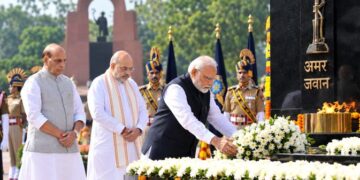
Kashmir Horizon View: The eighth UT Foundation Day was not confined to official celebrations. It also provided an opportunity to renew the collective commitment towards peace, democratic values, economic progress and social harmony. Earlier, the Lieutenant Governor administered the Unity Pledge and flagged off the Run for Unity to mark Rashtriya Ekta Diwas. A documentary film prepared by the Information Department on Jammu and Kashmir’s transformational journey was also screened. The event was attended by Chairperson J&K Waqf Board Dr Syed Darakhshan Andrabi, Chief Secretary Atal Dulloo, Director General of Police Nalin Prabhat, Additional Chief Secretary Home Department Chandraker Bharti, Principal Secretary to the Lieutenant Governor Govind Jaiswal, IGP Kashmir Sujit Singh, Divisional Commissioner Kashmir Anshul Garg, senior civil and police officers, security personnel, representatives of educational institutions, civil society members and youth. As Jammu and Kashmir enters another year of its Union Territory journey, the larger task is to convert the gains of stability and institutional change into durable improvements in people’s lives. The path ahead will require sustained attention to employment, economic diversification, public accountability, environmental conservation, social inclusion and democratic participation. The Lieutenant Governor’s message on the occasion placed peace and development as interconnected objectives, emphasising that a secure environment must ultimately create opportunities for every section of society. The real measure of Jammu and Kashmir’s transformation will be the confidence of its people, the strength of its institutions, the prosperity of its households and the opportunities available to its younger generation. Eight years into its new administrative chapter, the region’s future will increasingly be shaped by its ability to translate aspirations into outcomes and ensure that progress is both inclusive and sustainable. As Sinha summed up in his address, the future of Jammu and Kashmir must be shaped by peace rather than fear, equal opportunities rather than discrimination, and continuous progress rather than stagnation. The larger aspiration is clear: a Jammu and Kashmir where peace becomes permanent, development reaches every doorstep, institutions command public trust and every citizen has a meaningful stake in shaping the region’s future.
(“Team Kashmir Horizon” is committed to continuous improvement and invites feedback and suggestions from readers and its followers on social media sites. Reader insights are considered vital for enhancing content quality and empowering the community. The team encourages open communication and values the thoughts and ideas of its audience, believing that such input will enable them to serve the public more effectively. The initiative aims to ensure that readers have the best possible experience with “Kashmir Horizon”. Interested individuals can reach out to us via email at [email protected].)