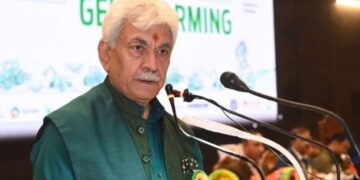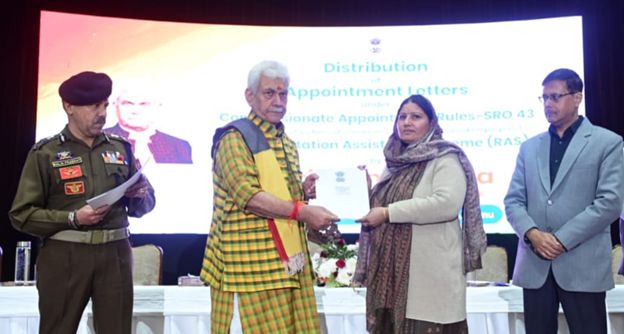
“LG Manoj Sinha handing over government job letters to terror victim families in Srinagar marks a meaningful step toward long-overdue justice and rehabilitation in Jammu and Kashmir. By employing families who lost their loved ones to terrorism, the administration has sought to move beyond mere expressions of sympathy and offer tangible support that restores dignity and economic security to those who suffered silently for decades.”
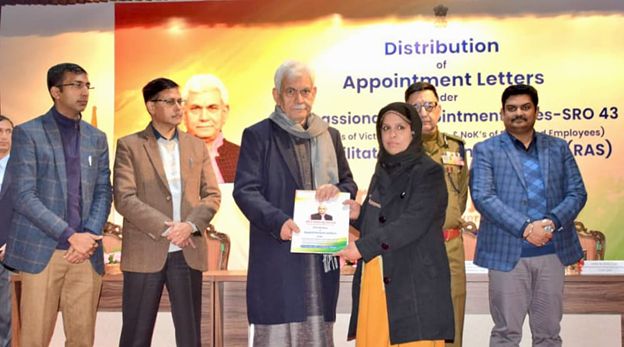
When Lieutenant Governor Manoj Sinha handed over government appointment letters to family members of terror victims at the Lok Bhavan Auditorium in Srinagar, the event went far beyond a routine administrative exercise. It marked a symbolic and substantive shift in how the state engages with those who have borne the deepest scars of terrorism in Jammu and Kashmir. For decades, terror victim families lived on the margins acknowledged occasionally in speeches, but rarely supported in a sustained, institutional manner. The latest initiative, which saw 39 families from the Kashmir division receiving job letters, alongside earlier appointments to families in the Jammu division, represents an attempt to correct a long-standing moral and governance deficit.
A History Of Silence, Neglect: The story of terror victim families in Jammu and Kashmir is one of prolonged invisibility. Since the eruption of militancy in the late 1980s and early 1990s, thousands of civilians farmers, labourers, teachers, special police officers, and ordinary citizens were killed by Pakistan-sponsored terrorists. While the violence dominated headlines, the aftermath for families was largely ignored. Widows, orphaned children, and ageing parents were left to navigate trauma, economic ruin, and social stigma with minimal state support. Successive political dispensations often framed terrorism through the prism of “conflict management” and electoral calculations. In that process, the suffering of victims was overshadowed by narratives that, at times, blurred the distinction between perpetrators and victims. Rehabilitation policies remained patchy, poorly implemented, or entangled in bureaucratic hurdles such as rigid documentation requirements, including FIRs that were often never registered during the peak years of violence. Against this backdrop, LG Sinha’s emphasis that even cases without formal FIRs would be examined for rehabilitation assumes particular significance. It acknowledges an uncomfortable truth: that institutional apathy and fear prevented many families from even reporting crimes, let alone seeking justice.
The Employment Initiative| Numbers, Meaning: According to official figures shared by the Lieutenant Governor, over 200 members of terror-affected families have been provided government employment this year alone. In the Srinagar programme, 39 families from the Kashmir division received appointment letters, adding to the 41 families in Jammu who were earlier given jobs. Notably, nine families affected by the recent Nowgam blast were provided job letters just a day earlier, underscoring the administration’s intent to act swiftly rather than allow cases to languish. In Jammu, the scale of intervention has been even more pronounced. Appointment letters were handed over to 41 Next of Kins (NoKs) of terror victims, along with 22 beneficiaries under age-relaxation provisions and 19 wards of J&K Police martyrs under the Compassionate Appointment Rules (SRO-43) and the Rehabilitation Assistance Scheme (RAS). Earlier, on July 28, 2025, 94 NoKs from the Jammu division had received similar relief. In total, 135 terror victim families from Jammu division—many of whom had waited for decades—have now been brought under the rehabilitation framework. While these numbers are significant, their deeper meaning lies in what they represent: a shift from symbolic condolence to tangible state responsibility. Employment, in this context, is not merely a welfare measure; it is recognition of loss, restoration of dignity, and an attempt to reintegrate families into the socio-economic mainstream.
Personal Narratives As Political Statements: One of the striking aspects of LG Sinha’s address was his deliberate recounting of individual stories—stories that had long remained confined to private grief. The narration of Naseeb Singh’s ordeal, whose father Dharam Singh and four others from Kotranka in Rajouri were brutally killed by terrorists on June 28, 2005, brought into focus the human cost of delayed justice. For nearly two decades, the family lived under fear and economic distress, with no assurance that the state remembered their sacrifice. Similarly, the case of Akhtar Hussain of Reasi, shot dead by terrorists on July 13, 2005, and SPO Sanjeet Kumar, murdered in Kishtwar on November 15, 2004, highlight a recurring pattern: ordinary citizens and low-ranking security personnel becoming targets, while their families slipped into anonymity. By foregrounding these narratives, the administration is attempting to reframe the discourse from abstract statistics of terrorism to lived human experiences. This serves a dual purpose. It restores visibility to victims and challenges any narrative that seeks to romanticize or justify violence.
Justice Delayed, Justice Reclaimed? “Terror victim families were left to struggle in silence for decades. Justice was denied to these families. The deep scars were never healed,” the Lieutenant Governor stated candidly. This admission is crucial, as it implicitly critiques past governance failures without naming specific regimes. It also raises a broader question: can justice, delayed by decades, truly heal wounds? From an analytical standpoint, employment cannot compensate for loss of life, nor can it erase trauma. However, in conflict-affected societies, material rehabilitation often serves as a foundation upon which psychological and social recovery can begin. Economic security reduces vulnerability, restores agency, and allows families to envision a future beyond survival. Moreover, the emphasis on “real victims of terror and true martyrs” reflects an attempt to draw clear moral boundaries. In the post-Article 370 landscape, the administration has consistently argued that earlier systems allowed individuals linked to separatist or terror networks to access state benefits. By contrast, the current policy framework claims to prioritize those who suffered at the hands of terrorism, not those who enabled it.
Art 370 Abrogation And the Governance Shift: LG Sinha’s assertion that the abrogation of Article 370 brought “dynamic change” in Jammu and Kashmir is central to understanding the political context of this initiative. According to him, the end of special status dismantled entrenched networks of patronage and impunity, enabling the administration to act decisively against the terror ecosystem. Critics may debate the broader implications of Article 370’s abrogation, but from the administration’s perspective, it has facilitated a more uniform application of laws, including compassionate appointment rules and rehabilitation schemes. The claim that “terrorists, separatists and their patrons are not given government jobs but are being identified and given the harshest punishment” signals a departure from what is portrayed as past mis-governance. This narrative is reinforced by warnings against elements attempting to spread misinformation or negative narratives. The administration frames such actions as the last gasps of a “dying terror ecosystem,” suggesting that ideological as well as operational battles are being fought simultaneously.
Rehabilitation Beyond Jobs: While employment is the most visible aspect of the rehabilitation drive, LG Sinha also spoke about restoring properties seized during periods of terrorism to their rightful owners. This dimension is often overlooked but is equally significant. During the height of militancy, many families lost land, homes, or businesses—either due to direct terror activity or subsequent security operations. Restitution of property represents not just economic relief but moral acknowledgment of injustice. The assurance that even cases lacking formal FIRs will be considered further expands the scope of rehabilitation. It recognizes that fear, coercion, and administrative breakdown prevented proper documentation in many instances. This approach, if implemented sincerely, could bring relief to hundreds of families still outside official records.
The Broader Security, Development Narrative: The employment initiative is embedded within a larger narrative of peace, development, and nation-building. LG Sinha repeatedly invoked the idea of a “Mahayagya of Development,” calling upon all sections of society to contribute selflessly. This framing positions rehabilitation not as charity but as a collective moral responsibility tied to Jammu and Kashmir’s future. The administration’s claim that it has “not bought peace, but established peace” reflects confidence in its security-centric approach. By coupling hard measures against terror networks with welfare-oriented initiatives for victims, it seeks to project a model where security and human dignity are mutually reinforcing. However, from an analytical lens, the sustainability of this approach depends on consistent implementation, transparency in beneficiary selection, and protection against politicization. Compassionate appointments, if perceived as selective or exclusionary, risk breeding new grievances. Ensuring that genuine victims across regions, communities, and time periods are treated equitably will be key to maintaining credibility.
“The initiative also signals a broader shift in governance, clearly distinguishing victims of terrorism from those who supported or glorified violence. While jobs cannot compensate for the loss of lives, they offer stability and hope, reinforcing the message that the state stands firmly with terror victims and is committed to ensuring that their sacrifices are neither forgotten nor ignored.”
Voices Of The Victims| From Fear To Assertion: A noteworthy development highlighted in Jammu was that families of terror victims “spoke out fearlessly,” recounting decades of terror and exposing Pakistan-sponsored terrorists and their local sympathizers. This public articulation of suffering marks a psychological shift. Fear of reprisals had long silenced many families; their willingness to speak suggests increased confidence in the state’s ability to protect them. This change has broader implications for counter-terrorism efforts. Societies emerge from cycles of violence not only through security operations but also through the empowerment of victims to reclaim public space and narrative authority.
Dignity As State Policy: Repeatedly, LG Sinha emphasized “dignity” alongside economic security. This choice of language is significant. Dignity implies respect, recognition, and moral standing—qualities that victims often felt were denied to them. By framing rehabilitation as restoration of dignity, the administration seeks to address not just material deprivation but symbolic injustice. The idea that “jobs to real victims of terror and true martyrs reflect the commitment that the nation stands with them with concrete action” reinforces the notion that citizenship entails reciprocal obligations. When citizens suffer due to violence aimed at the nation, the nation, in turn, must stand by them.
Challenges And The Road Ahead: Despite the positive momentum, challenges remain. Identifying “genuine victims” in a conflict zone with complex histories is fraught with difficulties. Documentation gaps, competing claims, and political sensitivities can slow down processes and invite controversy. There is also the risk that rehabilitation becomes an episodic gesture rather than a sustained policy with monitoring and follow-up. Moreover, employment alone cannot address psychological trauma. Comprehensive rehabilitation would ideally include counseling, educational support for children, healthcare access, and community-level reconciliation initiatives. Whether future policy iterations will expand in this direction remains to be seen.
Kashmir Horizon View: The distribution of government job letters to terror victim families in Srinagar and Jammu represents more than administrative relief; it is an attempt to close a painful chapter that remained open for decades. By acknowledging past neglect, offering tangible support, and situating victims at the center of the state’s moral universe, the administration under LG Manoj Sinha is redefining how Jammu and Kashmir remembers and responds to terrorism. For families like that of Naseeb Singh, Akhtar Hussain, and Sanjeet Kumar, the appointments do not erase loss, but they offer stability, recognition, and hope. In conflict-ridden regions, such gestures often become the first building blocks of trust between citizens and the state. Ultimately, the success of this initiative will be measured not just by the numbers distributed at ceremonies, but by whether these families can finally live without fear, with dignity, and with a sense that their sacrifices were neither forgotten nor in vain.
(“Team Kashmir Horizon” is committed to continuous improvement and invites feedback and suggestions from readers and its followers on social media sites. Reader insights are considered vital for enhancing content quality and empowering the community. The team encourages open communication and values the thoughts and ideas of its audience, believing that such input will enable them to serve the public more effectively. The initiative aims to ensure that readers have the best possible experience with “Kashmir Horizon”. Interested individuals can reach out to us via email at [email protected].)