- Omar’s Focus On Convention Centre At Gulmarg, Innovation In Education
“Chief Minister Omar Abdullah this week inaugurated the ₹21 crore Gulmarg Convention Centre built by NBCC, aiming to make Gulmarg “Asia’s Davos” for business, leisure, and cultural tourism. Additionally, he laid the foundation for a Ski Hire Shop. Beyond tourism, Abdullah is equally focused on bridging the gap between government and private schools to advance education and technology in Jammu and Kashmir, a point he stressed at the Techknow-2025 event.”
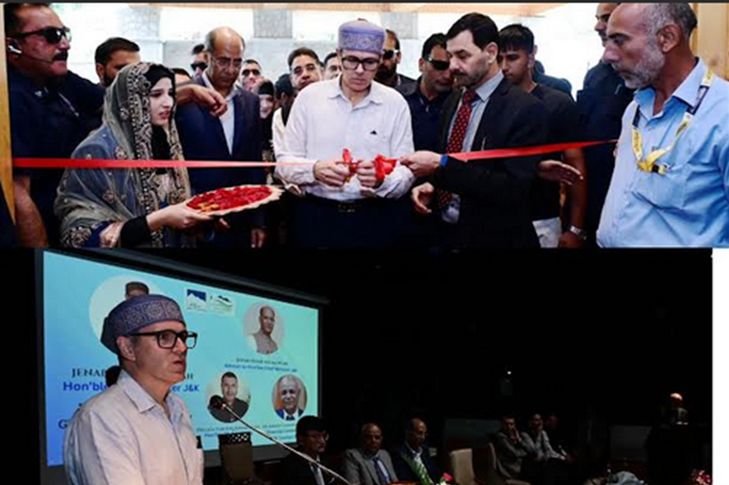 This week Chief Minister Omar Abdullah unveiled the much-anticipated Gulmarg Convention Centre, describing it as a landmark step toward placing Jammu and Kashmir on the international map of business, leisure, and cultural tourism. Constructed at a cost of ₹21 crore by the NBCC, the facility is envisioned as a hub for global conferences, exhibitions, and events, with Abdullah confidently asserting that it could one day position Gulmarg as “Asia’s Davos.” Alongside the inauguration, the Chief Minister also laid the foundation stone of a Ski Hire Shop to be developed by the J&K Cable Car Corporation, further bolstering Gulmarg’s profile as a world-class winter sports destination. Advisor to the Chief Minister Nasir Aslam Wani, MLA Gulmarg Pirzada Farooq A Shah, Additional Chief Secretary Tourism Dr. Ashish Chandra Verma, Deputy Commissioner Baramulla Minga Sherpa, Director Tourism Kashmir Raja Farooq Yaqoob, CEO GDA Tariq Hussain, and other senior officials were present at the ceremony.
A Vision Beyond Infra : Addressing a gathering of dignitaries, officials, and locals, Omar Abdullah emphasized that while constructing physical infrastructure was important, its meaningful use and upkeep was even more critical. “It is the easiest thing to build four walls. The real responsibility begins with their use and maintenance,” he said, noting that although NBCC had completed the project within time and budget, the furnishing component was missing from the original DPR. “Tourism Department, my Advisor, and I are working to finalize the furnishing so that the Centre can be put to immediate use.” The Chief Minister stressed that the Centre must not be allowed to become a white elephant. Instead, he urged that it be actively marketed and maintained as a hub for MICE tourism (Meetings, Incentives, Conferences, and Exhibitions), destination weddings, and high-profile events that would attract international attention.
Gulmarg As “Asia’s Davos”: Drawing a parallel with the globally renowned World Economic Forum held annually in Davos, Switzerland, Abdullah said Gulmarg had all the natural advantages—snow-clad peaks, pristine meadows, and global connectivity via Srinagar—to develop into a similar hub. “We are considering linking it with SKICC’s marketing network so that Gulmarg Convention Centre can be promoted as part of a broader package,” he noted. “Maintenance will also be done. And I want that one day, when we hear about Davos again and again, people recognize Gulmarg as Asia’s Davos, India’s Davos. I want it to develop on that scale—if not, at least on a scale where two or three annual events bring people here from across the world.”
Boosting Evening Tourism In Gulmarg : Chief Minister Omar Abdullah highlighted a long-standing challenge in Gulmarg: the lack of vibrant evening recreational options for tourists. “Visitors go skiing, sledging, or sightseeing, but in the evening they are left with little to do,” he said. “This facility can change that. By setting up a coffee shop, restaurant, and a digital cinema projection system, we can ensure that tourists enjoy lively evenings while generating revenue and keeping the asset active.” The Chief Minister added that such initiatives would not only boost tourism revenue but also create local employment and enhance the visitor experience.
Call To Government Deptts: Until private sector interest grows, Abdullah urged government departments to make active use of the new Convention Centre. “Education, health, social welfare, and other departments can hold training programmes and official events here, giving participants a refreshing change of location,” he suggested. “This will ensure the Centre’s optimum use while building its reputation.” Congratulating the NBCC and Gulmarg Development Authority, Abdullah said the project was a landmark addition to Gulmarg’s tourism profile, one that could serve as both a revenue generator and a platform for international cultural exchange. “With proper management, Gulmarg Convention Centre will not only host global conferences but also become a vibrant space for recreational and cultural tourism,” he added.
A Parallel Vision|Techknow-2025, Education: While Abdullah’s Gulmarg vision focuses on tourism, he has also placed equal emphasis on education and technology as drivers of Jammu and Kashmir’s future. On September 15, at the concluding session of Techknow-2025 organized by Delhi Public School (DPS) Srinagar, the Chief Minister outlined his commitment to bridging the gap between government and private schools. “I would like to see even more participation from government schools in such events,” Abdullah remarked. “Ultimately, it is our responsibility to ensure that government school students have access to the same facilities and opportunities as those in private schools. They must be prepared to compete not only with children across India, but with children across the world.” The two-day Techknow-2025 event saw enthusiastic participation from schools across the Valley, showcasing projects like a Humanoid Robot developed by students. Abdullah applauded their creativity, emphasizing the importance of AI literacy and innovation-driven education in preparing the next generation.
Technology As A Game-Changer: Reflecting on the pace of technological change, Abdullah cited Albania’s appointment of an AI entity as a minister as an example of how rapidly the world is evolving. “This shows us the pace at which technology is moving,” he observed. “Already, jobs once taken by young graduates in fields like data management are now being done by AI. Even software development is increasingly carried out by AI tools. With the latest version of ChatGPT, someone with no coding knowledge can generate code. That is how transformative this technology has become.” He stressed the urgent need for education to adapt to these changes, warning that while some institutions have advanced rapidly, others lag behind and risk leaving their students unprepared for the future.
Support For Government Schools: Abdullah praised DPS Srinagar for not only empowering its own students but also providing platforms for government school students. “I am heartened to see this inclusivity,” he said. He also offered advice to students: “Always keep asking questions. It is curiosity that drives progress, and it is questions that create the answers of tomorrow.” The Chief Minister toured the DPS Srinagar campus, visiting the computer labs, Atal Tinkering Lab, Innovation Hub, Junior School, and Learning Resource Centre. He also felicitated participating schools for their contributions to Techknow-2025.
“Chief Minister Omar Abdullah’s plan for Jammu and Kashmir focuses on making the region a hub for both tourism (“Asia’s Davos” in Gulmarg) and technology (AI readiness in schools). This vision aims to transform the region from one scarred by conflict into a model of innovation and inclusive growth. The key challenge, however, will be the effective implementation of these initiatives to ensure they truly benefit the youth and don’t just remain proposals.”
Linking Tourism, Education: The juxtaposition of the Gulmarg Convention Centre inauguration and the Techknow-2025 event reveals Abdullah’s integrated vision for Jammu and Kashmir: a future where world-class infrastructure attracts international business and cultural tourism, while empowered students position the region competitively in the global knowledge economy. By developing Gulmarg into a hub of MICE tourism and ensuring that students in government schools are prepared for an AI-driven future, Abdullah is charting a path of economic and social transformation that could redefine Jammu and Kashmir’s trajectory.
Conclusion| A Dual Strategy For Transformation: The inauguration of the Gulmarg Convention Centre and the emphasis on educational innovation reflect Omar Abdullah’s dual strategy for Jammu and Kashmir—strengthening physical infrastructure to attract global attention, while simultaneously preparing the youth for global competition. If Gulmarg evolves into the “Asia’s Davos” that Abdullah envisions, it could generate unprecedented tourism revenue, international exposure, and employment opportunities. At the same time, if education reforms ensure that government school students gain equal footing with their private school peers, Jammu and Kashmir could produce a new generation of globally competitive professionals. Together, these initiatives signal a forward-looking, inclusive, and ambitious roadmap: one where tourism and education are not isolated priorities but interlinked pillars of progress. Omar Abdullah’s message is clear—Jammu and Kashmir must build, innovate, and educate with a vision as expansive as the Himalayas themselves.
Kashmir Horizon View: The inauguration of the Gulmarg Convention Centre and the insights shared at Techknow-2025 are not isolated events; they are stepping stones toward a larger vision of transformation for Jammu and Kashmir. Both highlight a pressing need: to think beyond short-term achievements and build sustainable, inclusive systems that serve future generations. On the tourism front, the Gulmarg Convention Centre presents an unprecedented opportunity. For decades, Gulmarg has attracted adventure lovers and leisure tourists, but rarely has it been positioned as a hub for global conferences or knowledge-sharing platforms. If managed with foresight, the Centre could host international summits, destination weddings, cultural festivals, and high-profile corporate meetings, creating a year-round tourism economy. This, in turn, would generate employment for local youth—not just in hospitality, but also in allied sectors like event management, logistics, and creative industries. However, building infrastructure alone will not suffice. Effective marketing, sustainable upkeep, and dynamic programming are essential. Linking the Convention Centre with the marketing strategies of SKICC, as Omar Abdullah suggested, could ensure consistent usage and visibility. Encouraging government departments, universities, and professional bodies to host training sessions and academic conferences here will help establish a steady foundation until international interest grows. Partnerships with private event companies could also inject creativity and efficiency into the management of this facility. Equally critical is Abdullah’s call for expanding evening tourism in Gulmarg. A digital cinema, cafes, and cultural shows would not only keep tourists engaged but also create a vibrant after-ski ecosystem, making Gulmarg more than just a day destination. This vision aligns with global best practices where tourist towns thrive because they offer experiences round the clock. On the education and technology side, Abdullah’s message at Techknow-2025 resonates even more strongly. The rise of artificial intelligence and automation is reshaping industries faster than governments or educational systems can adapt. If schools in Jammu and Kashmir—particularly government schools—do not keep pace with AI literacy, coding, robotics, and problem-solving skills, thousands of students risk being left behind. The gap between privileged private school students and under-resourced government school students could widen into an economic chasm. The way forward, therefore, lies in mainstreaming innovation across all schools, not just elite ones. From 2025 onwards, introducing AI and digital learning modules should be mandatory in both government and private institutions. Public-private partnerships can play a role here: schools like DPS Srinagar, which are already pioneering robotics and innovation labs, could adopt nearby government schools, sharing resources and expertise. Teacher training must also be a priority—equipping educators with the tools to integrate technology into classrooms effectively. If pursued together, these two tracks—a globally competitive tourism economy and a technologically empowered education system—can reinforce each other. Tourism generates revenue, which can be invested in education. Education produces skilled human capital, which can sustain and innovate within the tourism and services sector. In conclusion, Omar Abdullah’s twin focus on “Asia’s Davos” in Gulmarg and AI readiness in schools is more than political rhetoric; it is a roadmap. It envisions a Jammu and Kashmir that is not only scenic but also smart, not only welcoming to tourists but also prepared for the challenges of the 21st century. The real test will lie in execution—ensuring that infrastructure does not gather dust, that reforms do not remain confined to speeches, and that opportunities truly reach thousands of young people. If that happens, the Valley could stand as a model of how a region scarred by conflict can rebuild itself through vision, innovation, and inclusive growth.
(“Team Kashmir Horizon” is committed to continuous improvement and invites feedback and suggestions from readers and its followers on social media sites. Reader insights are considered vital for enhancing content quality and empowering the community. The team encourages open communication and values the thoughts and ideas of its audience, believing that such input will enable them to serve the public more effectively. The initiative aims to ensure that readers have the best possible experience with “Kashmir Horizon”. Interested individuals can reach out to us via email at [email protected].)