- National Security Preparedness Reviewed At Three Top Security Meets In Delhi
“The incident, which occurred in the picturesque Baisaran Valley, widely known as ‘mini Switzerland’, marks one of the deadliest assaults on civilians in the Kashmir Valley in nearly two decades. In the wake of this national tragedy, Prime Minister Narendra Modi convened a series of top cabinet committee meetings and granted sweeping operational freedom to the armed forces, signaling India’s aggressive shift in its counter-terrorism posture.”
The gruesome terror attack in Jammu and Kashmir’s Pahalgam on April 22, 2025, which claimed the lives of 26 civilians—mostly tourists—has triggered a chain of high-level political, security, and diplomatic responses from across the country. The incident, which occurred in the picturesque Baisaran Valley, widely known as ‘mini Switzerland’, marks one of the deadliest assaults on civilians in the Kashmir Valley in nearly two decades. In the wake of this national tragedy, Prime Minister Narendra Modi convened a series of top cabinet committee meetings and granted sweeping operational freedom to the armed forces, signaling India’s aggressive shift in its counter-terrorism posture.
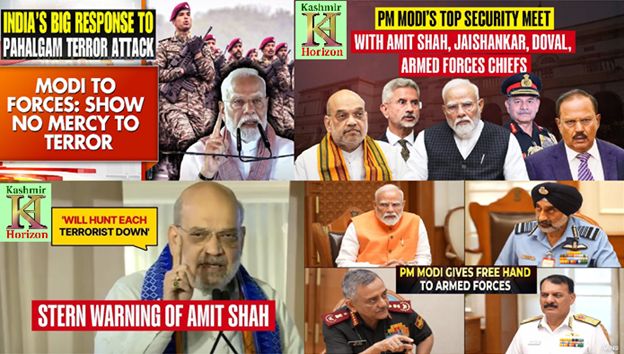
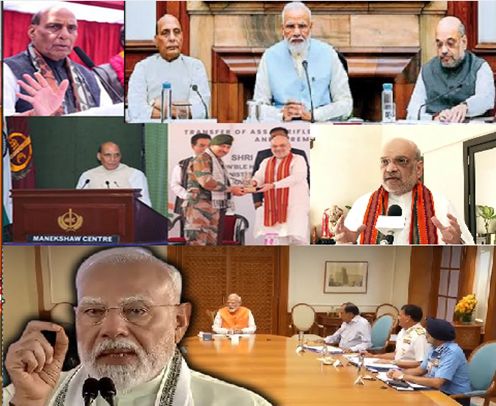
The Political Core Reactivated; CCPA, CCS Convene: At the heart of the government’s response were three critical back-to-back meetings chaired by Prime Minister Modi at his official residence, 7 Lok Kalyan Marg. These included the Cabinet Committee on Security (CCS), the Cabinet Committee on Political Affairs (CCPA), and the Cabinet Committee on Economic Affairs (CCEA)—a rare and emphatic political move reflecting the gravity of the situation. Among these, the CCS, which includes the Prime Minister, Defence Minister Rajnath Singh, Home Minister Amit Shah, Finance Minister Nirmala Sitharaman, and External Affairs Minister S. Jaishankar, met for the second time since the attack. This committee assessed the national security posture, operational readiness of the armed forces, and the broader intelligence landscape. The meetings reportedly led to an all-forces alert and laid the foundation for the government’s firm public messaging: the perpetrators would not escape justice. However, it was the CCPA meeting that held profound political significance. Often dubbed the “Super Cabinet”, the CCPA is not convened routinely. Its last high-profile meeting occurred after the 2019 Pulwama terror attack—an event that saw India retaliate with the Balakot airstrike. That the CCPA was brought into session for the first time in six years suggests a possible recalibration of India’s cross-border counter-terrorism doctrine. With key ministers like Rajnath Singh, Amit Shah, Nirmala Sitharaman, Nitin Gadkari, and Piyush Goyal in attendance, the political leadership sent a unified message: the government is in crisis mode and every lever of power—military, political, and economic—is being mobilized.
Strategic Empowerment; “Complete Operational Freedom”: The most consequential takeaway from these meetings was Prime Minister Modi’s decision to give the armed forces “complete operational freedom.” This statement is not a bureaucratic formality—it is a strategic license. It means that the Indian military now has the autonomy to choose the timing, target, and mode of its response to the Pahalgam massacre. This mirrors the policy adopted in the aftermath of the Pulwama attack, which culminated in a targeted airstrike deep inside Pakistani territory. The nature of this military empowerment underscores India’s evolved counter-terrorism posture—one that embraces proactive deterrence over reactive diplomacy. The message is clear: India will no longer wait for global sympathy or bureaucratic consensus to act. It will strike when it deems fit.
HM Shah’s Blunt Warning; “Chun Chun Ke Badla”: Union Home Minister Amit Shah’s reaction was as politically forceful as it was emotionally resonant. While inaugurating a road project in New Delhi, Shah declared, “Chun chun ke badla lenge” (We will take revenge on each one of them). He termed the Pahalgam carnage a “national grief” and emphasized that it affected not just the families of victims but the entire country. This rhetoric, while emotionally charged, aligns with the Modi government’s consistent narrative of zero tolerance towards terrorism. Shah’s address further indicated that there would be repercussions beyond military strikes: diplomatic, legal, and economic actions were also on the table.
The Diplomatic Front; Global Support, Naming Pakistan: India’s diplomatic apparatus wasted no time in rallying international support. Defence Minister Rajnath Singh spoke with his US counterpart, Secretary Pete Hegseth, who reaffirmed Washington’s backing for India’s right to self-defense. In another development, External Affairs Minister S. Jaishankar briefed US Secretary of State Marco Rubio, stating unequivocally that “the perpetrators, backers and planners of the Pahalgam attack must be brought to justice.” The conversations mark a pivotal moment in India’s diplomatic engagement: for the first time since the Pahalgam attack, a senior Indian minister directly named Pakistan for its role in supporting, training, and funding terrorist organizations. This marks a deliberate escalation of diplomatic pressure. US support, while strategically cautious, signaled understanding. Hegseth publicly posted on social media: “We stand with India and its great people.” Rubio encouraged India to “work with Pakistan to de-escalate tensions,” revealing a familiar balancing act by Washington—supportive, yet cautiously advocating regional stability.
Symbolism Meets Strategy; Indus Water Treaty in Abeyance: In a symbolic yet impactful diplomatic maneuver, India has reportedly moved to place the Indus Water Treaty (IWT) in abeyance. While this does not translate into an immediate cessation of water flows to Pakistan, it signals that India is willing to weaponize even long-standing bilateral agreements to exert pressure on Islamabad. By targeting a treaty brokered under World Bank auspices in 1960, India is underscoring the cost of cross-border terrorism—economic and strategic.
Lashkar’s Proxy And NIA’s Forensic March: The Resistance Front (TRF), a known proxy of Lashkar-e-Taiba (LeT), claimed responsibility for the Pahalgam attack. This assertion triggered the handover of the investigation to India’s premier counter-terrorism agency, the National Investigation Agency (NIA). On April 27, the NIA formally registered a new FIR and began its probe after an initial ground-level assessment in collaboration with Jammu and Kashmir Police. NIA Director General Sadanand Date personally visited the Baisaran attack site, signaling the seriousness of the central probe. The agency’s actions—securing forensic evidence, reconstructing the attack, and mapping terrorist logistics—aim to create an unassailable dossier for both national prosecution and international attribution. Intelligence sources reveal that 14 local terrorists are currently under the radar for their suspected involvement or support roles in the Pahalgam attack. The NIA’s focus is not only to bring these individuals to justice but also to trace the supply and communication chain that enabled the attack—both across the LoC and within India.
Military Preparedness; Lt Gen Pratik Sharma Takes Charge as GOC Northern Command: At a time of crisis, military leadership becomes a cornerstone of national security. Lt Gen Pratik Sharma assumed charge as the General Officer Commanding-in-Chief (GOC-in-C) of the Northern Command on May 1. His appointment comes with perfect timing, given his deep operational experience along the Line of Control and in strike corps deployments. Sharma’s battlefield understanding of both defensive and offensive tactics, especially in high-altitude conflict zones, will be crucial as India prepares its next move. His predecessor, Lt Gen Suchindra Kumar, was widely respected, and Sharma inherits a strategic command at a time of maximum alert.
“The April 22 Pahalgam attack was not just an act of terror—it was an assault on the very idea of a peaceful, unified, and resilient India. The massacre of innocent civilians, many of them tourists, was designed to instill fear, disrupt communal harmony, and question the effectiveness of the Indian state. But instead of yielding to panic, India has responded with composure, resolve, and strategic clarity. From empowering its military to mounting a global diplomatic offensive and strengthening internal security mechanisms, the country is poised to transform this tragedy into a turning point. The coming weeks will test not just India’s operational capabilities but also its political will and moral clarity. What emerges from this crisis may well define a new counter-terrorism doctrine—one that prioritizes deterrence, accountability, and a no-compromise attitude toward state-sponsored terrorism.”
Zero Tolerance For Terror: The political leadership’s swift and visible response to the Pahalgam attack reflects an acute awareness of the national mood. The victims were tourists—ordinary citizens who symbolize the very unity and diversity that terror outfits seek to undermine. Media coverage has amplified this sentiment, focusing on the vulnerability of civilians and the need for a strong, retaliatory posture. The Modi government’s message has been unambiguous: terror will not be tolerated, and no safe haven—domestic or foreign—will protect its perpetrators. This narrative resonates with a wide public, especially amid the growing perception that the global community often responds too late and too cautiously to such attacks. The coming weeks are likely to witness the unveiling of India’s multi-pronged response. While military retaliation may not be immediately visible, intelligence-led precision strikes—similar to those post-Uri and Pulwama—cannot be ruled out. Additionally, diplomatic efforts to isolate Pakistan in multilateral forums, economic review of bilateral agreements, and potential use of cyber and psychological warfare are all on the table. The NIA’s investigation will also play a central role in gathering irrefutable evidence against TRF and its Pakistani handlers. If done successfully, it could allow India to mobilize international legal opinion, potentially leading to sanctions or travel bans against individuals linked to LeT. At home, expect an intensification of counter-insurgency operations in Kashmir, increased surveillance, and arrests of overground workers. The presence of 14 suspected local terrorists gives Indian security forces a clear target list to pursue in the coming weeks. The Pahalgam terror attack marks a dangerous escalation in the strategy of Pakistan-backed terror groups operating in Jammu and Kashmir. But it also marks a turning point in India’s internal and external response mechanisms. From military empowerment and strategic cabinet coordination to diplomatic signaling and symbolic pressure, the Indian state has activated its entire national security architecture.
Kashmir Horizon View: In the aftermath of the Pahalgam terror attack, India’s long-term strategy must go beyond immediate military retaliation and focus on a multi-dimensional framework that neutralizes both the symptoms and root causes of terrorism. Firstly, intelligence coordination between central and local agencies must be sharpened to pre-empt such attacks. The National Investigation Agency (NIA), along with RAW, IB, and the Jammu & Kashmir Police, should work in tandem with advanced surveillance systems, including AI-based facial recognition and geospatial mapping, to dismantle the terror network’s infrastructure from within. A stronger ground intelligence grid that involves community policing can also help identify overground workers who enable such attacks logistically. On the military front, India must sustain its readiness along the LoC and consider targeted anti-terror operations, including the use of specialized drone warfare, to eliminate high-value targets across the border without full-scale escalation. Diplomatically, India must continue to build a coalition of support among global powers, particularly at the United Nations and through bilateral platforms with allies such as the US, France, and Australia. A consistent narrative that exposes Pakistan’s support to terror outfits—backed by verifiable evidence from the Pahalgam probe—should be used to push for global sanctions or blacklisting of specific individuals and organizations. Simultaneously, India must review key strategic agreements like the Indus Water Treaty to exert calibrated pressure on Islamabad. Economically, disrupting the terror-financing ecosystem is essential. Stringent implementation of the Unlawful Activities (Prevention) Act (UAPA), closer scrutiny of hawala channels, and cyber-finance trails must be made a top priority. Within Kashmir, socio-economic outreach programs that engage youth in education, entrepreneurship, and employment can help prevent radicalization in the long run. A secure and economically vibrant Kashmir is India’s strongest answer to cross-border terror. The April 22 Pahalgam attack was not just an act of terror—it was an assault on the very idea of a peaceful, unified, and resilient India. The massacre of innocent civilians, many of them tourists, was designed to instill fear, disrupt communal harmony, and question the effectiveness of the Indian state. But instead of yielding to panic, India has responded with composure, resolve, and strategic clarity. From empowering its military to mounting a global diplomatic offensive and strengthening internal security mechanisms, the country is poised to transform this tragedy into a turning point. The coming weeks will test not just India’s operational capabilities but also its political will and moral clarity. What emerges from this crisis may well define a new counter-terrorism doctrine—one that prioritizes deterrence, accountability, and a no-compromise attitude toward state-sponsored terrorism. In memory of the 26 lives lost in Pahalgam, the nation now moves with unity and determination—toward justice, toward security, and toward a future where terror has no place.
(In commitment to continuous improvement the “Team Kashmir Horizon” invites it’s valuable readers to share their valuable feedback and suggestions with the “Team Kashmir Horizon”. The insights of readers will surely play a vital role in improving the content quality of “Kashmir Horizon” and contribute more for the empowerment of people. Please feel free to reach out to us at editor@ thekashmirhorizon.com. Team “Kashmir Horizon” eagerly anticipates thoughts and ideas of it’s readers, which will help us serve people and even more effectively. The inputs of valuable readers are highly valued as “Kashmir Horizon” strives to provide it’s readers the best possible experience.)