
“Flash floods, hailstorms and landslides in Jammu’s Ramban district and plains of Kashmir Valley last week have yet again exposed the fragile ecosystem, the vulnerabilities of infrastructure, the traditional crops and apple orchards and the daunting challenges of disaster response in Jammu and Kashmir. With at least three lives lost, hundreds stranded, and vital infrastructure crippled, the situation underlines not just the immediate human tragedy, but also the urgent need for long-term planning and resilience-building in the Union Territory.”
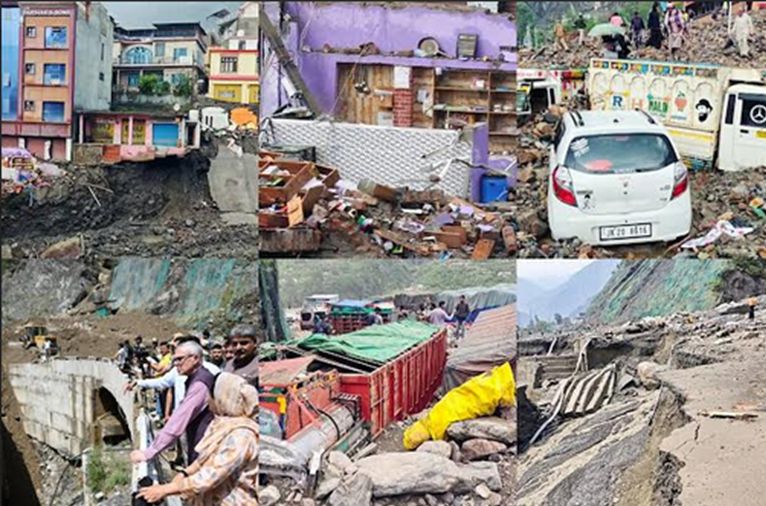 The overnight torrential rains that triggered flash floods, hailstorms and landslides in Jammu’s Ramban district and plains of Kashmir Valley last week have yet again exposed the fragile ecosystem, the vulnerabilities of infrastructure, the traditional crops and apple orchards and the daunting challenges of disaster response in Jammu and Kashmir. With at least three lives lost, hundreds stranded, and vital infrastructure crippled, the situation underlines not just the immediate human tragedy, but also the urgent need for long-term planning and resilience-building in the Union Territory.
A Region Cut Off;The Immediate Impact: The most immediate and devastating impact of the rains was the severing of Ramban from the rest of Jammu and Kashmir. National Highway 44 (NH-44), the lifeline connecting the Valley to the rest of India, was buried under landslide debris at multiple points between Nashri and Banihal. It remains suspended for several days, leaving hundreds of vehicles and commuters stranded. In a region already dependent on a few major arteries for connectivity, such disruptions paralyze movement of essential goods, medicines, and fuel, amplifying the suffering of the population. Significantly, the damage to NH-44 comes at a time when supplies to the Valley are crucial ahead of the tourist season and regular economic activities. The strategic and economic cost of such disruptions is immense, with losses running into crores within just a few days of highway closure. Meanwhile, smaller link roads have also been destroyed, cutting off villages like Seri, Banga, Panote, and Khari. In these areas, relief teams have struggled to reach affected populations due to dangerous conditions, while families have been forced to brave treacherous terrains to seek safety and aid.
Disaster Response; A Race Against Time: The response from disaster management agencies has been prompt, but the scale of the calamity poses significant challenges. Teams from the National Disaster Response Force (NDRF), State Disaster Response Force (SDRF), Jammu and Kashmir police, and the Indian Army were quickly deployed. Over 500 people have reportedly been rescued, a testament to the commitment and preparedness of these agencies. The Indian Army’s role, as often in times of natural disasters in the region, has been pivotal. By organizing langars (community kitchens), providing temporary shelters, distributing hot meals, and offering basic medical assistance, the Army has offered crucial support to stranded travelers. Their efforts have earned praise from various quarters, including Union Minister Jitendra Singh. Yet, even with these efforts, it is clear that disaster response remains heavily reliant on physical access. When roads themselves are washed away or buried under debris, traditional response mechanisms are severely hampered. In Ramban, even the Chief Minister Omar Abdullah had to abandon vehicular travel and trek nearly six kilometers to oversee relief operations, highlighting the gravity of the situation.
Human Face Of The Tragedy: Beyond statistics of damaged houses and vehicles, the tragedy has countless human stories of resilience and heartbreak. Among them, the story of Hashkhor Ahmad stands out — a bridegroom who, adorned in his wedding attire, had to walk with his entire wedding party for nearly 10 kilometers through rain, mud, and rock fall to reach his bride’s village. Scenes of families trudging along collapsed roads, carrying children and elderly relatives and of commuters forming human chains to cross unstable landslide zones reflect both the desperation and the courage of the affected communities. The loss of lives — including two minors who were among the three dead on Sunday — brings into sharp focus the brutal cost of nature’s fury and the need to better protect vulnerable populations.
Structural Fragility, Ecological Imbalance: While the disaster was triggered by an intense spell of rain and cloudbursts, the severity of the damage points to deeper issues. The Ramban sector of NH-44 is notorious for its vulnerability, given its complex geology and steep slopes. In recent years, extensive construction, tunneling, and road widening under various infrastructure projects have further destabilized the terrain. Experts have repeatedly warned that blasting activities for road expansion, inadequate drainage systems, and indiscriminate cutting of slopes without proper retention mechanisms have made areas like Ramban more prone to landslides and flash floods. The incident is a grim reminder that infrastructure development must go hand-in-hand with ecological sensitivity. Without robust environmental impact assessments and stringent implementation of mitigation measures, human interventions can greatly amplify natural disasters.
Relief, Rehabilitation: A Mammoth Task: Divisional Commissioner Ramesh Kumar, along with Deputy Commissioner Baseer-ul-Haq Choudhary, has been on the ground, assuring affected families of relief and compensation. According to officials, a detailed damage assessment is underway, covering over 200 damaged houses and a similar number of vehicles. Chief Minister Omar Abdullah has promised adequate relief packages, though he was quick to clarify that the disaster, while severe, does not classify as a “national disaster” — a status that could have potentially unlocked greater central assistance. Given the extent of displacement and infrastructure damage, relief and rehabilitation will require coordinated efforts over the coming months. Temporary shelters, restoration of roads, rebuilding of damaged homes, and psychological support for trauma-affected families are immediate needs. In parallel, a long-term rehabilitation plan must be charted out, factoring in sustainable rebuilding practices to reduce future risks.
“Nature’s fury is becoming more frequent and intense with changing climate patterns. Cloudbursts, flash floods, and landslides are no longer rare anomalies but increasingly recurrent threats in Jammu and Kashmir. In such a reality, a purely reactive approach is insufficient. There is an urgent need to move from response to preparedness, from ad-hoc relief to strategic resilience building. The Ramban incident must therefore be seen not just as a disaster to be managed, but as a lesson to be learned. It must push governments, planners, engineers, and communities to reimagine infrastructure, revise building codes, regulate land use, and invest in nature-based solutions. The tragedy must also instill a culture of vigilance and disaster literacy among the public.”
Challenges In Road Restoration: Perhaps the most pressing technical challenge is the reopening of NH-44. Officials admit that in some severely damaged sections, mere clearing of debris may not be sufficient. Structural damage to the highway may necessitate realignment in places, along with rebuilding retaining walls and drainage systems. With continued rainfall forecast in the coming days, the task becomes even more complicated. Loose soil, waterlogging, and the risk of further landslides could delay restoration efforts, leaving Kashmir valley’s supplies and tourism sector in a precarious position. As CM Omar Abdullah noted, certain parts of the highway could reopen within 24 hours if weather conditions improve, but sections like those around Kelamorh and Seri may take two to three days or more, given the scale of destruction.
Political,Administrative Implications: The Ramban disaster also has political overtones. In a Union Territory where governance structures have been in flux since the revocation of Article 370, disaster management becomes a litmus test for both the local administration and the Centre. Public expectations for swift and efficient relief are high, and any perceived delays or inadequacies could fuel dissatisfaction. Moreover, the incident calls for a rethinking of administrative preparedness. From ensuring the availability of helicopters for rapid response (which was hampered this time due to weather) to strengthening local emergency response capacities in remote villages, systemic improvements are needed.
Learning from the Crisis; A Roadmap for Future: Ramban’s tragedy must not become yet another footnote in the long list of disasters in the Himalayan region. It should serve as a catalyst for serious introspection and action on several fronts:
- Disaster-Resilient Infrastructure: All new infrastructure projects, especially in sensitive areas, must integrate disaster resilience as a core design principle.
- Community Preparedness: Locals must be trained in basic disaster response skills, including first aid, evacuation drills, and communication protocols.
- Environmental Safeguards: Strict enforcement of environmental regulations is necessary. Haphazard construction, especially along rivers and slopes, must be curtailed.
- Early Warning Systems: Investments in real-time weather monitoring, early warning dissemination, and pre-emptive evacuation mechanisms can save lives.
- Multi-Agency Coordination: A more integrated framework involving civil authorities, the army, disaster response forces, and community organizations can lead to quicker, more effective responses.
Kashmir Horizon View: The devastating flash floods and landslides in Ramban have once again highlighted the pressing need for a more comprehensive and proactive disaster management strategy, especially in geologically sensitive regions like Jammu and Kashmir. While immediate rescue and relief operations were commendable, the scale of destruction demands a deeper, long-term approach to minimize future vulnerabilities. Firstly, a detailed vulnerability mapping of the region must be prioritized. Ramban and adjoining areas are prone to landslides and flash floods due to steep terrain, fragile slopes, and unpredictable weather patterns. Using modern technologies like remote sensing, GIS mapping, and drones, authorities must identify high-risk zones and restrict construction activities in these areas. Secondly, strengthening infrastructure resilience is critical. The repeated damage to the Jammu-Srinagar National Highway, especially around Kelamorh and Seri, underlines the need for redesigning certain sections of NH-44. Authorities, including the National Highways Authority of India (NHAI), must work on realigning vulnerable road sections and reinforcing them with proper slope stabilization measures, robust drainage systems, and landslide control structures such as retaining walls and bioengineering methods. Thirdly, early warning systems must be deployed extensively. Real-time weather monitoring stations, landslide sensors, and flood forecasting models can offer timely alerts to residents and travelers. Mobile-based alert systems, community sirens, and dedicated apps can ensure that information reaches public in minutes, giving them precious time to evacuate or take precautions. Fourth, community participation and capacity-building must become a central part of disaster risk management. Locals are often the first responders during natural calamities. Conducting regular training sessions, mock drills, and awareness programs can equip communities to respond better and reduce dependence solely on official agencies. Fifth, expanding emergency shelters and stockpiling essentials in vulnerable districts like Ramban is crucial. Relief camps should be built in advance, equipped with food supplies, medical kits, sanitation facilities, and emergency communication tools to handle large displaced populations during disasters. Sixth, environmental conservation efforts need immediate strengthening. Unplanned deforestation, hill-cutting, and reckless construction have exacerbated the region’s fragility. Strict adherence to environmental norms, afforestation drives, and promotion of sustainable land use practices can go a long way in stabilizing the region’s ecology. Finally, multi-agency coordination needs to be institutionalized beyond emergencies. Seamless collaboration between the NDRF, SDRF, Army, civil administration, and local bodies should become part of regular governance, not just disaster-time responses. Setting up a Regional Disaster Response Coordination Center in Jammu could facilitate quicker decision-making and better resource deployment. The Ramban tragedy must serve as a wake-up call. Proactive governance, scientific planning, community involvement, and environmental respect are the cornerstones of building disaster-resilient Himalayan regions. Waiting for the next tragedy is not an option.
Conclusion: The flash floods and landslides that crippled Ramban this week have brought unimaginable hardship, grief, and disruption. Yet, amid the wreckage, the swift and coordinated response by agencies like the NDRF, SDRF, Army, and the civil administration showcased the resilience and spirit of the region. More than 500 people were rescued, basic amenities were provided, and critical efforts to restore the Jammu-Srinagar National Highway began almost immediately. These efforts deserve appreciation. However, the sheer scale of destruction — with over 200 homes and vehicles damaged, vital highways buried under debris, and several lives lost — underlines deeper systemic issues. Ramban’s devastation cannot be dismissed as an isolated event; it is a symptom of broader vulnerabilities stemming from unregulated development, fragile ecosystems, and climatic volatility in the Himalayan belt. Chief Minister Omar Abdullah’s personal involvement — walking several kilometers to reach the affected site — reflects the seriousness with which the administration treated the disaster. His assurance of relief packages, realignment of highway stretches, and long-term rehabilitation plans offer hope. Yet, the Chief Minister’s assertion that this is not a “national disaster” but a “localised” one should not downplay the urgent need for national-level attention and resources to fortify such sensitive regions. Nature’s fury is becoming more frequent and intense with changing climate patterns. Cloudbursts, flash floods, and landslides are no longer rare anomalies but increasingly recurrent threats in Jammu and Kashmir. In such a reality, a purely reactive approach is insufficient. There is an urgent need to move from response to preparedness, from ad-hoc relief to strategic resilience building. The Ramban incident must therefore be seen not just as a disaster to be managed, but as a lesson to be learned. It must push governments, planners, engineers, and communities to reimagine infrastructure, revise building codes, regulate land use, and invest in nature-based solutions. The tragedy must also instill a culture of vigilance and disaster literacy among the public.
(In commitment to continuous improvement the “Team Kashmir Horizon” invites it’s valuable readers to share their valuable feedback and suggestions with the “Team Kashmir Horizon”. The insights of readers will surely play a vital role in improving the content quality of “Kashmir Horizon” and contribute more for the empowerment of people. Please feel free to reach out to us at editor@ thekashmirhorizon.com. Team “Kashmir Horizon” eagerly anticipates thoughts and ideas of it’s readers, which will help us serve people and even more effectively. The inputs of valuable readers are highly valued as “Kashmir Horizon” strives to provide it’s readers the best possible experience.)