“Key priorities for achieving ‘Viksit Bharat’ (Developed India): Productivity and Resilience in Agriculture, Employment & Skilling, Inclusive Human Resource Development and Social Justice, Manufacturing & Services, Urban Development, Energy Security , Infrastructure, Innovation, Research & Development and Next Generation Reforms.”
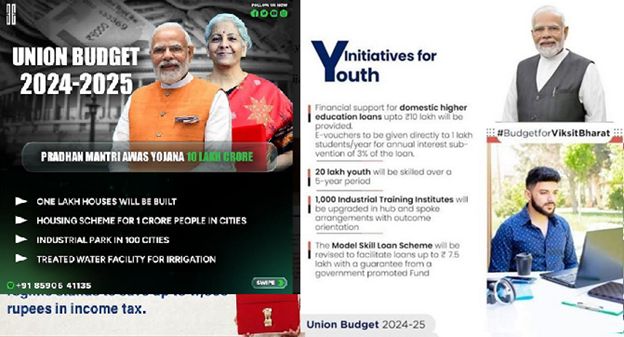
Finance Minister Nirmala Sitharaman presented the Union Budget for 2024-25 in Parliament on this week, marking her seventh consecutive budget. The budget aims to stimulate economic growth, create jobs, and provide relief to the middle class. Despite global economic uncertainties, India’s economic growth stands out as a shining exception and is expected to continue its strong performance in the coming years. Presenting the Union Budget 2024-25 in Parliament, Minister of Finance and Corporate Affairs, Nirmala Sitharaman, highlighted that India’s inflation remains low, stable, and on track toward the 4 percent target. Core inflation (excluding food and fuel) is currently at 3.1 percent, and measures are being implemented to ensure that perishable goods are adequately supplied to the market.
Interim Budget: In her address, the Finance Minister reiterated the focus areas outlined in the interim budget: ‘Garib’ (Poor), ‘Mahilayen’ (Women), ‘Yuva’ (Youth), and ‘Annadata’ (Farmers).
Budget Theme: Discussing the budget theme, Sitharaman emphasized a forward-looking approach with a focus on employment, skill development, MSMEs, and the middle class. She introduced the Prime Minister’s package, which includes five schemes and initiatives aimed at providing employment, skilling, and other opportunities to 41 million youth over the next five years, with a central outlay of ₹2 lakh crore. This year, ₹1.48 lakh crore has been allocated for education, employment, and skill development.
Budget Priorities: The Finance Minister outlined nine key priorities for achieving ‘Viksit Bharat’ (Developed India): Productivity and Resilience in Agriculture, Employment & Skilling, Inclusive Human Resource Development and Social Justice, Manufacturing & Services, Urban Development, Energy Security , Infrastructure, Innovation, Research & Development and Next Generation Reforms.
“To promote investment, angel tax for investors will be abolished, and a simpler tax regime for foreign shipping companies will be introduced. Corporate tax rates for foreign companies will be reduced from 40 to 35 percent. The budget also simplifies tax regimes for charities, TDS rate structures, and capital gains taxation, including adjustments to customs duties for various goods”.
Key Highlights of the Budget
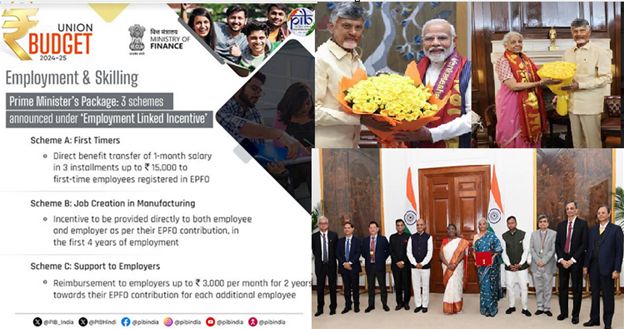
Employment-Linked Incentive Schemes: Sitharaman announced three employment-linked schemes to boost job creation for first-time employees. Scheme A offers up to ₹15,000 salary support for new workers; Scheme B incentivises manufacturing job growth; and Scheme C reimburses employers ₹3,000 monthly for new hires, aiming to create 50 lakh jobs across sectors.
Agriculture: The Centre has allocated ₹1.52 lakh crore for agriculture in the Union Budget 2024. Finance Minister Nirmala Sitharaman announced plans to enhance productivity through 109 new high-yielding, climate-resilient crop varieties. Additionally, 1 crore farmers will transition to natural farming, supported by certification and branding initiatives. The government will establish 10,000 bio-input resource centres and promote vegetable production clusters near consumption hubs, while also implementing Digital Public Infrastructure in agriculture.
Defence: India has allocated ₹6,21,940 crore for defence in the Union Budget 2024-25, an increase from last year’s ₹5.94 lakh crore
Internship Opportunities: The budget includes a comprehensive internship scheme aimed at providing 1 crore youth with internship opportunities in 500 top companies over five years. Interns will receive an allowance of ₹5,000 per month and a one-time assistance of ₹6,000, with companies expected to cover training costs from their CSR funds.4 The budget also proposes a revision of the tax regime, increasing the standard deduction from ₹50,000 to ₹75,000, which could save taxpayers up to ₹17,500 annually. The government has tweaked income tax slabs under the New Tax Regime (NTR) to provide additional relief to middle-class taxpayers. The long-term capital gains tax rate has been increased from 10% to 12.5%.
Higher Education Loans: The government announced loans of up to ₹10 lakh for higher education in domestic institutions, making education more accessible for students.
Support for Start-ups: In a significant move to bolster the start-up ecosystem, the budget abolished the angel tax for all classes of investors, alleviating the financial strain on young businesses.
What gets cheaper, what gets costlier?
Duty Cuts on Goods: To stimulate consumption, the budget proposes customs duty cuts: duties on gold and silver are reduced to 6%, potentially lowering retail prices, while mobile phone duties are cut to 15%, making these devices more affordable for consumers.
Strategic Allocations for States: The budget also outlines targeted allocations for states like Andhra Pradesh and Bihar, which are crucial political allies. Key schemes for Bihar include the Purvodaya initiative, enhancing road connectivity with major expressways, and new infrastructure like medical colleges and sports facilities. In Andhra Pradesh, the Centre focuses on capital development with Rs 15,000 crore support, alongside investments in renewable energy and improved transportation networks to boost growth.
MSME Support: The budget introduces a new credit rating mechanism for smaller units, enhancing the Mudra loan limit from ₹10 lakh to ₹20 lakh. A pivotal aspect of this budget is the introduction of a credit guarantee scheme aimed at facilitating term loans to MSMEs for the purchase of machinery and equipment without the need for collateral or third-party guarantees. This scheme will pool credit risks associated with these enterprises, providing a guarantee cover of up to ₹100 crore. For 2024-25, total receipts (excluding borrowings) are estimated at ₹32.07 lakh crore, and total expenditure at ₹48.21 lakh crore. The fiscal deficit is estimated at 4.9 percent of GDP, with gross and net market borrowings estimated at ₹14.01 lakh crore and ₹11.63 lakh crore, respectively. The government aims to reduce the deficit below 4.5 percent next year.
Relief To Salaried Individuals,Pensioners:
In addition to providing relief to salaried individuals and pensioners through direct tax changes, the Union Budget 2024-25 will review and simplify direct and indirect taxes over the next six months. The budget proposes rationalization of the GST tax structure, review of the Customs Duty rate structure, and a comprehensive review of the Income Tax Act to reduce disputes and make it more user-friendly. The standard deduction for salaried employees will increase to ₹75,000, and the deduction on family pensions will rise to ₹25,000. The new tax regime will provide benefits up to ₹17,500 for salaried employees.
| Income Tax Slabs |
| Income Slabs Tax Rate |
| 0 – 3 Lakh rupees NIL |
| 3 – 7 Lakh rupees 5 percent |
| 7 – 10 Lakh rupees 10 percent |
| 10 – 12 Lakh rupees 15 percent |
| 12 – 15 Lakh rupees 20 percent |
| Above 15 Lakh rupees 30 percent |
To promote investment, angel tax for investors will be abolished, and a simpler tax regime for foreign shipping companies will be introduced. Corporate tax rates for foreign companies will be reduced from 40 to 35 percent. The budget also simplifies tax regimes for charities, TDS rate structures, and capital gains taxation, including adjustments to customs duties for various goods. The Vivad se Vishwas Scheme, 2024, will address income tax disputes, with increased monetary limits for appeals. The scope of safe harbour rules and transfer pricing assessment procedures will be expanded to reduce litigation and provide certainty in international taxation.

“Moving forward, effective implementation of employment schemes and monitoring advancements in agriculture will be crucial. The increased defence budget needs to be efficiently utilized to strengthen national security. The simplification of the tax regime, including GST and Customs Duty revisions, should be expedited to improve compliance and reduce disputes. Support measures for start-ups should be facilitated, and strategic investments in states must be used effectively for infrastructure growth. Fiscal discipline will be essential to achieve the goal of reducing the deficit below 4.5% next year while balancing growth and expenditure priorities. By addressing these areas, the government can drive sustainable economic development, support key sectors, and improve overall fiscal health.”
Kashmir Horizon View: Finance Minister Nirmala Sitharaman presented the Union Budget for 2024-25, marking her seventh consecutive budget, with a focus on stimulating economic growth, creating jobs, and providing relief to the middle class amidst global economic uncertainties. The budget highlights include a commitment to strong economic growth with low and stable inflation, efforts to create 50 lakh jobs through new employment-linked schemes, and a significant allocation of ₹1.52 lakh crore for enhancing agricultural productivity and supporting natural farming. Additionally, the defence budget has been increased to ₹6,21,940 crore, while tax reforms include an increased standard deduction, revised income tax slabs, and the abolition of angel tax to support start-ups. Strategic investments have been earmarked for states like Andhra Pradesh and Bihar to boost infrastructure and development. Moving forward, effective implementation of employment schemes and monitoring advancements in agriculture will be crucial. The increased defence budget needs to be efficiently utilized to strengthen national security. The simplification of the tax regime, including GST and Customs Duty revisions, should be expedited to improve compliance and reduce disputes. Support measures for start-ups should be facilitated, and strategic investments in states must be used effectively for infrastructure growth. Fiscal discipline will be essential to achieve the goal of reducing the deficit below 4.5% next year while balancing growth and expenditure priorities. By addressing these areas, the government can drive sustainable economic development, support key sectors, and improve overall fiscal health.
(In commitment to continuous improvement the “Team Kashmir Horizon” invites it’s valuable readers to share their valuable feedback and suggestions with the “Team Kashmir Horizon”. The insights of readers will surely play a vital role in improving the content quality of “Kashmir Horizon” and contribute more for the empowerment of people. Please feel free to reach out to us at editor@ thekashmirhorizon.com. Team “Kashmir Horizon” eagerly anticipates thoughts and ideas of it’s readers, which will help us serve people and even more effectively. The inputs of valuable readers are highly valued as “Kashmir Horizon” strives to provide it’s readers the best possible experience. Thank you for being a part of the reader community!)