

Syed Vakas Bukhari
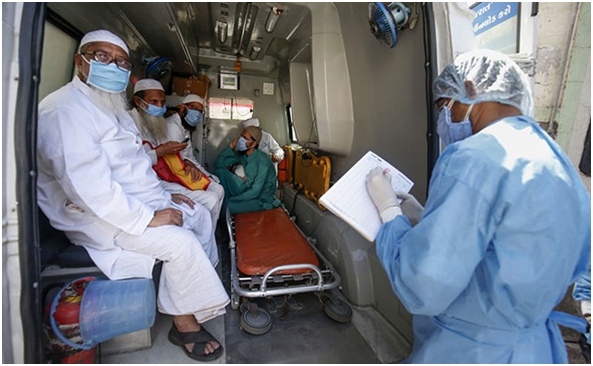
The coronavirus pandemic struck India at a moment when the country was more polarized than it has been in decades. Particularly since 2019, when Prime Minister Narendra Modi won a landslide reelection victory, he and his government have exacerbated the country’s polarization by advancing a majoritarian, Hindu nationalist agenda. On the surface, the coronavirus has put political animosities on hold, as Modi has toned down his populist and confrontational rhetoric. Yet at the same time, fears surrounding the pandemic have rapidly amplified societal polarization and intolerance, in particular against India’s Muslims. At the broader societal level, however, the pandemic has fueled intolerance and even violence in some instances against the country’s Muslim minority. The catalyst for rapidly growing anti-Muslim sentiment was a single event in mid-March organized by a Muslim missionary movement called Tablighi Jamaat. The group’s event center, or Markaz, rapidly emerged as a major hot spot in India’s coronavirus outbreak. Hundreds of followers, including many foreign nationals, attended the Markaz event, and by mid-April, after weeks of testing and contact tracing, the Indian government had identified more than 4,000 coronavirus cases related to the event, representing almost 30 percent of India’s total confirmed infections.
The pandemic has aggravated the religious polarization that has been intensifying since Modi over the reigns of power in 2014.
The Markaz incident fanned the flames of societal polarization in a country where violence against Muslims has erupted as recently as February 2020. The event became a 24/7 subject of conversation on social media and television stations, while bigots exploited the outbreak to paint the entire Muslim community as a vector of disease. “Corona jihad” became the top trending hashtag on Twitter for days; between March 28 and April 3, the incendiary hashtag appeared 300,000 times and was viewed by possibly 300 million people on Twitter. Meanwhile, prominent television channels openly spouted anti-Muslim conspiracy theories, and even many respected print outlets fell into the trap of playing to Islamophobia. The relentless media attention to the event found its way into the health ministry’s daily press briefing, in which the spokesperson regularly cited the number of coronavirus cases linked to the Markaz incident. This outpouring of hateful rhetoric has translated into an increase in anti-Muslim discrimination and violence across India. Painted as “corona villains” or virus spreaders, Muslims have been beaten and attacked by vigilante groups. After many days of silence, Prime Minister Modi appealed for unity, emphasizing that the virus “doesn’t see religion, language, or borders.” Yet his words have proven largely unable to stem growing inter communal discord, and in this context, Muslim communities’ deep distrust of the Hindu nationalist government—evident in a series of violent attacks on frontline health workers—has emerged as a potential barrier to providing them with healthcare and containing the spread of the virus to others. Thus, the pandemic has aggravated the religious polarization that has been intensifying since Modi over the reigns of power in 2014. Just months before this crisis, in December 2019, Modi’s government passed the discriminatory Citizenship Amendment Act that established religion as a basis for granting citizenship and proposed a National Register of Citizens, fueling fears among many Indian Muslims that their legal citizenship was in jeopardy. Now, at a time when the minority community was already under attack, it would by all probabilities confront a new wave of hatred and stigma.
(The author is a freelancer. Views are his own, [email protected])





