“Congratulating ISAE on completing six decades of service, LG acknowledged the contribution of agricultural engineers to India’s journey from food shortages towards greater food security. He also commended SKUAST-K for its contribution to agricultural research, education and innovation…….”
Mohammad Irfan
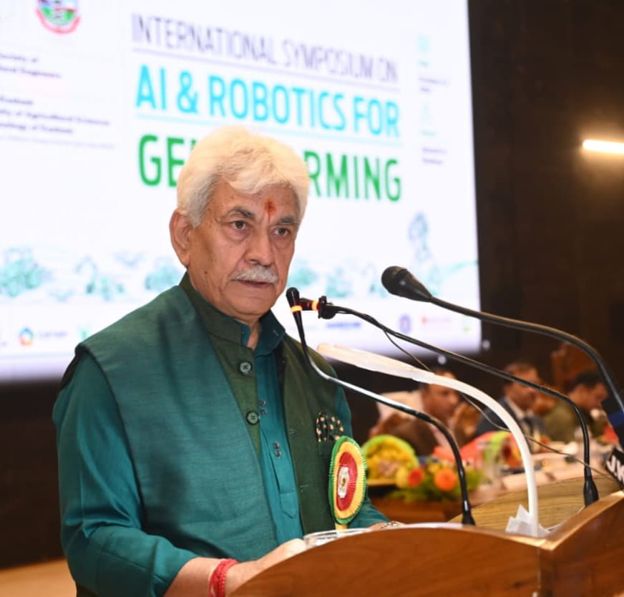
 As Indian agriculture navigates the challenges of climate change, rising input costs, labour shortages and growing pressure on natural resources, Lieutenant Governor Manoj Sinha has called for a farmer-centric approach to technological innovation, emphasising that the true measure of agricultural engineering lies in its ability to improve livelihoods in the field rather than merely generate patents and research publications. Addressing the 60th Annual Convention of the Indian Society of Agricultural Engineers (ISAE), co-hosted by Sher-e-Kashmir University of Agricultural Sciences and Technology of Kashmir (SKUAST-K), on October 5, Sinha outlined a vision of agricultural development in which artificial intelligence, robotics, precision farming and women-led innovation work together to make farming more productive, sustainable and economically viable. His message carries particular significance for Jammu and Kashmir, where agriculture and horticulture sustain rural livelihoods and where varied terrain, changing weather patterns and fragmented landholdings demand locally adapted technological solutions. The convention brought together agricultural scientists, engineers, researchers, academicians and industry representatives to deliberate on women-led engineering innovations in smart farming and the application of artificial intelligence and robotics to the next generation of agriculture. Congratulating ISAE on completing six decades of service, the Lieutenant Governor acknowledged the contribution of agricultural engineers to India’s journey from food shortages towards greater food security. He also commended SKUAST-K for its contribution to agricultural research, education and innovation. However, he stressed that the next phase of agricultural progress would require a different set of priorities: technologies that are affordable, accessible and capable of delivering measurable improvements in farmers’ lives. “Create technology that can endure in real fields, under real monsoon conditions, and within the limited budgets of real farmers. Do not measure your success solely by patents or published research papers. Measure it by whether, five years later, a small farmer in Anantnag, Amritsar or Akola is genuinely better off because of your tools,” Sinha said.
From Food Security To Technology-Driven Agriculture: India’s agricultural transformation since the Green Revolution demonstrates the role that scientific research, mechanisation, improved seeds, irrigation and public investment can play in strengthening food production. Agricultural engineers contributed to this progress through machinery, irrigation systems, harvesting technologies, storage facilities and innovations designed to reduce post-harvest losses. Today, however, the challenge extends beyond increasing production. Farmers must improve productivity while managing water scarcity, soil degradation, climate variability, rising costs and changing market conditions.
Precision agriculture offers an opportunity to address some of these pressures. Soil-moisture sensors can help farmers make informed irrigation decisions, drones can assist with crop monitoring, and artificial intelligence can analyse weather information and crop images to identify potential pest and disease risks. Robotic equipment can help automate repetitive operations, while digital platforms can provide timely agricultural advice and support more efficient use of fertilisers, pesticides and water. Yet technological sophistication alone does not guarantee success. A system designed for large farms may be unsuitable for small landholdings, while expensive equipment can remain beyond the reach of farmers with limited financial resources.
Jammu and Kashmir’s Case For Locally Adapted Innovation: For Jammu and Kashmir, the opportunities are considerable. The region’s agricultural economy includes apple orchards, paddy cultivation, vegetable production, livestock rearing and other activities that operate under different climatic and geographical conditions. In the Kashmir Valley, horticulture is a major source of rural income. Apple growers must manage irrigation, pruning, pest control, harvesting, grading, transportation and storage while responding to changing weather patterns and market requirements. Affordable technologies could help orchardists monitor soil moisture, identify disease risks, improve spraying efficiency and manage irrigation more precisely. Digital advisory systems could also help farmers access timely weather information and crop-management recommendations. In paddy-growing areas, improved machinery and water-management systems could reduce labour requirements and improve resource efficiency. In mountainous districts, lightweight equipment and tools designed for uneven terrain could prove more useful than machinery intended for large, level farms. The region also has opportunities to strengthen cold-chain infrastructure, improve post-harvest handling and introduce energy-efficient storage and processing technologies. Such interventions require close collaboration between scientists, engineers, horticulture experts and farmers. Equipment must be tested under local conditions before wider adoption, with attention to durability, maintenance costs and the availability of technical support. The Lieutenant Governor described Jammu and Kashmir’s Holistic Agriculture Development Programme (HADP) as a model that could offer lessons to other states. The programme’s wider relevance lies in the opportunity to combine agricultural development, technological adoption, capacity-building and support for allied activities within a coordinated framework. For the region, the next step is to ensure that promising technologies reach farmers beyond demonstration plots and become affordable, dependable tools in everyday agricultural operations.
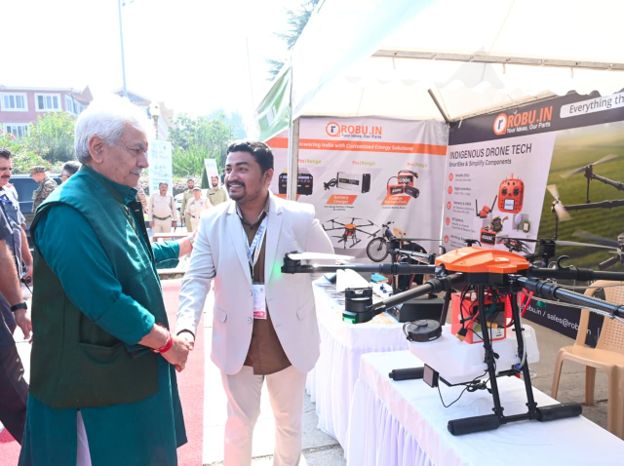
Artificial Intelligence And Robotics Must Remain Affordable: One of the central themes of the convention was the application of artificial intelligence and robotics to what Sinha described as the future of farming. AI-based systems can process weather forecasts, soil information, satellite imagery and crop photographs to support agricultural decisions. In suitable applications, they can help identify disease symptoms, estimate crop stress and improve the timing of irrigation or other farm operations. Drones and robotic equipment can assist with crop monitoring and targeted applications, potentially reducing unnecessary use of certain inputs when properly calibrated and operated. However, access remains a major concern. High equipment costs, unreliable connectivity, limited digital literacy and difficulties in obtaining repairs can prevent small farmers from benefiting from advanced systems. Lt Governor Sinha urged innovators to develop tools that can operate on ordinary smartphones, including in villages with low-bandwidth internet connections. He also called for robotic instruments that could be leased through Farmer Producer Organisations (FPOs) or collectively owned by farming communities. “I urge the Indian Society of Agricultural Engineers, SKUAST-Kashmir, and every young engineer and innovator to develop tools with affordability and access at their core. Create instruments that work not only on cloud infrastructure, but also on an ordinary smartphone in a low-bandwidth village in Reasi,” he said. The approach recognises that farmers do not necessarily need to own every piece of technology they use. Equipment-sharing arrangements, machinery banks, cooperatives and service providers can allow smallholders to access costly tools by paying only for the services required.
“Lieutenant Governor’s message placed farmers at the centre of this process, calling on engineers and innovators to develop tools that are practical, affordable and durable.….”
Women-Led Innovation Can Reshape Agricultural Engineering: Lt Governor Sinha also placed special emphasis on women’s participation in agricultural technology, calling for an ecosystem that enables women to become innovators, entrepreneurs and leaders in engineering. Women perform substantial work in farming and allied activities, including livestock care, harvesting, food processing and other labour-intensive operations. Yet their contributions have often received insufficient recognition, while limited access to land ownership, finance, technical training and professional networks can restrict their economic opportunities. The Lieutenant Governor urged institutions and private-sector stakeholders to support women-led agricultural technology start-ups and establish laboratories, fellowships and incubation platforms to help young women engineers from rural backgrounds develop their ideas. “Women-led start-ups in agricultural technology should receive financing with the same confidence with which any other start-up is provided the necessary support and facilities,” he said. He stressed that agricultural universities and engineering colleges should actively nurture women innovators and create opportunities for them to turn promising ideas into market-ready products.
Climate Change Makes Innovation More Urgent: Climate resilience is another area where agricultural engineering can make a substantial contribution. Agriculture depends heavily on seasonal conditions, and changes in temperature, rainfall distribution and the frequency of extreme weather events can complicate decisions about sowing, irrigation, harvesting and pest management. In Jammu and Kashmir, where horticulture and farming are closely linked to seasonal weather, access to reliable information and efficient resource management is particularly important. Local weather stations, improved forecasting systems, soil-moisture monitoring and precision irrigation can help farmers make more informed decisions. Better drainage, protected cultivation and improved storage facilities can also reduce certain production and post-harvest risks. In orchards, temperature monitoring and efficient cold-storage systems can support better handling of produce, while renewable-energy-powered equipment may reduce operating costs where conditions permit. However, technology cannot eliminate climate risks on its own. It must be integrated with soil conservation, watershed management, crop planning, improved agricultural practices and accessible extension services. Research institutions have an important role in developing evidence-based recommendations suited to local crops and conditions. They must also help farmers understand both the benefits and limitations of new technologies. The Lieutenant Governor’s appeal to develop solutions that work under real monsoon conditions highlights the importance of testing equipment and systems beyond controlled laboratory settings. Technologies must be able to withstand practical use, remain affordable to maintain and provide benefits that justify their costs. Research institutions must connect laboratories with farmers The participation of SKUAST-K and other research institutions is critical to translating scientific progress into practical outcomes. Agricultural universities can bring together agronomists, horticultural experts, engineers, economists and extension specialists to address problems that cannot be solved by a single discipline. Engineering colleges can contribute expertise in electronics, robotics, software, materials and manufacturing, while agricultural scientists can assess how proposed technologies affect crops, soil and farm productivity. Field trials should form an essential part of this process. Equipment needs to be tested across seasons, soil types, farm sizes and terrain, with farmers involved in evaluating its performance. Researchers must also examine operating costs, maintenance requirements, access to spare parts and the availability of trained operators. A machine that performs well during a demonstration may not necessarily remain effective under prolonged field use. Similarly, digital advisory systems must provide reliable information in accessible formats and should not assume that every farmer has continuous internet access or advanced digital skills. Lt Governor Sinha’s emphasis on measuring research through tangible improvements in farmers’ lives provides a useful framework for evaluating these efforts. Research success should be reflected in reduced production costs, improved resource efficiency, lower post-harvest losses, more reliable crop management and better economic outcomes for farming households. Such an approach would strengthen the relationship between universities and rural communities while making agricultural research more responsive to real-world needs.
Building An Agricultural Technology Economy: Agricultural innovation can also create opportunities for employment and entrepreneurship beyond the farm. Young engineers and entrepreneurs can develop businesses in drone services, irrigation automation, crop-monitoring software, equipment manufacturing, food processing, storage and agricultural logistics. For Jammu and Kashmir, these activities could create stronger links between technical education and the region’s agricultural economy. Locally developed equipment and services could also reduce dependence on distant suppliers for certain specialised products. Public institutions can support this transition through innovation centres, prototype-testing facilities, entrepreneurship programmes and partnerships with industry. Private companies can contribute manufacturing expertise, investment and distribution networks, while FPOs and cooperatives can help connect innovators with farmers who need practical solutions. The commercialisation process must nevertheless remain grounded in affordability and performance. A product should not be promoted simply because it incorporates advanced technology; its value should be demonstrated through reliable results and a clear economic case for farmers. The development of local repair and maintenance services will be equally important. Farmers are more likely to adopt unfamiliar equipment when they know that technical support and spare parts are readily available. By bringing together research, entrepreneurship and agricultural extension, the region can build an innovation ecosystem that supports both farm productivity and employment generation.
Kashmir Horizon View: The 60th Annual Convention of ISAE offered an opportunity to reflect on the next phase of India’s agricultural transformation. The country’s experience demonstrates the value of scientific research, mechanisation and sustained investment in agricultural development. The challenges ahead require these efforts to be extended towards climate resilience, resource efficiency, affordable automation and stronger participation by women. For Jammu and Kashmir, the priorities include locally adapted orchard technologies, improved water management, efficient post-harvest systems and digital services that respond to the needs of small and marginal farmers. The Lieutenant Governor’s message placed farmers at the centre of this process, calling on engineers and innovators to develop tools that are practical, affordable and durable. The significance of this approach lies in its focus on outcomes rather than technological novelty. A successful innovation is one that farmers can afford, understand, maintain and use to improve their livelihoods. As India seeks to build a more productive and sustainable agricultural sector, the partnership between scientists, engineers, universities, entrepreneurs and farming communities will become increasingly important. Lt Governor Sinha’s vision challenges agricultural institutions to ensure that progress in artificial intelligence, robotics and precision farming is not confined to laboratories and conference halls, but reaches the fields where its benefits matter most. If translated into sustained action, this approach can help strengthen agricultural resilience, expand opportunities for women and young entrepreneurs, and make technological progress a practical instrument of prosperity for farming communities across Jammu and Kashmir and the country.
(“Team Kashmir Horizon” is committed to continuous improvement and invites feedback and suggestions from readers and its followers on social media sites. Reader insights are considered vital for enhancing content quality and empowering the community. The team encourages open communication and values the thoughts and ideas of its audience, believing that such input will enable them to serve the public more effectively. The initiative aims to ensure that readers have the best possible experience with “Kashmir Horizon”. Interested individuals can reach out to us via email at [email protected].)