“PM Modi underlined the rapid expansion of India’s semiconductor ecosystem and said it was creating new opportunities for innovation, investment and economic growth. He also emphasised the growing confidence of the international community in India’s economy and its manufacturing capabilities…”
Mohammad Irfan
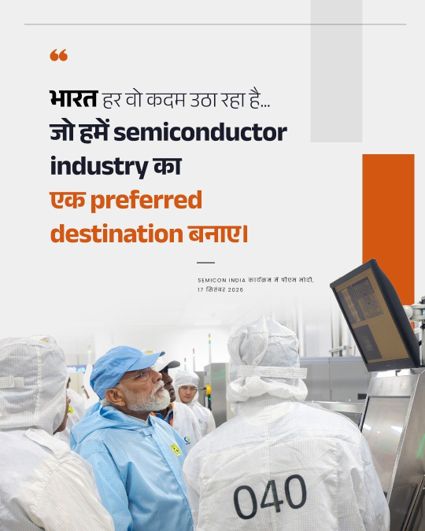 India’s semiconductor journey has entered a new and significant phase, with the country rapidly emerging as an important destination for semiconductor manufacturing, chip design, advanced packaging, research and technology innovation. The inauguration of SEMICON India 2026 by Prime Minister Narendra Modi in New Delhi on September 17 marked another milestone in this journey. The fifth edition of the event brought together global semiconductor companies, technology leaders, investors, researchers, start-ups and policymakers, reflecting the growing international interest in India’s semiconductor ambitions. The transformation underway is part of a broader national effort to build a technology-driven manufacturing ecosystem and strengthen India’s position in global supply chains. Addressing the gathering, the Prime Minister underlined the rapid expansion of India’s semiconductor ecosystem and said it was creating new opportunities for innovation, investment and economic growth. He also emphasised the growing confidence of the international community in India’s economy and its manufacturing capabilities. The semiconductor push comes at a time when chips have become fundamental to almost every modern technology. Smartphones, automobiles, telecommunications equipment, defence systems, artificial intelligence infrastructure, medical devices and consumer electronics all depend on semiconductors.As demand for these technologies expands, India is positioning itself to participate across the semiconductor value chain.
From Policy To Production : India’s semiconductor programme has developed rapidly since the launch of the India Semiconductor Mission in 2022. What began with policy formulation, investment proposals and project planning has progressively moved towards manufacturing and commercial production. The Prime Minister highlighted this evolution during his SEMICON India address, noting that semiconductor projects had progressed from initial discussions to project implementation, pilot lines and commercial production. The commencement of commercial production represents an important stage in India’s technology journey. The country is now developing capabilities not only in semiconductor manufacturing but also in chip design, assembly, testing, packaging, equipment, materials and supporting infrastructure. According to government information, five semiconductor manufacturing plants have commenced commercial production, creating a growing foundation for the country’s semiconductor ecosystem. The development is significant because semiconductor manufacturing requires a sophisticated industrial environment involving highly specialised equipment, precision engineering, clean-room facilities, advanced materials, specialised gases, uninterrupted power and highly trained technical personnel. The emergence of these capabilities is creating opportunities for companies across multiple sectors. Semiconductor manufacturing is therefore becoming a catalyst for a much wider industrial transformation.
Semicon 2.0 Expands The Ambition: The next phase of this journey is being driven by Semicon 2.0, approved with an outlay of ₹1.275 lakh crore. The second phase expands the scope of India’s semiconductor strategy and focuses on building a comprehensive ecosystem covering design, machines and materials, additional fabrication facilities, advanced packaging, research and development and talent. This broader approach reflects the changing nature of the semiconductor industry. A modern chip ecosystem is not limited to a fabrication plant. It includes a network of designers, manufacturers, equipment suppliers, materials companies, packaging and testing facilities, research institutions, universities, start-ups and technology companies. India is now working to develop these interconnected capabilities. The objective is to ensure that the semiconductor ecosystem grows across the value chain, creating opportunities for both large global companies and Indian enterprises. The Prime Minister specifically called upon industry leaders involved in equipment, chemicals, gases and materials to participate in this emerging opportunity. With twelve projects already approved under the semiconductor program and demand for electronics and digital technologies continuing to expand, the supporting industries are expected to become an increasingly important part of India’s manufacturing landscape.
A Growing Opportunity For Indian Companies: One of the most promising aspects of India’s semiconductor strategy is the opportunity it creates for domestic companies. The expansion of semiconductor manufacturing can generate demand for precision engineering, industrial automation, specialised chemicals, gases, electronic components, testing equipment, logistics and other industrial services. This can encourage the growth of a new generation of technology-oriented manufacturing companies. The ecosystem can also create opportunities for start-ups working on specialised semiconductor technologies. The Government has been supporting the development of fabless semiconductor companies and encouraging Indian entrepreneurs to develop intellectual property and innovative chip designs. This is particularly important because chip design is an area where India already possesses considerable engineering strength. Indian engineers have for years contributed to semiconductor design and research for global technology companies. The emerging domestic ecosystem provides an opportunity to apply this expertise to Indian-designed products and technologies. According to Government data, more than 100 semiconductor design start-ups are being supported under the national semiconductor initiative. The growth of these companies can strengthen India’s position in the global chip-design landscape while creating opportunities for young entrepreneurs and engineers.
From Talent To Technology: India’s demographic strength is one of the major foundations of its semiconductor ambitions. The country has one of the world’s largest pools of engineering talent, with thousands of young engineers graduating every year from institutions across the country. The semiconductor industry provides an opportunity to channel this talent into one of the most technologically advanced sectors of the global economy. The Government has therefore placed significant emphasis on specialised training. The Prime Minister said that around 70,000 engineering students had already been trained in semiconductor design, with an ambitious target of training one lakh students. This expanding talent pool could become a major asset for companies establishing operations in India. The focus is not limited to classroom education. Students are increasingly being exposed to chip-design tools and real-world semiconductor projects. The Prime Minister recalled receiving custom-designed chips developed by students, illustrating the growing interest among young engineers in semiconductor technology. Such initiatives can help create a strong culture of innovation from universities and technical institutions. India’s young researchers are also being encouraged to contribute to advanced technology development. The Prime Minister urged Indian researchers working domestically as well as talented researchers working abroad to participate in the country’s technological development. The message reflects an ambition to connect India’s global scientific talent with the country’s expanding technology ecosystem.
Strengthening Research And Development: Research and development will remain central to India’s semiconductor ambitions. The semiconductor industry evolves continuously, with every generation of chips requiring advances in architecture, materials, power efficiency, packaging and manufacturing processes. India’s growing research institutions and engineering talent provide an opportunity to contribute to this technological evolution. The Prime Minister also called upon industry leaders to spearhead R&D in India, emphasising that stronger industry-led research would benefit both companies and young Indian researchers. Greater collaboration between universities, research institutions, start-ups and industry can create new opportunities for innovation. It can also help convert academic research into commercial technologies. The growing semiconductor ecosystem provides a new platform for researchers working in areas such as artificial intelligence, photonics, advanced materials, electronics, thermal management and high-performance computing. Silicon photonics, highlighted by the Prime Minister, is one such emerging area. As AI and high-performance computing expand, technologies capable of moving large volumes of data efficiently will become increasingly important. India’s semiconductor ecosystem can therefore participate in technological areas extending well beyond traditional chip manufacturing.
“The objective is to ensure that the semiconductor ecosystem grows across the value chain, creating opportunities for both large global companies and Indian enterprises. PM Modi specifically called upon industry leaders involved in equipment, chemicals, gases and materials to participate in this emerging opportunity..…..”
PM Modi’s AI Opportunity: Artificial intelligence is rapidly changing the global technology landscape and creating a new wave of demand for advanced computing infrastructure. AI systems require powerful processors, specialised accelerators, high-bandwidth memory and advanced packaging technologies.The rapid expansion of AI is consequently creating new opportunities for semiconductor manufacturers and designers. India’s semiconductor strategy is being developed alongside its broader ambitions in artificial intelligence and digital infrastructure. The country’s large technology workforce, expanding data-centre ecosystem and rapidly growing digital economy provide a strong domestic market for advanced computing technologies. The semiconductor and AI ecosystems can reinforce each other. More advanced semiconductor capabilities can support India’s AI ambitions, while the growth of AI can create additional demand for chips, computing infrastructure and specialised technologies. This creates the possibility of a virtuous cycle in which manufacturing, research, design and digital applications grow together.
Energy infra As A Technology Foundation : Another important element of India’s semiconductor strategy is the expansion of energy infrastructure. Semiconductor manufacturing and advanced computing require reliable and uninterrupted electricity. India is therefore expanding its energy capacity alongside its technology ambitions. The Prime Minister highlighted the country’s rapidly growing renewable energy capacity, including solar power, while also pointing to the opening of the nuclear energy sector to private participation and the development of small modular reactors. The expansion of renewable and nuclear energy can provide an increasingly diversified power base for India’s industrial development. For semiconductor facilities, reliable energy availability is not simply an infrastructure requirement; it is part of the foundation on which high-value manufacturing depends. The integration of energy planning with industrial and technology policy can therefore strengthen India’s attractiveness as a manufacturing destination.
A Trusted Destination For Global Companies: India’s semiconductor ambitions are unfolding against a global transformation in manufacturing. Companies around the world are looking to diversify their supply chains and establish manufacturing capabilities in multiple locations. India is seeking to become an important part of this global diversification. The Prime Minister described India as a country preparing to meet the world’s demand for new and trusted manufacturing destinations. India’s large domestic market provides an additional advantage. The country is already one of the world’s largest markets for smartphones, automobiles, digital services and electronic products. As electronics consumption grows, the domestic market itself can support semiconductor and component manufacturing. The combination of domestic demand and access to global markets can create a strong foundation for semiconductor companies operating in India. The country’s improving infrastructure, expanding electronics manufacturing base and growing pool of technical talent further strengthen this opportunity.
Building A Complete Ecosystem: The central idea emerging from SEMICON India 2026 is that India’s semiconductor ambition extends beyond manufacturing individual chips. The larger objective is to create a complete ecosystem. This includes chip design at one end, manufacturing and fabrication at another, and advanced packaging, testing, equipment, materials and system integration connecting the entire chain. Such an ecosystem can generate employment at multiple skill levels. It can create opportunities for engineers, researchers, technicians, entrepreneurs, manufacturing professionals and specialised service providers. It can also encourage new academic programmes and research initiatives. As more companies establish operations in India, knowledge and expertise can spread across the wider industrial ecosystem. The resulting capabilities can support other sectors as well. Automobiles, telecommunications, consumer electronics, defence technology, medical devices and industrial automation can all benefit from a stronger domestic semiconductor ecosystem. In this way, semiconductor development can become a foundation for broader technological and industrial growth.
India’s Growing Global Role: The semiconductor initiative also reflects India’s broader evolution as a technology and manufacturing economy. Over the past decade, India has expanded its digital infrastructure, electronics manufacturing, renewable energy capacity and technology start-up ecosystem. The semiconductor programme adds another important layer to this transformation. The Prime Minister linked the semiconductor journey with India’s wider economic growth and increasing international confidence. He pointed to recent economic milestones, infrastructure development and India’s growing international engagement as indicators of the country’s expanding capabilities. The semiconductor industry now provides another avenue through which India can strengthen its participation in high-technology global supply chains. The opportunity extends beyond attracting foreign investment. It includes creating Indian intellectual property, nurturing domestic companies, developing specialised talent and establishing research capabilities that can contribute to the next generation of technologies.
A Long-Term Technology Journey: India’s semiconductor ambitions are part of a long-term journey. The establishment of manufacturing facilities provides the physical foundation. The expansion of chip-design companies creates intellectual capability. The development of suppliers builds industrial depth. Talent programmes create the workforce, while R&D provides the technological foundation for future generations. Semicon 2.0 brings these elements together under a broader national framework. The Prime Minister’s address at SEMICON India 2026 therefore presented India’s semiconductor development as an opportunity extending across technology, manufacturing, research, entrepreneurship and employment. The country’s message to global industry is increasingly clear: India wants to participate in the semiconductor industry not merely as a market, but as a producer, designer, researcher and technology partner. The coming years are expected to see greater integration between India’s semiconductor ecosystem and its rapidly expanding electronics and digital economy. With commercial production already beginning, new projects progressing, design start-ups expanding and thousands of young engineers receiving specialised training, the foundations for this transformation are steadily taking shape. The semiconductor sector can become an important pillar of India’s ambition to build a technologically advanced and manufacturing-driven economy.
Kashmir Horizon View: From the first policy discussions in 2022 to commercial production today, India’s semiconductor journey has moved at considerable speed. With Semicon 2.0 now expanding the ecosystem towards design, advanced packaging, materials, equipment, research and talent, the next chapter promises to be even broader. For India’s young engineers, researchers and entrepreneurs, this represents a new frontier. For global companies, it represents an expanding technology and manufacturing destination. And for India, it represents an opportunity to build capabilities that can shape not only the country’s electronics industry but its wider position in the global technology economy. The semiconductor story is therefore becoming a story of India’s broader technological transformation — one in which chips are not the destination, but the foundation for a much larger ecosystem of innovation, manufacturing and opportunity.
(“Team Kashmir Horizon” is committed to continuous improvement and invites feedback and suggestions from readers and its followers on social media sites. Reader insights are considered vital for enhancing content quality and empowering the community. The team encourages open communication and values the thoughts and ideas of its audience, believing that such input will enable them to serve the public more effectively. The initiative aims to ensure that readers have the best possible experience with “Kashmir Horizon”. Interested individuals can reach out to us via email at [email protected].)