“Marking the completion of 12 years on September 25, Prime Minister Modi highlighted three broad outcomes of the initiative—“more made in India”, “more investment in India” and “more exports from India”and said that the transformation was visible across sectors…….”
Mohammad Irfan
 When Prime Minister Narendra Modi launched the ‘Make in India’ initiative on September 25, 2014, the central proposition was straightforward but ambitious: India should not merely be a large consumer market but should increasingly become a place where goods are designed, manufactured and exported to the world. Twelve years later, the initiative has evolved well beyond its original campaign identity. It has become an umbrella for a series of policy interventions aimed at attracting investment, expanding domestic manufacturing, improving infrastructure, supporting technology-intensive industries and integrating Indian companies into global value chains. Marking the completion of 12 years on September 25, Prime Minister Modi highlighted three broad outcomes of the initiative—“more made in India”, “more investment in India” and “more exports from India”—and said that the transformation was visible across sectors. The more significant story, however, lies not merely in the slogan but in how the manufacturing ecosystem has changed during this period. According to the government’s latest assessment, manufacturing Gross Value Added at constant prices recorded a compound annual growth rate of 10.88 per cent between 2022-23 and 2025-26 under the revised national accounts series. The manufacturing component of the Index of Industrial Production also grew 7 per cent during April-July 2026 compared with the corresponding period a year earlier. These figures suggest that the manufacturing push has acquired greater breadth, even as the larger objective of making India a globally competitive manufacturing base remains an ongoing process.
From An Initiative To An Industrial Policy Architecture: One of the important changes over the past 12 years has been the expansion of Make in India from a broad investment-promotion initiative into a wider policy architecture. Make in India 2.0 currently covers 27 sectors, including 15 manufacturing sectors and 12 services sectors. Alongside it, the government has introduced or expanded programmes such as the Production Linked Incentive scheme, National Single Window System, PM GatiShakti, the GIS-enabled Industrial Land Bank, Startup India, industrial parks, public procurement measures and initiatives to reduce compliance burdens. This matters because manufacturing competitiveness depends on more than factories. A company deciding to establish a production facility must consider land, logistics, power, skilled workers, taxation, access to suppliers, regulatory approvals, ports and roads, technology and the availability of a market. The policy approach of the past decade has increasingly attempted to address these interconnected requirements rather than treating manufacturing as an isolated activity. The Production Linked Incentive scheme represents perhaps the clearest example of this shift. Introduced across 14 strategic sectors, the scheme links incentives to incremental production and sales, encouraging companies to expand manufacturing capacity in India. By December 2025, the PLI framework had attracted more than Rs 2.16 lakh crore in investment, generated over Rs 20.41 lakh crore in incremental production and sales, and supported more than 14.39 lakh direct and indirect jobs, according to government data. By June 2026, the government reported that cumulative PLI investments had risen to Rs 2.6 lakh crore, with production and sales of Rs 23.8 lakh crore, exports exceeding Rs 15.5 lakh crore and 14.6 lakh jobs generated across the covered sectors. The figures illustrate how Make in India has increasingly relied on targeted industrial policy rather than a single incentive or program.
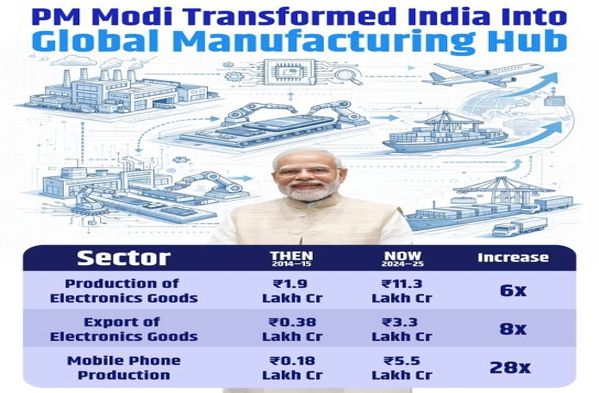
Electronics| Perhaps The Most Visible Transformation: Few sectors demonstrate the changing character of Indian manufacturing as clearly as electronics. In 2014-15, electronics production was valued at around Rs 1.9 lakh crore. By 2025-26, government data put electronics production at approximately Rs 13.11 lakh crore—nearly seven times the earlier level. Mobile-phone production increased from around Rs 18,900 crore to approximately Rs 6.3 lakh crore during the same period. India is now the world’s second-largest mobile-phone manufacturer by volume, according to the government’s latest Make in India assessment. The transformation is also reflected in export figures. Ministry of Electronics and Information Technology data show that electronics production rose from Rs 6.41 lakh crore in 2021-22 to Rs 11.33 lakh crore in 2024-25. Electronics exports increased from Rs 1.17 lakh crore to Rs 3.27 lakh crore over the same period, registering a compound annual growth rate of about 40.9 per cent. More importantly, the sector is gradually moving beyond simple assembly. Government data on the PLI programme indicate that domestic manufacturing has expanded into printed circuit board assemblies, batteries, camera and display modules, enclosures and other sub-assemblies. The direction of this change is significant because the long-term value of manufacturing depends on the depth of the domestic supply chain, not simply on the final assembly of imported components.
The challenge ahead is therefore to deepen localisation further, bringing more components, design capabilities, semiconductor-related activities and high-value technologies into India’s production ecosystem.
Automobiles Show The Depth Of An Established Industrial Base: The automobile industry provides another important window into India’s manufacturing trajectory. India already possessed a substantial automotive industry before Make in India was launched. The significance of the past 12 years, therefore, is less about creating the sector from scratch and more about expanding its scale, technological capabilities, supply chains and export potential. According to the Ministry of Heavy Industries’ annual report, vehicle production in India increased from around two million units in 1991-92 to approximately 31 million units in 2024-25. The Indian automotive industry’s turnover is estimated at around $240 billion, or roughly Rs 20 lakh crore. The industry has also become an important destination for foreign investment and a major source of components and engineering capabilities. The next phase is increasingly linked to electric mobility, batteries, advanced chemistry cells and cleaner transportation technologies. These areas have been included within the broader manufacturing incentive framework, indicating that Make in India is being used not only to expand traditional manufacturing but also to position Indian industry for emerging technologies. That transition is particularly important because global manufacturing is being reshaped by electrification, automation, artificial intelligence and supply-chain diversification.
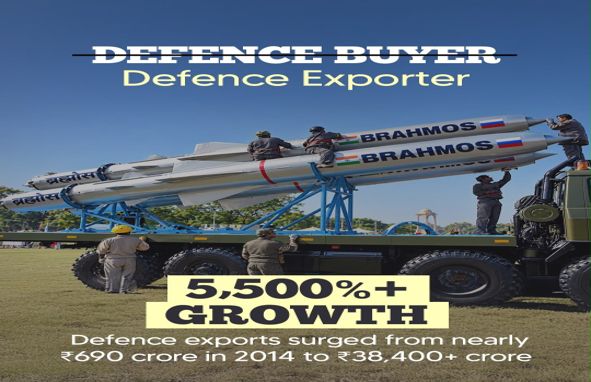
Defence Manufacturing|From Procurement To Production And Exports : Defence is another area where the domestic manufacturing base has expanded sharply. India’s defence production reached a record Rs 1.78 lakh crore in 2025-26, according to government data. Defence exports increased from Rs 686 crore in 2013-14 to Rs 38,424 crore in 2025-26. Government figures state that Indian defence products are now being exported to more than 80 countries. The significance of this change extends beyond the export number. A domestic defence manufacturing ecosystem can create demand for engineering, electronics, materials, software, precision manufacturing and research. The government’s indigenization programmes have also sought to expand the role of domestic firms, startups and academic institutions. Since 2022-23, 25 per cent of the defence research and development budget has been opened to industry, startups and academia, according to the Ministry of Defence data cited by the government. This reflects a broader movement from a procurement-centred model towards a more integrated defence industrial ecosystem.
Investment As A Critical Pillar: The second part of the Prime Minister’s September 25 message—“more investment in India”—is equally important. India received cumulative FDI inflows of approximately $843 billion between financial years 2014-15 and 2025-26, according to government data. The figure represents a substantial increase over the preceding 12-year period. FDI inflows in 2025-26 were reported at a record $94.53 billion. Manufacturing has been an important component of this investment story. Government data put manufacturing FDI equity inflows between April 2014 and March 2025 at $184.15 billion. Total FDI inflows during 2014-25 were reported at $748.78 billion. The significance of FDI for Make in India is not limited to the capital it brings. Foreign investment can bring technology, managerial practices, supplier networks and access to international markets. When foreign companies manufacture in India and source increasingly from Indian suppliers, the potential impact extends beyond the individual factory.The policy challenge is to ensure that investment creates deeper domestic value addition, technology transfer, employment and local supply chains.
Exports Provide The Global Test: The third pillar highlighted by the Prime Minister is exports.India’s total merchandise and services exports were estimated at $860.09 billion in 2025-26, compared with $825.26 billion in 2024-25, an increase of about 4.22 per cent. Manufacturing exports are particularly important to the Make in India proposition because the ultimate test of an industrial strategy is whether products made domestically can compete in global markets on quality, price, reliability and delivery. Electronics and defence offer two examples of changing export profiles, while pharmaceuticals, automobiles, engineering goods, textiles and chemicals remain important parts of India’s export basket. The emerging pattern is therefore not a single-sector transformation but a gradual diversification of India’s manufacturing and export base.
“Since 2022-23, 25 per cent of the defence research and development budget has been opened to industry, startups and academia, according to the Ministry of Defence data cited by the government.….”
The Green Manufacturing And The Next Industrial Frontier: The next phase of Make in India is also being shaped by the global energy transition. Solar manufacturing has expanded considerably, with India reaching 100 GW of solar photovoltaic module manufacturing capacity under the Approved List of Models and Manufacturers framework in 2025, according to the Ministry of New and Renewable Energy. Advanced batteries, electric vehicles, renewable-energy equipment and green technologies are increasingly becoming part of the industrial policy conversation. This could become an important dimension of India’s manufacturing strategy because global investment decisions are increasingly influenced by supply-chain resilience as well as environmental considerations. India’s opportunity lies in combining its large domestic market with manufacturing capacity that can serve international demand for cleaner technologies.
Beyond Factories| Infra, Logistics: Manufacturing cannot expand sustainably without infrastructure. Over the past decade, the government’s industrial strategy has therefore been accompanied by initiatives such as PM GatiShakti, the National Logistics Policy, industrial corridors, industrial parks and the National Single Window System. The objective is to reduce the time and cost involved in moving goods and establishing industrial units. This is an important but less visible aspect of the Make in India story. A modern manufacturing economy depends on the efficiency of the entire chain—from raw material and component suppliers to factories, warehouses, ports, airports, roads and final markets.The growing emphasis on integrated infrastructure planning reflects an understanding that competitiveness is determined by the entire production ecosystem.
The MSME Dimension: Large factories often receive the most attention, but India’s manufacturing ecosystem is heavily dependent on micro, small and medium enterprises. MSMEs supply components, provide specialised services and form the backbone of several industrial clusters. Their integration into larger domestic and global value chains is therefore critical. The long-term impact of Make in India will depend partly on whether smaller enterprises can adopt modern technology, access affordable finance, improve quality standards and become reliable suppliers to large Indian and multinational companies. The spread of digital systems, formalisation and new procurement mechanisms has created additional opportunities, but financing, technology adoption and scale remain important areas requiring continued attention.
The Unfinished Agenda: The 12-year journey also makes clear that manufacturing transformation is a long-term project rather than a completed destination. India’s manufacturing sector still needs deeper domestic supply chains, greater research and development, stronger technology capabilities and higher productivity. The country also needs to increase its participation in sophisticated global value chains where design, intellectual property and advanced components account for a larger share of value. Employment is another important dimension. Higher manufacturing output does not automatically translate into proportionately higher employment. Automation and modern production methods can raise productivity while limiting the number of workers required for individual production lines. The broader objective, therefore, is to create an ecosystem in which manufacturing expansion generates jobs not only inside factories but also across logistics, services, supplier networks, maintenance, design and technology. Skill development will consequently remain central to the next phase.
Kashmir Horizon View: The most significant feature of the Make in India journey may ultimately be the changing definition of what it means to manufacture in India. In its initial phase, the emphasis was strongly associated with attracting companies and encouraging production. Over time, the agenda has widened to include domestic components, strategic technologies, research and development, startups, infrastructure, exports, supply-chain resilience and integration with global markets. The Government’s latest assessment describes this transition as a movement from simply producing more goods towards building the skills, technology and capacity required to create greater value domestically and compete internationally. The numbers provide evidence of substantial expansion in several areas: electronics production has multiplied, defence exports have risen sharply, pharmaceutical and medical-device investments have grown, FDI has expanded and PLI-supported sectors have recorded significant investment, production and employment. At the same time, these figures also point towards the scale of the next challenge. The question for the coming decade is increasingly not whether India can manufacture, but how much value it can create through manufacturing—and how deeply Indian firms can participate in global technology and supply chains. Twelve years after its launch, Make in India has therefore moved from being principally an investment invitation to becoming part of a broader industrial strategy. The journey from assembling products to designing, developing and exporting them at scale will determine the next chapter. For India, the opportunity is substantial: a large domestic market, a growing industrial base, expanding infrastructure, a sizeable workforce and an increasingly diversified manufacturing ecosystem. The first twelve years have built much of the foundation. The next phase will be about depth—more domestic value addition, more technology, stronger supply chains, greater productivity and a larger presence in global markets.That is ultimately where the longer-term significance of “Make in India” will be measured.
(“Team Kashmir Horizon” is committed to continuous improvement and invites feedback and suggestions from readers and its followers on social media sites. Reader insights are considered vital for enhancing content quality and empowering the community. The team encourages open communication and values the thoughts and ideas of its audience, believing that such input will enable them to serve the public more effectively. The initiative aims to ensure that readers have the best possible experience with “Kashmir Horizon”. Interested individuals can reach out to us via email at [email protected].)