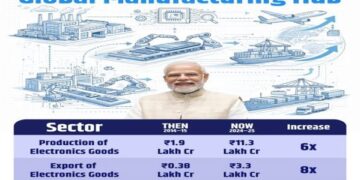
“PM Modi underlined the rapid expansion of India’s semiconductor ecosystem and said it was creating new opportunities for innovation, investment and economic growth. He also emphasised the growing confidence of the international community in India’s economy and its manufacturing capabilities…”
Mohammad Irfan
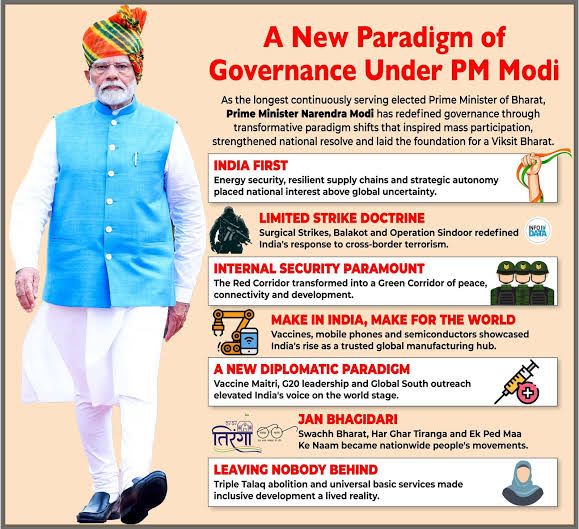 India’s semiconductor The completion of 25 years in government by Prime Minister Narendra Modi marks a significant milestone in India’s contemporary political and administrative history. Beginning his tenure as Gujarat Chief Minister on October 7, 2001, and assuming office as Prime Minister in May 2014, Modi has spent a quarter-century at the head of a government, carrying a political and administrative approach from the state level to the national stage. On October 6, 2026, the Union Cabinet passed a resolution congratulating him on completing 25 years of continuous leadership as head of government. The resolution outlined ten defining features of his tenure, spanning welfare delivery, social empowerment, economic reforms, infrastructure, technological innovation, national security, diplomacy and cultural heritage. The Cabinet resolution presents these areas as interconnected elements of a broader vision of national development. Beyond the symbolism of the anniversary, the milestone offers an opportunity to examine how the priorities associated with Modi’s leadership have influenced governance and public service delivery. The central theme is the movement from announcing welfare programmes and development projects towards building systems intended to deliver benefits directly, monitor implementation and expand access across a country of continental scale. The philosophy frequently associated with this approach is Jan Seva Se Desh Seva—service to the people as service to the nation. Its larger objective is expressed through the ambition of Viksit Bharat 2047, a vision of a developed India by the centenary of Independence.
From Gujarat’s Administrative Experiments To National Governance: Modi’s tenure in Gujarat provided an early setting for several administrative initiatives that subsequently influenced the national governance framework. The Cabinet resolution highlights the SWAGAT grievance-redressal system and Jyotigram Yojana as examples of this evolution. SWAGAT, designed to bring citizens’ grievances directly to the attention of the administration, received the United Nations Public Service Award in 2010. Its underlying principle was that public complaints should not remain trapped in layers of bureaucracy but should be reviewed, tracked and addressed through a structured mechanism. At the national level, the PRAGATI platform extended a related approach by enabling the Prime Minister to review important projects, examine implementation delays and bring officials from different levels of government into the same monitoring process. The emphasis on regular review and accountability sought to address a longstanding challenge in Indian administration: the gap between policy approval and delivery on the ground. Jyotigram Yojana, which reorganised electricity supply through separate feeders for agricultural and other rural consumers, represented another effort to address a practical development problem through infrastructure and administrative planning. The significance of these initiatives lies less in any claim that a single state model can be transferred unchanged to an entire country and more in the effort to adapt administrative practices to a larger scale. India’s diversity requires policies to respond to regional conditions, but systems for grievance redressal, monitoring and coordination can provide common institutional foundations. The Gujarat experience therefore became part of the narrative of Modi’s national leadership: identify an administrative problem, establish a mechanism to address it, monitor its performance and extend the approach where it proves useful.
Direct Benefit Transfer| Changing The Architecture Of Welfare: One of the most consequential changes associated with the period since 2014 has been the expansion of Direct Benefit Transfer (DBT), which seeks to transfer government assistance directly into beneficiaries’ bank accounts. The idea of DBT predates Modi’s prime ministership, having been launched in 2013. Its subsequent expansion, however, was closely linked to the growth of Jan Dhan bank accounts, Aadhaar-based identification and mobile connectivity. Together, these systems strengthened the infrastructure through which government benefits could reach individuals. The scale of the programme illustrates the transformation. According to the official DBT Bharat dashboard, cumulative transfers had crossed ₹53 lakh crore by October 2026, covering 320 schemes administered by 56 ministries. The portal also reports estimated gains of more than ₹5.14 lakh crore from measures associated with reducing duplication and leakages. These are official estimates rather than an independent audit of every programme. DBT Bharat dashboard. The importance of DBT becomes clearer when viewed against the longstanding problem of welfare delivery. In 1985, former Prime Minister Rajiv Gandhi famously observed that only 15 paise of every rupee intended for the poor reached the intended beneficiary. The remark came to symbolise the weaknesses of a system in which multiple administrative layers could separate public expenditure from its intended recipient. DBT seeks to reduce that distance. Instead of relying entirely on physical distribution, paper-based processes and intermediaries, the government can transfer money directly to a verified account. This approach can improve traceability, reduce certain forms of duplication and allow beneficiaries to receive payments without travelling repeatedly to government offices. Its significance extends across different forms of assistance, including pensions, scholarships, agricultural support and other welfare entitlements. For a farmer awaiting financial assistance, a student receiving a scholarship or an eligible household receiving a benefit, the timing and reliability of a payment can affect everyday decisions. The system is not without implementation challenges. Failed transactions, inactive accounts, authentication difficulties and errors in beneficiary records can prevent eligible people from receiving assistance on time. Digital delivery must therefore be accompanied by accessible grievance-redressal mechanisms, functioning banking services and safeguards against exclusion. Nevertheless, DBT represents an important administrative shift: welfare is increasingly being designed around identifiable beneficiaries and traceable transactions. Its larger contribution lies in creating a delivery infrastructure that can support multiple programmes rather than requiring each scheme to build an entirely separate payment mechanism.
Financial Inclusion And Dignity For Households: The expansion of financial inclusion has reinforced this change. The Pradhan Mantri Jan Dhan Yojana brought millions of people into the formal banking system, particularly households that previously had limited access to bank accounts.
Women, Farmers And Communities At The Centre Of Development : The Cabinet resolution places particular emphasis on social empowerment, recognising women, young people, farmers and vulnerable communities as important participants in India’s development. The Lakhpati Didi initiative seeks to support women associated with self-help groups in developing livelihoods that generate annual household incomes of at least ₹1 lakh. The government has highlighted the expansion of such initiatives as part of its effort to strengthen women’s economic participation. The significance of this approach lies in moving beyond welfare recipients towards income-generating participation. Access to credit, training, markets and enterprise opportunities can enable women to strengthen their economic independence and contribute more directly to household decision-making. The Nari Shakti VandanAdhiniyam, which provides for reservation for women in the Lok Sabha and state legislative assemblies, is another major policy development. Its implementation remains linked to the constitutional process specified in the legislation, including the relevant census and delimitation provisions. Its long-term significance will depend on how effectively the commitment translates into greater representation. For farmers, the PM-KISAN scheme has provided direct financial assistance to eligible landholding farmer families. The Cabinet resolution notes that cumulative transfers under the scheme have exceeded ₹4 lakh crore. While such support can help meet some agricultural expenses, farmers’ long-term prosperity also depends on remunerative prices, irrigation, storage, market access, climate resilience and affordable inputs. Similarly, the PM-JANMAN initiative has focused on particularly vulnerable tribal communities, seeking to improve access to housing, roads, healthcare, education, drinking water and other essential services. These initiatives reflect a development approach that combines financial support with efforts to address gaps in access. Their lasting value will depend on whether they expand opportunities, improve incomes and help communities become more resilient.
“The vision of Viksit Bharat 2047 provides a long-term framework within which infrastructure, education, healthcare, manufacturing, scientific research and social empowerment can be pursued together……..”
Artificial Reform, Infra And The Pursuit Of Self-Reliance: Another defining feature of Modi’s tenure has been the emphasis on economic reform and large-scale infrastructure development. The introduction of the Goods and Services Tax in 2017 sought to bring multiple indirect taxes into a common framework. The reform aimed to reduce the fragmentation of India’s internal market and improve the movement of goods across state borders. Its implementation required extensive coordination between the Centre and states, while businesses, particularly smaller enterprises, had to adapt to new compliance systems. The Government’s broader reform agenda has also included changes to insolvency procedures, digital payments, labour regulation and criminal laws. The replacement of colonial-era criminal laws in 2023, which came into force in July 2024, was presented as an effort to modernise India’s criminal justice framework. The results of reform must ultimately be judged by whether they improve efficiency, reduce unnecessary compliance burdens, support investment and strengthen public institutions. In a large and diverse economy, reforms frequently require adjustments after implementation, making consultation and administrative capacity essential to their success. Infrastructure investment has been another prominent feature of the period. The Cabinet resolution points to an increase in public capital expenditure from approximately ₹2 lakh crore to more than ₹12 lakh crore. Higher public investment in roads, railways and other infrastructure is intended to improve connectivity, reduce logistics costs and support economic activity.
Digital India And The Growing Role Of Technology: Technology has become a central instrument of governance during Modi’s tenure. The combination of digital identity, bank accounts and mobile connectivity has helped expand the delivery of public services, while the Unified Payments Interface has changed how individuals and businesses make everyday payments. Digital payments have reduced dependence on cash in many transactions and enabled small merchants, service providers and consumers to transfer money quickly. Their expansion has also demonstrated how a shared digital infrastructure can support a wide range of private and public services.
Heritage, Environmental Responsibility And The 2047 Vision: The final theme of the Cabinet resolution brings together cultural heritage, environmental responsibility and the long-term ambition of a developed India. The promotion of yoga internationally, the development of pilgrimage infrastructure and the restoration or redevelopment of important religious and cultural sites have been presented as part of a wider effort to strengthen India’s cultural identity. The consecration of Ram Lalla at Ayodhya in January 2024 became a major national event, while projects such as the redevelopment of Kashi Vishwanath Dham sought to improve access to a significant pilgrimage centre. Alongside cultural initiatives, the government has highlighted renewable energy, climate action and international environmental partnerships. India’s expansion of solar and wind energy, its participation in the International Solar Alliance and its commitments under international climate agreements reflect the growing importance of energy transition. The challenge is to balance economic growth with environmental protection. For a country facing rising energy demand, extreme weather risks and pressure on natural resources, development must increasingly account for resilience, efficient resource use and the needs of future generations. The vision of Viksit Bharat 2047 provides a long-term framework within which infrastructure, education, healthcare, manufacturing, scientific research and social empowerment can be pursued together. Reaching that objective will require sustained productivity growth, quality employment, effective institutions, investment in human capital and equitable access to opportunities.
Kashmir Horizon View : The Union Cabinet’s resolution marks 25 years since Modi began leading a government in Gujarat and recognises the continuation of that leadership at the national level since 2014. The journey has been characterised by an emphasis on direct welfare delivery, administrative monitoring, infrastructure expansion, digital systems, manufacturing, national security and international engagement. The spread of these priorities across different sectors provides a framework for understanding the governance model associated with his tenure. The most important test of this model lies in its outcomes. Financial transfers must translate into meaningful household security; infrastructure must generate productive opportunities; manufacturing must create sustainable employment; and technological advances must remain accessible and secure. Social empowerment must be reflected in greater participation and opportunity, while national ambition must be matched by improvements in the everyday lives of citizens. The next phase will require the government to build on existing systems, address implementation gaps and respond to changing economic, environmental and technological conditions. India’s development goals are too extensive to be achieved through any single programme or institution. They depend on cooperation among the Centre, states, local governments, businesses, universities, civil society and citizens. As Modi completes 25 years at the head of government, the anniversary therefore represents both a record of initiatives undertaken and a measure of the responsibilities that lie ahead. The ambition of Viksit Bharat 2047 will ultimately be judged by whether India’s growth becomes more inclusive, its institutions more effective, its economy more productive and the opportunities available to its people more secure. The enduring significance of the milestone will rest not simply on the length of leadership, but on the lasting improvements that this period of governance delivers to the country and its citizens.
(“Team Kashmir Horizon” is committed to continuous improvement and invites feedback and suggestions from readers and its followers on social media sites. Reader insights are considered vital for enhancing content quality and empowering the community. The team encourages open communication and values the thoughts and ideas of its audience, believing that such input will enable them to serve the public more effectively. The initiative aims to ensure that readers have the best possible experience with “Kashmir Horizon”. Interested individuals can reach out to us via email at [email protected].)