“Prime Minister said the operation demonstrated a new approach and linked it with the Balakot airstrike and Operation Sindoor, arguing that India had repeatedly communicated that terrorist attacks would invite a response……..”
Mohammad Irfan
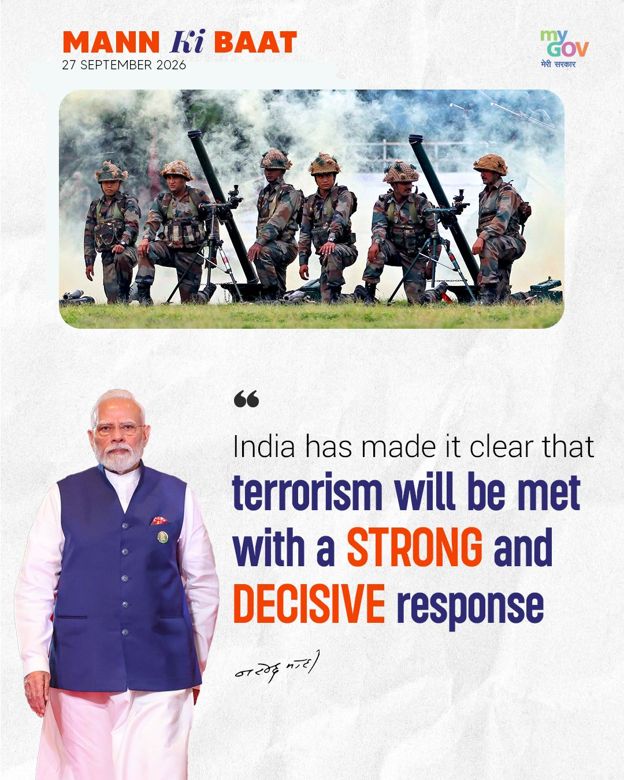 From the surgical strikes of 2016 to the Balakot airstrike in 2019 and Operation Sindoor in 2025, India’s response to terrorism has undergone a visible transformation—from a predominantly reactive security posture to an approach that places greater emphasis on intelligence, precision, preparedness and the ability to impose costs on terrorist infrastructure. Prime Minister Narendra Modi, while addressing the latest episode of Mann Ki Baat, marked 10 years of the 2016 surgical strikes and placed them within this broader evolution of India’s counter-terrorism policy. He recalled the September 28-29, 2016 operation in which the Indian Army crossed the Line of Control to strike terrorist launch pads, describing it as a significant moment in India’s response to terrorism. The Prime Minister said the operation demonstrated a new approach and linked it with the Balakot airstrike and Operation Sindoor, arguing that India had repeatedly communicated that terrorist attacks would invite a response. The significance of the message lies not only in the military operations themselves but in how India’s security establishment has sought to change the strategic calculations surrounding cross-border terrorism. The evolution has involved changes in the choice of targets, the use of intelligence and technology, jointness among the armed forces and the effort to distinguish terrorist infrastructure from conventional military targets. Operation Sindoor, launched in May 2025 following the Pahalgam terrorist attack, became the latest major example of this approach.
From 2016 To 2025| A decade Of Changing Doctrine: The 2016 surgical strikes came after years in which major terrorist attacks had repeatedly triggered demands for stronger action against those responsible. Prime Minister Modi recalled the 2008 Delhi serial blasts and the November 26, 2008 Mumbai attacks while describing the security environment India had faced in earlier years. The 2016 operation marked a significant departure in public signalling. According to the government, Indian forces targeted terrorist infrastructure across the LoC, demonstrating that the geographical boundary would not necessarily prevent India from acting against identified terrorist launch pads. Three years later, the Balakot airstrike extended this approach. Following the February 2019 Pulwama terrorist attack, India conducted a precision airstrike on February 26 against a Jaish-e-Mohammed training facility at Balakot in Pakistan, according to the government. The operation was presented as an expansion of India’s options in responding to terrorism, with the target located beyond the LoC. Operation Sindoor in 2025 represented another stage in that trajectory. Following the April 22, 2025 Pahalgam terrorist attack, India launched Operation Sindoor on May 7, targeting terrorist infrastructure in Pakistan and Pakistan-occupied Jammu and Kashmir. The Defence Ministry said nine sites were targeted and described the action as focused, measured and non-escalatory, adding that Pakistani military facilities were not targeted in the initial strikes. The Government subsequently described Operation Sindoor as a coordinated, intelligence-led campaign involving multiple domains and emphasised the use of precision and restraint. Taken together, these episodes illustrate an expanding set of military options—from ground-based cross-LoC action to airpower and increasingly integrated, technology-enabled operations.
Operation Sindoor And The Pahalgam Trigger: The immediate backdrop to Operation Sindoor was the Pahalgam terrorist attack of April 2025.The attack killed 26 people, including a Nepali citizen, according to subsequent government accounts. The attack had a particularly significant impact because it targeted civilians in a prominent tourist destination in Jammu and Kashmir. The Indian response came after a period of intelligence assessment and political deliberation. On May 7, the Defence Ministry announced that the armed forces had launched Operation Sindoor against terrorist infrastructure in Pakistan and Pakistan-occupied Jammu and Kashmir. The initial Government statement said nine sites had been targeted. Importantly, it also described the action as “focused, measured and non-escalatory” and stated that no Pakistani military facilities had been targeted in that phase. This aspect of the operation is important to understanding the emerging doctrine. The stated objective was to hit terrorist infrastructure while attempting to control the risk of a wider military escalation. In other words, the response was framed around the source of the terrorist threat rather than a broad conventional military confrontation.
Precision As The New Language Of Counter-Terrorism: One of the clearest developments between 2016 and 2025 has been the increasing importance of precision. Modern counter-terrorism operations depend not only on the ability to strike a target but also on the ability to identify it accurately, assess its significance and select the appropriate means of attack. Government accounts of Operation Sindoor repeatedly highlighted intelligence, target identification and precision. The Ministry of Information and Broadcasting described the operation as based on multi-agency intelligence and said nine major camps were identified and targeted. The Government has also highlighted the growing role of indigenous technologies, including drones, layered air defence and electronic warfare capabilities, in the operation. This suggests that the future of counter-terrorism will not be determined solely by traditional military strength. It will increasingly depend on the quality of intelligence, surveillance, communications, data analysis, unmanned systems, air defence and the ability to integrate different capabilities quickly.
Jointness Changes The Character Of Operations: Another important feature associated with Operation Sindoor was the emphasis on joint operations.The government described the campaign as demonstrating greater coordination among the armed forces and involving multiple operational domains.
Modern warfare increasingly blurs the boundaries between land, air, maritime, cyber, space and information domains. A terrorist network may use encrypted communications, social media, financial networks and cross-border infrastructure while operating through physical camps and launch facilities.Countering such a network therefore requires more than conventional firepower. It requires intelligence agencies, armed forces, technology platforms and diplomatic institutions to work in coordination.The evolution from the 2016 strikes to Operation Sindoor therefore also reflects a broader institutional shift towards integration.
A Calibrated Response Rather Than An Open-Ended Conflict: A central feature of the official description of Operation Sindoor has been calibration. The initial Defence Ministry statement explicitly characterised the action as measured and non-escalatory. That distinction matters because military action against terrorist infrastructure across an international boundary or in Pakistan-occupied Jammu and Kashmir carries the risk of escalation. The challenge for policymakers is consequently twofold: demonstrate the capacity and willingness to respond to terrorism while preventing an individual counter-terrorism operation from automatically developing into a broader conventional conflict. The Government’s framing of Operation Sindooremphasised this balance. The objective was presented as targeting terrorist infrastructure while maintaining limits on the scope of the operation. This represents one of the more significant strategic questions for India’s future counter-terrorism policy: how to retain credible deterrence while keeping escalation under control.
“Drones have become relatively inexpensive and widely accessible. Artificial intelligence can assist in analysing large volumes of information. Satellite imagery can improve situational awareness. Electronic warfare can disrupt communications and sensors..….”
The Green Manufacturing And The Next Industrial Frontier: The next phase of Make in India is also being shaped by the global energy transition. Solar manufacturing has expanded considerably, with India reaching 100 GW of solar photovoltaic module manufacturing capacity under the Approved List of Models and Manufacturers framework in 2025, according to the Ministry of New and Renewable Energy. Advanced batteries, electric vehicles, renewable-energy equipment and green technologies are increasingly becoming part of the industrial policy conversation. This could become an important dimension of India’s manufacturing strategy because global investment decisions are increasingly influenced by supply-chain resilience as well as environmental considerations. India’s opportunity lies in combining its large domestic market with manufacturing capacity that can serve international demand for cleaner technologies. Beyond factories: infrastructure and logistics Manufacturing cannot expand sustainably without infrastructure. Over the past decade, the government’s industrial strategy has therefore been accompanied by initiatives such as PM GatiShakti, the National Logistics Policy, industrial corridors, industrial parks and the National Single Window System. The objective is to reduce the time and cost involved in moving goods and establishing industrial units. This is an important but less visible aspect of the Make in India story. A modern manufacturing economy depends on the efficiency of the entire chain—from raw material and component suppliers to factories, warehouses, ports, airports, roads and final markets. The growing emphasis on integrated infrastructure planning reflects an understanding that competitiveness is determined by the entire production ecosystem.
The MSME Dimension: Large factories often receive the most attention, but India’s manufacturing ecosystem is heavily dependent on micro, small and medium enterprises. MSMEs supply components, provide specialised services and form the backbone of several industrial clusters. Their integration into larger domestic and global value chains is therefore critical. The long-term impact of Make in India will depend partly on whether smaller enterprises can adopt modern technology, access affordable finance, improve quality standards and become reliable suppliers to large Indian and multinational companies. The spread of digital systems, formalisation and new procurement mechanisms has created additional opportunities, but financing, technology adoption and scale remain important areas requiring continued attention.
The Unfinished Agenda: The 12-year journey also makes clear that manufacturing transformation is a long-term project rather than a completed destination. India’s manufacturing sector still needs deeper domestic supply chains, greater research and development, stronger technology capabilities and higher productivity. The country also needs to increase its participation in sophisticated global value chains where design, intellectual property and advanced components account for a larger share of value. Employment is another important dimension. Higher manufacturing output does not automatically translate into proportionately higher employment. Automation and modern production methods can raise productivity while limiting the number of workers required for individual production lines. The broader objective, therefore, is to create an ecosystem in which manufacturing expansion generates jobs not only inside factories but also across logistics, services, supplier networks, maintenance, design and technology. Skill development will consequently remain central to the next phase.
Kashmir Horizon View: The most significant feature of the Make in India journey may ultimately be the changing definition of what it means to manufacture in India. In its initial phase, the emphasis was strongly associated with attracting companies and encouraging production. Over time, the agenda has widened to include domestic components, strategic technologies, research and development, startups, infrastructure, exports, supply-chain resilience and integration with global markets. The Government’s latest assessment describes this transition as a movement from simply producing more goods towards building the skills, technology and capacity required to create greater value domestically and compete internationally. The numbers provide evidence of substantial expansion in several areas: electronics production has multiplied, defence exports have risen sharply, pharmaceutical and medical-device investments have grown, FDI has expanded and PLI-supported sectors have recorded significant investment, production and employment. At the same time, these figures also point towards the scale of the next challenge. The question for the coming decade is increasingly not whether India can manufacture, but how much value it can create through manufacturing—and how deeply Indian firms can participate in global technology and supply chains. Twelve years after its launch, Make in India has therefore moved from being principally an investment invitation to becoming part of a broader industrial strategy. The journey from assembling products to designing, developing and exporting them at scale will determine the next chapter. For India, the opportunity is substantial: a large domestic market, a growing industrial base, expanding infrastructure, a sizeable workforce and an increasingly diversified manufacturing ecosystem. The first twelve years have built much of the foundation. The next phase will be about depth—more domestic value addition, more technology, stronger supply chains, greater productivity and a larger presence in global markets. That is ultimately where the longer-term significance of “Make in India” will be measured.
(“Team Kashmir Horizon” is committed to continuous improvement and invites feedback and suggestions from readers and its followers on social media sites. Reader insights are considered vital for enhancing content quality and empowering the community. The team encourages open communication and values the thoughts and ideas of its audience, believing that such input will enable them to serve the public more effectively. The initiative aims to ensure that readers have the best possible experience with “Kashmir Horizon”. Interested individuals can reach out to us via email at [email protected].)