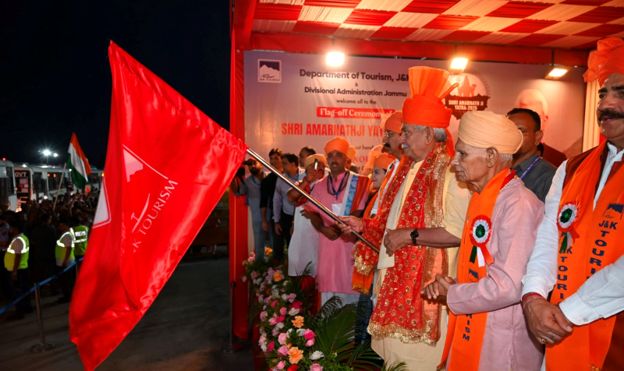
“Amarnath Yatra is a sacred path where devotion meets spiritual awakening. I wish all devotees a safe, comfortable, blissful and spiritually fulfilling journey,” LG Sinha

This week annual Shri Amarnath Ji Yatra-2026 commenced on a spiritually uplifting note as more than 12,000 devotees offered prayers at the holy cave shrine on the opening day of the 57-day pilgrimage, while Lieutenant Governor Manoj Sinha flagged off the first batch of pilgrims from the Bhagwati Nagar Base Camp in Jammu amid elaborate security and administrative arrangements. The annual pilgrimage to the sacred cave shrine of Baba Barfani, situated at an altitude of 3,880 metres in the south Kashmir Himalayas, began with chants of “Har Har Mahadev” and “Bum BumBhole” echoing through the mountains as thousands of devotees embarked on their spiritual journey. The pilgrimage, considered one of the holiest annual religious events in the country, witnessed overwhelming enthusiasm from devotees arriving from across India despite intermittent rainfall and challenging weather conditions.
LG Flags Off First Batch From Jammu: Lieutenant Governor Manoj Sinha, who also serves as Chairman of the Shri Amarnath Ji Shrine Board (SASB), formally flagged off the first batch of pilgrims from the Bhagwati Nagar Yatri Niwas in Jammu. Extending his greetings to devotees, the Lieutenant Governor described the pilgrimage as a sacred journey that transcends physical travel and leads devotees towards spiritual awakening. ” Amarnath Yatra is a sacred path where devotion meets spiritual awakening. I wish all devotees a safe, comfortable, blissful and spiritually fulfilling journey. May this holy pilgrimage bring immense joy and divine peace to all,” the Lieutenant Governor said. He said the annual pilgrimage reflects India’s rich spiritual traditions, cultural heritage and the enduring spirit of unity among people from diverse regions, languages and backgrounds. The Lieutenant Governor also appreciated the courage and unwavering faith of devotees undertaking the challenging Himalayan pilgrimage and wished them a safe and memorable journey.
More Than 4,800 Pilgrims Leave In First Convoy: The first batch comprised more than 4,800 pilgrims, including men, women, elderly devotees, first-time yatris and saints, who left Bhagwati Nagar in a convoy of 259 light and heavy vehicles under tight security. The convoy moved towards the twin base camps of Baltal in Ganderbal district and Nunwan-Pahalgam in Anantnag district, escorted by security personnel and emergency response teams. Officials said the movement of yatri convoys was closely monitored through an integrated control system to ensure smooth traffic management and prompt emergency response.
Over 12,000 Devotees Offer Darshan On Day One: The opening day of the pilgrimage witnessed a massive turnout at the holy cave shrine. Officials said more than 12,100 pilgrims paid obeisance at the naturally formed ice Shivling inside the sacred cave shrine on Friday, marking a successful beginning to this year’s Yatra. The devotees included around 9,350 men, 2,250 women, over 200 children, 70 sadhus, nine transgender pilgrims and more than 260 security personnel, reflecting the inclusive and nationwide participation in the pilgrimage. The impressive turnout on the very first day highlighted the deep religious significance of the Amarnath Yatra, which attracts lakhs of devotees every year from different parts of the country and abroad.
Pilgrimage Begins Simultaneously From Twin Routes: The pilgrimage commenced simultaneously from the traditional 48-kilometre Nunwan-Pahalgam route in Anantnag district and the shorter but steeper 14-kilometre Baltal route in Ganderbal district. Pilgrims started their journey before sunrise despite intermittent rainfall in several parts of Kashmir. The atmosphere at both base camps remained charged with religious fervour as devotees chanted hymns in praise of Lord Shiva while beginning their ascent towards the holy cave shrine. The first batches of yatris were formally flagged off from both the Nunwan Base Camp and the Baltal Base Camp by district authorities amid enthusiastic participation by pilgrims, officials and volunteers. While the Pahalgam route offers a gradual ascent through picturesque Himalayan landscapes via Chandanwari, Sheshnag and Panchtarni, the Baltal route provides a shorter but steeper trek preferred by many pilgrims seeking a quicker journey.
Extensive Security Arrangements Across Yatra Routes: Authorities have put in place one of the most comprehensive security arrangements ever for the smooth conduct of the pilgrimage. A multi-layer security grid has been established across Jammu and Kashmir, particularly along the pilgrimage routes, transit camps and vulnerable stretches. Thousands of personnel from the Jammu and Kashmir Police, Central Reserve Police Force (CRPF), Army and other Central Armed Police Forces have been deployed for round-the-clock security. Security agencies are also using advanced surveillance systems, drone monitoring, CCTV cameras, aerial reconnaissance and real-time intelligence inputs to maintain constant vigilance throughout the pilgrimage. Checkpoints, vehicle scanning systems, baggage screening facilities and quick reaction teams have been positioned at strategic locations to ensure the safety of pilgrims. Officials said all arrangements have been made keeping in view the large number of expected devotees and the challenging terrain through which the pilgrimage passes.
Strict Crowd Management Measures Implemented: Following safety assessments and expert recommendations, the administration has introduced strict crowd management measures for this year’s pilgrimage. Officials said no pilgrim will be permitted to undertake the Yatra before the date mentioned on their registration permit. The administration has urged devotees to strictly adhere to their allotted travel schedule to facilitate better crowd regulation and reduce congestion along the pilgrimage routes. Authorities said the daily limit on the number of pilgrims has been fixed in accordance with safety norms to ensure effective crowd management, minimise risks associated with difficult terrain and provide prompt emergency response whenever required. Pilgrims have also been advised to carefully follow weather advisories, avoid unnecessary halts in vulnerable areas and cooperate fully with security personnel and civil administration officials.
Comprehensive Administrative Arrangements: The Jammu and Kashmir Union Territory Administration, in coordination with the Shri Amarnath Ji Shrine Board, has made elaborate arrangements for the successful conduct of the pilgrimage. Comprehensive facilities have been established at Bhagwati Nagar, Nunwan, Baltal and various transit camps to provide accommodation, sanitation, drinking water, electricity, healthcare and communication facilities. Medical teams comprising doctors, paramedics and emergency healthcare workers have been deployed at strategic locations along both routes. Oxygen booths, emergency medical centres, ambulance services and helicopter evacuation facilities have also been kept on standby to deal with any medical emergencies during the pilgrimage. Disaster response teams, mountain rescue units and weather monitoring stations have also been activated to respond quickly to emergencies arising from changing weather conditions.
Registration Conducted Nationwide: Advance registration for Amarnath Yatra had been opened several weeks before the commencement of the pilgrimage through designated bank branches across the country and online platforms. Officials said the overwhelming majority of pilgrims completed their registration well in advance. Limited Tatkal registration facilities continue to remain available subject to availability and administrative guidelines. Authorities have advised devotees to undertake the pilgrimage only after completing the prescribed medical examination and carrying valid registration documents throughout their journey.
Spirit Of Service Defines The Yatra: As in previous years, thousands of volunteers and charitable organisations have established community kitchens (langars) along the pilgrimage routes, providing free meals, tea, refreshments, medical assistance and resting facilities to devotees. The hospitality extended by local residents and volunteers continues to be one of the defining features of Amarnath Yatra. The Lieutenant Governor appreciated the coordinated efforts of the Jammu and Kashmir Administration, Shri Amarnath Ji Shrine Board, Army, Jammu and Kashmir Police, Central Armed Police Forces, disaster response agencies, healthcare workers, volunteers and members of the local community for ensuring smooth arrangements.
“The administration has urged devotees to strictly adhere to their allotted travel schedule to facilitate better crowd regulation and reduce congestion along the pilgrimage routes..”
A Journey Of Faith, National Unity: The Amarnath Yatra is not merely a pilgrimage but a powerful symbol of India’s spiritual heritage, communal harmony and national integration. Every year, devotees from different faiths, regions and cultural backgrounds come together in pursuit of a common spiritual goal, reaffirming the timeless values of faith, sacrifice, perseverance and unity. As thousands of pilgrims continue their journey towards the sacred cave shrine over the coming weeks, the administration remains focused on ensuring that the pilgrimage is conducted safely, peacefully and efficiently. With more than 12,000 devotees already having darshan on the opening day and thousands more expected to arrive in the coming days, Shri Amarnath Ji Yatra-2026 has begun on a note of deep devotion, meticulous planning and collective resolve, reaffirming its place as one of India’s most significant and spiritually revered annual pilgrimages.
Kashmir Horizon View: As 57-day Amarnath Yatra-2026 progresses, authorities are expected to maintain a high level of coordination to ensure the pilgrimage remains safe, smooth and incident-free. With lakhs of devotees expected to visit the holy cave shrine in the coming weeks, continuous monitoring of weather conditions, road connectivity, pilgrim movement and healthcare services will remain crucial. Given the challenging Himalayan terrain and the possibility of sudden weather changes, officials are likely to review security and logistical arrangements on a daily basis to respond swiftly to emerging situations. The Government has appealed pilgrims to undertake the Yatra only on their allotted dates, carry valid registration and health certificates, and strictly follow advisories issued by the Shri Amarnath Ji Shrine Board and security agencies. Adherence to safety protocols, including weather warnings and movement restrictions, is expected to play a vital role in preventing overcrowding and ensuring the orderly conduct of the pilgrimage. Environmental conservation is another key focus area for this year’s Yatra. Authorities have appealed to pilgrims to avoid littering, minimise the use of single-use plastics and help preserve the fragile Himalayan ecosystem. Dedicated sanitation teams, waste management systems and awareness campaigns have been put in place to ensure that the pilgrimage is conducted in an environmentally responsible manner without compromising the ecological balance of the region. Healthcare infrastructure has also been significantly strengthened, with medical camps, oxygen facilities, ambulance services and emergency evacuation mechanisms positioned along both the Pahalgam and Baltal routes. Continuous deployment of doctors, paramedics, disaster response teams and rescue personnel is expected to provide timely assistance to pilgrims, particularly senior citizens and those facing health-related challenges during the trek. Security agencies, including the Jammu and Kashmir Police, Army, CRPF and other Central Armed Police Forces, will continue maintaining a multi-layered security grid throughout the Yatra. Advanced surveillance systems, aerial monitoring, intelligence-based operations and round-the-clock vigilance are aimed at ensuring a secure environment for devotees while allowing the pilgrimage to proceed without disruption. Beyond the administrative and security dimensions, Amarnath Yatra continues to embody India’s enduring spiritual traditions and cultural unity. Every year, the pilgrimage brings together devotees from diverse regions, languages and backgrounds, reflecting the country’s pluralistic ethos and shared faith. The participation of thousands of volunteers, local residents and charitable organisations further reinforces the spirit of service, compassion and communal harmony that has long been associated with the Yatra. The successful commencement of this year’s pilgrimage, marked by the flagging off of the first batch of yatris from Jammu and the darshan of more than 12,000 devotees on the opening day, reflects months of meticulous planning and coordinated efforts by the administration, Shri Amarnath Ji Shrine Board and various stakeholder agencies. As thousands more pilgrims make their way to the sacred cave shrine over the coming weeks, the focus will remain on ensuring that every devotee completes the journey safely while experiencing the profound spiritual significance of the pilgrimage. With robust infrastructure, enhanced security, improved medical facilities and active community participation, Shri Amarnath Ji Yatra-2026 is poised to strengthen not only the faith of millions but also the values of national integration, resilience and collective responsibility.
(“Team Kashmir Horizon” is committed to continuous improvement and invites feedback and suggestions from readers and its followers on social media sites. Reader insights are considered vital for enhancing content quality and empowering the community. The team encourages open communication and values the thoughts and ideas of its audience, believing that such input will enable them to serve the public more effectively. The initiative aims to ensure that readers have the best possible experience with “Kashmir Horizon”. Interested individuals can reach out to us via email at [email protected].)