
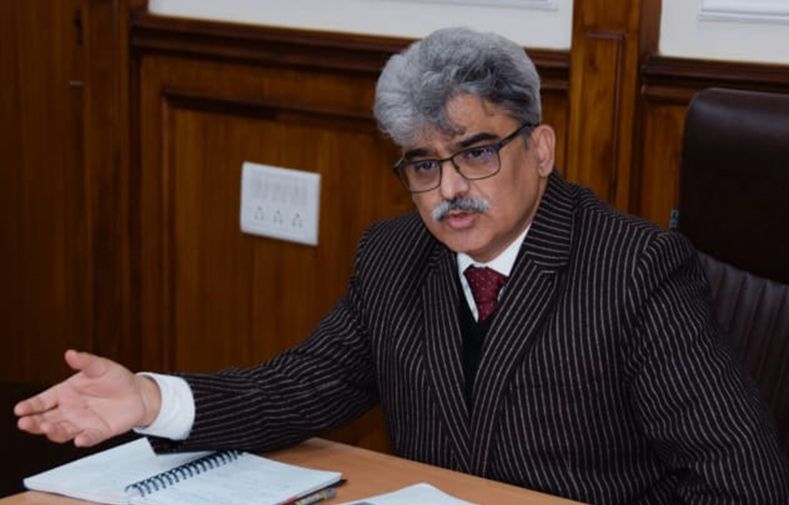
Srinagar: Chief Secretary, Atal Dulloo Monday chaired the Apex Committee Meeting of Mission YUVA and reviewed the progress achieved under the ambitious initiative aimed at fostering entrepreneurship, generating employment and establishing Jammu & Kashmir as a thriving hub of enterprises and sustainable livelihoods.
The meeting was attended by senior officers from different departments including ACS, Finance; Commissioner Secretary, School Education; Secretary, Labour & Employment; Secretary, RDD; Director, Employment; Executive Director, EDI representatives from J&K Bank and other financial institutions, district administrations and other stakeholders associated with implementation of Mission YUVA.
During the meeting Chief Secretary thoroughly reviewed Mission YUVA’s performance, focusing on its four foundational pillars: Culture, Capital, Capacity, and Connectivity. The assessment included district-wise achievements, institutional readiness, credit facilitation, and entrepreneurship development, highlighting the necessity for coordinated efforts among departments, financial institutions, and district administrations to transform Mission YUVA into a significant movement for youth empowerment and economic growth in the Union Territory. A key area of concern was the backlog in application processing. The Chief Secretary instructed district administrations, State Business Development Units (SBDUs), and banking institutions to expedite the clearance of pending applications and adhere strictly to established timelines for application verification, approvals, and loan sanctions. This emphasis on timely processing is crucial for maintaining the momentum of the mission. Progress in capacity-building was also reviewed, revealing that over 21,000 applicants have completed hybrid-mode entrepreneurship training, supported by more than 300 training centers and 200 trainers across the UT. Plans for collaboration with the Jammu and Kashmir Entrepreneurship Development Institute (JKEDI) aim to enhance entrepreneurship and management training for applicants. The Chief Secretary stressed the importance of outcome-based monitoring, directing Deputy Commissioners to improve metrics related to application conversion, training completion, market linkage, and enterprise sustainability. He reiterated that Mission YUVA should evolve beyond a financial assistance program to create a comprehensive ecosystem that fosters an entrepreneurial culture and long-term livelihood opportunities for the youth. The Secretary of Labour and Employment, Kumar Rajeev Ranjan, outlined Mission YUVA’s vision to create employment through nano enterprises, new MSMEs, and innovative business initiatives. The program aims to build an entrepreneurship ecosystem through targeted interventions in awareness generation, credit enablement, capacity building, market linkages, and business support. The meeting also reviewed the status of credit facilitation, noting that over 1.07 lakh applications had been received, with more than 57,000 approved by District Level Implementation Committees (DLICs). Banks have sanctioned loans in over 25,000 cases, amounting to more than ₹1,200 crore, with approximately ₹1,119 crore disbursed in over 21,000 cases. Mission YUVA has set an ambitious target of establishing 50,000 enterprises by 2026-27, including 44,000 nano enterprises and support for existing MSMEs. The Chief Secretary was informed about the success of the UdyamJagriti 4.0 campaign, which reached nearly 3.4 lakh citizens, and the plans for UdyamJagriti 5.0, focusing on mobilizing college students, SHG women, and trained youth to convert awareness into enterprise creation and credit linkage. Proposed interventions include hackathons, entrepreneurship competitions, and application facilitation camps. Significant progress has been made in institutional strengthening, with over 900 motivators and numerous SBDU personnel engaged to support aspiring entrepreneurs. On the connectivity front, advancements in onboarding local products on digital platforms have been achieved, enhancing market access for entrepreneurs. The meeting also addressed key policy interventions and operational reforms aimed at improving mentorship support and the efficiency of enterprise facilitation systems across districts.