In times of conflict and political upheaval, one of the most troubling phenomena is the invocation of religion to justify violence, war, and destruction. The claim that God sanctions bloodshed is not only morally questionable but also profoundly inconsistent with the teachings of the world’s major religious traditions. The recent condemnation by Pope Leo XIV—who firmly declared that “God cannot be enlisted in the service of darkness”—echoes a long-standing and deeply rooted ethical position shared across religions: that the sanctity of life stands above all forms of political or ideological ambition. This essay is a strong plea and genuine protest from the perspective of religious authority—grounded in scripture, theology, and moral philosophy—against the misuse of religion by war mongers. It seeks to demonstrate that religion, in its authentic form, never justifies bloodshed, and that those who manipulate sacred symbols for violent ends stand in contradiction to the very traditions they claim to represent.
The Sacredness Of Life |A Universal Religious Principle: At the heart of all major religions lies a profound reverence for life. In Islam, the Qur’an unequivocally declares: “Whoever kills a soul… it is as if he had slain all mankind; and whoever saves one—it is as if he had saved all mankind” (Qur’an 5:32). This verse establishes a universal ethic that transcends religious, ethnic, and political boundaries. Life is sacred not because of identity, but because it is a divine trust. Similarly, in Christianity, the teachings of Jesus Christ emphasize peace, forgiveness, and love even for one’s enemies. In the Gospel of Matthew (5:9), it is stated: “Blessed are the peacemakers, for they shall be called the children of God.” Moreover, when confronted with violence, Jesus rebukes it directly: “Put your sword back in its place… for all who take the sword will perish by the sword” (Matthew 26:52). In Judaism, the commandment “Thou shalt not kill” (Exodus 20:13) stands as a foundational moral injunction. The Talmud further elaborates that saving a single life is akin to saving an entire world. Hinduism, often misrepresented through selective readings of texts like the Bhagavad Gita, fundamentally upholds non-violence (ahimsa) as a supreme virtue. The Mahabharata states: “Non-violence is the highest duty.” In Buddhism, the First Precept explicitly prohibits taking life: “I undertake the precept to refrain from destroying living creatures.” Thus, across traditions, the sanctity of life is not merely a moral suggestion—it is a divine command.
Misuse Of Religion | A Historical, Contemporary Reality: Despite these clear teachings, history is replete with examples where religion has been manipulated to justify war. From the medieval Crusades to modern geopolitical conflicts, leaders have often cloaked political ambitions in religious rhetoric. This misuse is not a reflection of religion itself but of human ambition, insecurity, and the desire for power. The recent remarks attributed to political figures claiming divine sanction for military campaigns—such as assertions that wars are “protected by God”—are deeply problematic. They represent a dangerous conflation of divine will with human agendas. As Pope Leo XIV rightly observed, invoking God’s name in the service of death is a distortion of faith. In Islamic history, scholars like Imam Al-Ghazali and Ibn Taymiyyah emphasized strict ethical conditions for warfare, including the prohibition of killing non-combatants, women, children, and even animals. War, in Islamic jurisprudence, is not a tool of expansion but a last resort under strict moral constraints. Similarly, Christian theologians like St. Augustine developed the “Just War Theory,” which places heavy restrictions on when and how war can be conducted. Even within this framework, the emphasis is on minimizing harm and seeking peace. Yet, these nuanced teachings are often ignored or selectively interpreted by those seeking to legitimize violence.
Religion As A Moral Compass, Not A Political Weapon: Religion, in its essence, is meant to guide human beings toward moral excellence, compassion, and justice. It is not a tool to be wielded for political gain. When religion is reduced to a slogan for mobilizing masses or justifying aggression, it loses its spiritual integrity. The Qur’an warns against such manipulation: “Do not mix the truth with falsehood or conceal the truth while you know it” (Qur’an 2:42). This verse is particularly relevant in contexts where religious language is used to obscure political motives. The ethical responsibility of religious scholars and leaders is to expose such distortions and reaffirm the true teachings of their faiths.
In this regard, the statement by Pope Leo XIV serves as a powerful reminder that religious authority must stand as a moral counterweight to political excesses. His words are not merely a critique of a particular policy but a defense of the very essence of religion.
“Claiming divine support for war is a moral betrayal of the Divine. True religion affirms peace and life; weaponizing faith opposes its core essence.”
Role Of Religious Leaders| Speaking Truth To Power: Religious leaders have a unique responsibility in times of conflict. They are not merely custodians of rituals but guardians of ethics and conscience. When political leaders misuse religion, it is incumbent upon religious authorities to speak out. Historically, figures like Martin Luther King Jr. invoked religion not to justify violence but to oppose it. Drawing from Christian teachings, he championed non-violence and justice, demonstrating that religion can be a force for peace rather than war. In the Islamic tradition, scholars have often resisted tyranny by invoking higher moral principles. The concept of “enjoining good and forbidding evil” requires believers to challenge injustice—even when it is politically inconvenient. The Pope’s recent statement aligns with this prophetic tradition of moral courage. It is a call to all religious leaders—Muslim, Christian, Jewish, Hindu, and Buddhist—to reclaim their voices and reject the politicization of faith.
War, Justice, The Limits Of Religious Justification: It is important to acknowledge that some religious traditions do discuss the concept of justifiable war. However, these discussions are always framed within strict ethical boundaries. War is never glorified; it is tolerated only under exceptional circumstances.In Islam, the concept of Jihad is often misunderstood. While it can include armed struggle, its primary meaning is striving for righteousness. The Qur’an permits fighting only in self-defense:“Fight in the way of God those who fight you but do not transgress. Indeed, God does not like transgressors” (Qur’an 2:190).This verse clearly prohibits aggression and emphasizes restraint.
In Christianity, even the Just War Theory developed by St. Thomas Aquinas requires that war must be declared by a legitimate authority, have a just cause, and be conducted with right intention. Civilians must be protected, and unnecessary suffering must be avoided.Thus, any attempt to use religion as a blanket justification for war—especially offensive or preemptive war—lacks theological legitimacy.
The Ethical Crisis Of Our Time: The contemporary world is witnessing a crisis where technology has amplified the destructive capacity of war, while ethical restraint has weakened. In such a context, the misuse of religion becomes even more dangerous. When weapons of mass destruction are combined with claims of divine approval, the result is catastrophic. The global resonance of the Pope’s statement reflects a widespread concern that religion is being hijacked. It is not only a Christian issue or a Western issue—it is a human issue. Muslim scholars, too, have repeatedly condemned terrorism and unjust war. Institutions like Al-Azhar University and declarations such as the Amman Message have emphasized that violence in the name of Islam is a betrayal of its teachings.
A Call For Reclaiming Religion: The need of the hour is not to abandon religion but to reclaim it from those who misuse it. This requires:
Scholarly Integrity: Scholars must present authentic teachings without distortion.
Public Awareness: Communities must be educated to distinguish between religion and its misuse.
Interfaith Solidarity: Religious leaders must stand together against violence.
Moral courage: Speaking truth to power, as the Pope has done.
Conclusion| Religion As A Force For Peace: Religion, when understood and practiced sincerely, is a powerful force for peace, justice, and human dignity. It calls for compassion over cruelty, dialogue over destruction, and life over death.
The statement by Pope Leo XIV is not an isolated remark—it is part of a broader moral tradition that rejects the use of God’s name for violent ends. It is a reminder that God is not a partisan in human conflicts, nor can He be invoked to sanctify bloodshed. Those who claim divine support for war must be challenged—not only politically but morally and theologically. For in doing so, we are not opposing religion; we are defending it. In the final analysis, the true voice of religion is not heard in the thunder of bombs or the rhetoric of war, but in the quiet affirmation of life, justice, and peace. Any attempt to turn it into a weapon is a betrayal—not only of humanity but of the Divine itself.
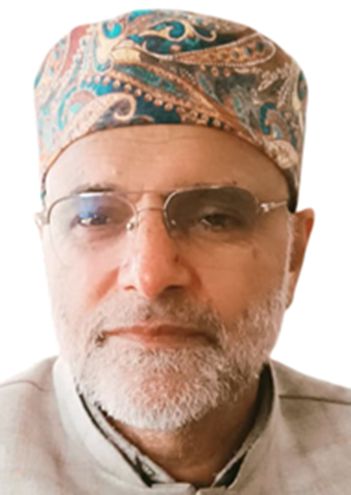
(The author a veteran academician is a former Professor and Head Department of Islamic Studies, Kashmir University. The views, opinions and conclusions expressed in this article are those of the author and aren’t necessarily in accord with the views of “Kashmir Horizon”)