“What makes this revolution unique is its unprecedented speed and scale. AI is not just about machines becoming intelligent; it is about amplifying human capability. The true question, he emphasised, is not what AI can do in the future, but what humanity chooses to do with it today, as its direction will determine whether it disrupts or empowers.” PM Modi
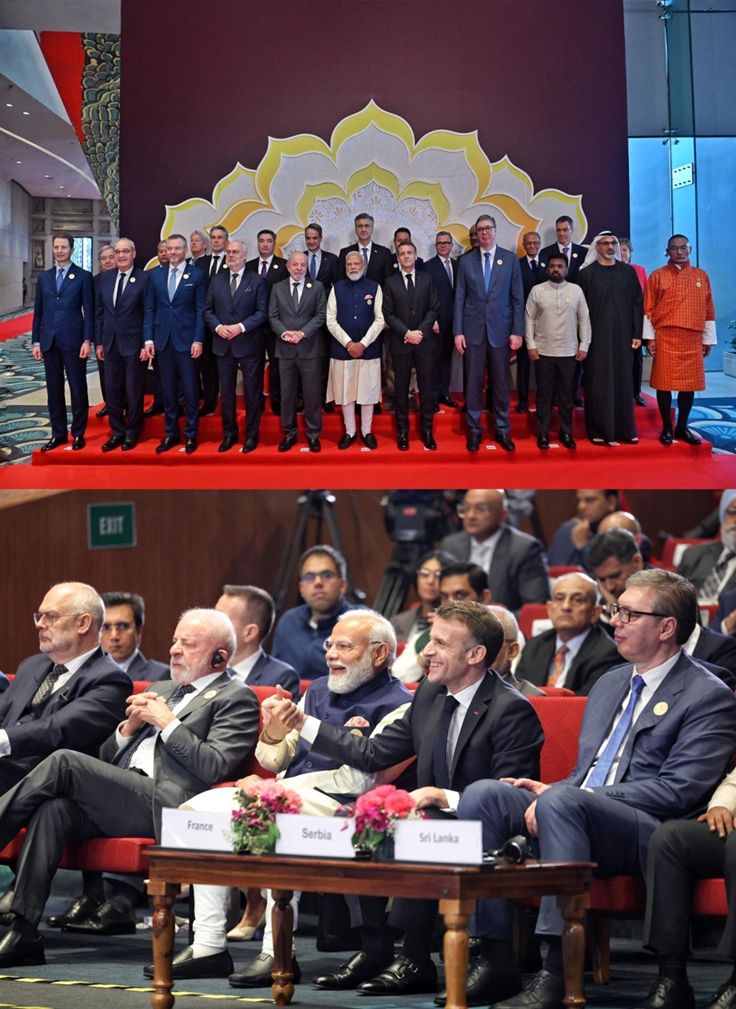
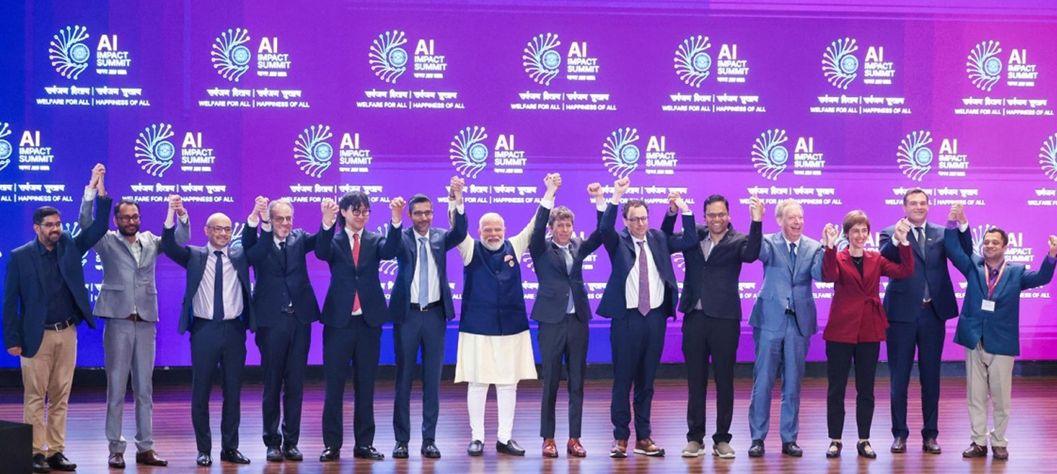
In what may well be remembered as a defining moment in India’s technology diplomacy, Prime Minister Narendra Modi delivered a sweeping, future-facing address at the AI Impact Summit 2026, positioning India not just as a participant in the artificial intelligence revolution but as a moral and strategic anchor for its global evolution. Held at Bharat Mandapam from February 16–20, the summit brought together more than 100 countries, 20 heads of state and government, global AI pioneers, startup founders, investors and hundreds of thousands of students. Yet the intellectual and philosophical centre of gravity was unmistakably the Prime Minister’s speech — a broad civilizational reflection on artificial intelligence and a policy blueprint rooted in India’s civilizational ethos. In tone and structure, the address moved beyond technocratic detail. It sought to answer a deeper question: What kind of AI-driven world does humanity want to build?
A Civilizational Turning Point: Modi began by placing AI within the long arc of human history. He spoke of turning points that reshaped civilization — the discovery of fire, the development of script, the advent of wireless communication — moments whose long-term consequences were not fully grasped at inception. Artificial intelligence, he argued, is one such turning point. “What we see today are only the early signs of its impact,” he said, underlining the unprecedented speed and scale at which AI is transforming human activity. Unlike earlier technologies that took decades to diffuse, AI is evolving in real time, reshaping economies, governance systems, education models and security frameworks simultaneously. The Prime Minister’s framing was deliberate: AI is not merely another digital tool. It is a paradigm shift that multiplies human capability. By positioning AI as a multiplier rather than a replacement, the speech sought to move the global narrative away from fear-based discourse — job losses, surveillance, misinformation — and toward a capability-based discourse centred on augmentation and empowerment.
From Artificial Intelligence To Human Intelligence Amplified: A key conceptual pivot in the speech was the assertion that AI is not about machines becoming intelligent; it is about humans becoming more capable. “We are entering an era where humans and intelligent systems co-create, co-work and co-evolve,” he said. This reframing is significant. In global debates, AI is often portrayed either as an existential threat or as an efficiency engine. Modi’s articulation emphasised collaboration between human judgement and machine precision. The analogy of GPS suggesting routes while humans retain final control was emblematic. AI can advise, optimise and simulate, but ethical direction must remain human. This idea formed the philosophical backbone of what he termed India’s MANAV Vision.
The MANAV Framework|A Structured Vision For AI Governance: At the heart of the address was the unveiling of M.A.N.A.V. — Moral, Accountable, National, Accessible, Valid a governance framework designed to embed ethics and inclusivity into AI systems.
M – Moral, Ethical Systems: AI must be guided by ethical norms from inception, not retrofitted after harm occurs.
A – Accountable Governance: Transparent rules and oversight mechanisms are essential to build trust.
N – National Sovereignty: Data belongs to those who generate it — a subtle but firm assertion of digital sovereignty.
A – Accessible, Inclusive: AI must not be a monopoly of a few corporations or countries; it should serve humanity at large.
V – Valid, Legitimate: Systems must be lawful, verifiable and subject to scrutiny. This structured articulation positions India between competing global AI models. While some economies emphasize deregulated innovation and others prioritise heavy regulation, the MANAV framework proposes a balance: openness with oversight, innovation with inclusion.
Safeguarding Trust| Deepfakes, Transparency, Child Safety: A major portion of the Prime Minister’s address was devoted to the issue of trust. “Sunlight is the best disinfectant,” he said, advocating transparency in AI development. He proposed authenticity labels and watermarking standards for AI-generated content — likening them to nutrition labels on food products. As AI-generated text, images and videos proliferate, misinformation risks increase. By calling for authenticity standards at the architectural level, India is advocating preventive design rather than reactive censorship. Child safety was another theme. Just as school curricula are curated, he argued, AI ecosystems must ensure family-guided, child-safe digital environments. This proactive approach strengthens India’s claim to moral leadership in AI governance.
Blueprint For The AI Century: The AI Impact Summit 2026 was more than an event; it was a statement of intent. In his speech, Prime Minister Narendra Modi articulated a vision that situates AI within India’s civilizational philosophy while aligning it with contemporary global governance needs. By combining ethical grounding, sovereign capability, inclusive access and international cooperation, the MANAV framework seeks to ensure that AI amplifies humanity rather than diminishes it. The coming years will determine how effectively this blueprint is implemented. Investment must translate into infrastructure. Ethical frameworks must become enforceable standards. Inclusion must move beyond rhetoric into measurable outcomes. But for now, the summit marks a confident stride. India has declared that it does not see fear in AI, it sees opportunity, responsibility and the future. If the momentum generated in New Delhi sustains, the AI century may well carry an unmistakable imprint of India’s human-centric vision.
Very Strong Endorsement From Global Leaders: Union IT Minister Ashwini Vaishnaw later described the vision as receiving “very strong endorsement” from global leaders attending the summit.
India The Voice Of The Global South: One of the most notable dimensions of the speech was its emphasis on representation. India, home to 1.4 billion people and the world’s largest youth population, hosted what was described as the first major AI summit in the Global South. The Prime Minister highlighted that the event was a matter of pride not only for India but for developing nations seeking a greater role in shaping global technology norms. For decades, digital rule-making has largely been dominated by advanced Western economies. By convening over 100 countries many from Africa, Asia and Latin America — India signalled a more distributed future for AI governance. Several participating nations reportedly expressed interest in collaborating with India to develop indigenous AI capabilities, particularly in sectors such as agriculture, healthcare, education and climate resilience. In doing so, India aims to export not just products but frameworks replicating its earlier digital public infrastructure successes at scale.
Investment Momentum| Confidence In India’s AI Ecosystem: Beyond philosophy, the summit generated substantial economic commitments. According to Minister Vaishnaw, India secured over USD 270 billion in investment pledges — USD 250 billion for infrastructure and USD 20 billion for venture capital and deeptech funding. While such pledges will require long-term execution, the scale reflects global investor confidence in India’s AI roadmap. Vaishnaw emphasised India’s “sovereign bouquet of models,” highlighting indigenous AI systems launched during the summit by Indian startups. He noted that global industry leaders were impressed by the quality of output achieved with relatively modest resources — reinforcing India’s reputation for frugal innovation. The semiconductor dimension also featured prominently. India’s integration into global supply chains, including participation in the Pax Silica coalition, signals recognition that AI competitiveness rests on chip manufacturing and hardware resilience.
“Prime Minister stressed that AI must remain human-centric and inclusive. It should be built on moral foundations, accountable governance and respect for national data sovereignty. AI must be accessible to all, not monopolised by a few, and transparency must be embedded from the start to build trust. India, he asserted, sees not fear in AI, but opportunity and is ready to shape its future responsibly.”
Engagement With Global Tech Leadership: On the sidelines of the summit, Prime Minister Modi held discussions with prominent technology leaders including Sam Altman of OpenAI and executives from Qualcomm. Altman praised India’s rapid AI adoption and sovereign AI initiatives, noting the scale of Indian usage of advanced AI systems and the country’s fastest-growing developer ecosystem. These engagements illustrate a key diplomatic strategy: India is not positioning itself in opposition to global tech giants but as a collaborative yet sovereign partner.
Youth At The Centre Of The AI Narrative: The summit’s exhibition reportedly drew over 2.5 lakh students, reflecting the strong resonance of AI among India’s youth. Modi emphasised that the future of work is not pre-defined; it will depend on collective choices. Rather than seeing AI as a destroyer of jobs, he described it as a creator of higher-value roles. “Skilling, reskilling and lifelong learning must become a mass movement,” he said. For a country with a vast demographic dividend, this is both an opportunity and a policy imperative. If managed effectively, AI could enable India to leapfrog into high-value innovation sectors.
India’s Strategic Advantage| Diversity, Demography, Democracy: In concluding his speech, the Prime Minister highlighted what he described as India’s triple strength — diversity, demography and democracy. India’s linguistic plurality, socio-economic complexity and democratic governance structure make it a rigorous testing ground for AI solutions. If systems can succeed in India’s environment, they can scale globally. “Design and Develop in India. Deliver to the World,” he invited. This phrase encapsulates the summit’s strategic thrust: India aims to transition from a technology services provider to a technology rule-maker and solution exporter.
A Positive Global Reception: The Ministry of External Affairs described the summit as a “grand success,” noting participation from 20 world leaders and 45 ministerial-level delegations. Many leaders reportedly appreciated India’s inclusive and human-centric approach. The endorsement of the MANAV vision indicates growing appetite for a governance model that balances innovation with ethical oversight.
Kashmir Horizon View: Prime Minister Narendra Modi’s address at the AI Impact Summit 2026 was not merely a philosophical reflection on artificial intelligence; it was a call to action. By framing AI as a civilizational turning point and unveiling the MANAV vision — Moral, Accountable, National, Accessible and Valid systems — he laid out both an ethical compass and a governance roadmap. The way forward now lies in translating that vision into institutional mechanisms, global partnerships and measurable outcomes. India must operationalise the Moral and Ethical Systems pillar through robust regulatory frameworks that are innovation-friendly yet firm on accountability. Ethical AI cannot remain aspirational; it must be embedded into procurement standards, public sector AI deployments and startup ecosystems. Clear guidelines on bias mitigation, transparency and explainability will strengthen trust domestically and internationally. In his speech, the Prime Minister asserted that India does not see fear in AI — it sees fortune and the future. The summit demonstrated that the world is receptive to a human-centric approach. The path ahead will demand sustained political will, strategic investment and international collaboration. If implemented with consistency, the MANAV vision can ensure that AI strengthens human agency, accelerates inclusive development and cements India’s role as a guiding force in shaping the AI century.
(“Team Kashmir Horizon” is committed to continuous improvement and invites feedback and suggestions from readers and its followers on social media sites. Reader insights are considered vital for enhancing content quality and empowering the community. The team encourages open communication and values the thoughts and ideas of its audience, believing that such input will enable them to serve the public more effectively. The initiative aims to ensure that readers have the best possible experience with “Kashmir Horizon”. Interested individuals can reach out to us via email at [email protected].)