“Our goal should be that in the coming 10 years, India leads the world in new startup trends and technology. I have full faith in the confidence, courage and innovation of our startups and entrepreneurs, because the future of the nation is taking shape through their ideas. A forward-looking approach to artificial intelligence will give India a decisive competitive advantage, and our startups must focus on developing quality products that solve real problems and strengthen the country’s technological leadership.”
Mohammad Irfan
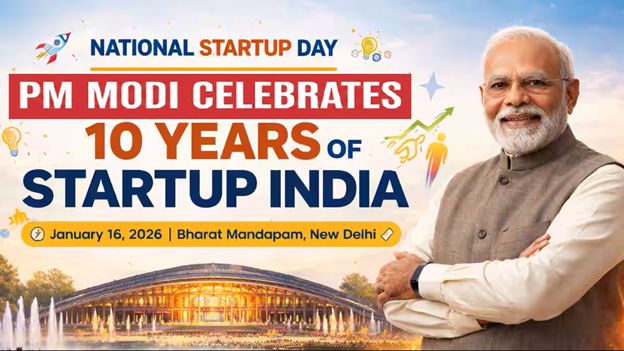 As India marked a decade of the flagship Startup India programme, Prime Minister Narendra Modi used the milestone not merely to reflect on past achievements but to articulate an ambitious vision for the country’s future—one in which India emerges as a global leader in startup innovation, advanced technology and democratic governance. Speaking at a mega event commemorating ten years of Startup India, Modi asserted that India must set global trends in entrepreneurship and technology over the next decade, signalling a decisive shift from catching up with global innovation hubs to shaping the direction of innovation itself. “Our goal should be that in the coming 10 years, India will lead the world in new startup trends and technology,” the Prime Minister said, expressing strong confidence in the courage, creativity and innovation capacity of Indian entrepreneurs. His remarks came at a moment when India’s startup ecosystem has matured into one of the largest in the world, while simultaneously navigating global economic uncertainty, rapid technological disruption and intense geopolitical competition.
Startup India @ 10 Years |A Policy Experiment That Changed Economic Thinking: Launched on January 16, 2016, Startup India was envisioned as a transformative national programme to nurture innovation, promote entrepreneurship and unlock investment-driven growth. At its core was a fundamental shift in economic philosophy—from a system focused largely on public-sector employment and traditional industries to one that encouraged risk-taking, private enterprise and job creation. Over the past decade, the programme has significantly altered India’s entrepreneurial landscape. Thousands of startups have emerged across sectors such as fintech, health-tech, ed-tech, agritech, e-commerce, clean energy and mobility. Importantly, innovation has expanded beyond metropolitan cities into Tier-II and Tier-III towns, helping democratise access to entrepreneurship and capital. Prime Minister Modi’s emphasis on having “removed outdated rules and trusted innovators” highlighted a deliberate policy choice to reduce bureaucratic friction and regulatory uncertainty. Simplified compliance norms, faster company incorporation, tax incentives, startup recognition frameworks and government-backed seed funding mechanisms have collectively contributed to a more enabling environment.
Trust-Based Governance, Entrepreneurial State: One of the most significant undercurrents of Modi’s address was the idea of trust-based governance. By stating that outdated rules were removed and innovators were trusted, the Prime Minister framed the government not as a gatekeeper but as a facilitator of innovation. This approach reflects a broader evolution in India’s governance model, particularly in the digital economy. The state has increasingly focused on creating enabling infrastructure—both physical and digital—while allowing private players to innovate atop these platforms. Examples include Aadhaar for identity verification, UPI for digital payments and the CoWIN platform for vaccination delivery. Such platforms have not only improved governance efficiency but also created fertile ground for startups to build scalable solutions, reinforcing the idea that public digital infrastructure can coexist with market-driven innovation.
Artificial Intelligence |The Next Frontier Of National Competitiveness: A central theme of the Prime Minister’s speech was artificial intelligence (AI), which he described as a defining factor in global competitiveness. “A nation that is forward-looking on AI will have a competitive advantage,” Modi said, underscoring the urgency for India to position itself at the forefront of AI research, deployment and governance. AI is increasingly reshaping economies, defence systems, healthcare, education and governance worldwide. For India, the stakes are particularly high. With a vast digital population, large datasets and a strong base of software engineers, the country has the potential to leverage AI for both economic growth and social transformation. However, the Prime Minister’s call was not limited to rapid adoption. He also stressed the importance of quality and purpose-driven innovation, urging startups to focus on solving real-world problems rather than chasing short-term valuations. This signals an awareness of the ethical, social and economic risks associated with unregulated technological growth.
Manufacturing, Research, The Push For Intellectual Property: In a notable shift from India’s traditionally services-heavy startup narrative, Modi urged entrepreneurs to focus more on manufacturing and research. “Today’s research becomes tomorrow’s intellectual property,” he said, making a strong case for deep-tech innovation and IP creation. This emphasis aligns with broader national initiatives such as Make in India, Atmanirbhar Bharat and the production-linked incentive (PLI) schemes, which aim to strengthen domestic manufacturing capabilities and reduce import dependence. Sectors such as semiconductors, defence production, renewable energy, electric mobility and advanced materials are increasingly seen as strategic priorities. By encouraging startups to invest in research and manufacturing, the government is signalling a desire to move up the global value chain—from assembling products to designing and owning core technologies. Intellectual property, in this vision, becomes a strategic national asset rather than merely a corporate advantage.
India’s Startup Story in Numbers, Context: India today hosts the world’s third-largest startup ecosystem, a fact repeatedly highlighted by the Prime Minister in his public addresses. The country has also emerged as the fastest-growing major economy, the world’s largest digital payments market through UPI, and a global leader in vaccine manufacturing. These achievements, Modi argued, are not isolated successes but interconnected outcomes of democratic governance, digital infrastructure and policy consistency. He cited India’s expansive infrastructure networks—from railways and metro systems to aviation and logistics—as essential enablers of economic scale and startup growth. Scale, in Modi’s narrative, is India’s greatest strategic advantage. Unlike smaller innovation hubs, India’s startups are forced to design for diversity, affordability and mass adoption—qualities that position them well for expansion into other developing and emerging markets.
Democracy Delivers| Innovation Anchored In Governance: A day before the Startup India event, Prime Minister Modi addressed the 28th Conference of Speakers and Presiding Officers of the Commonwealth, where he articulated a broader philosophical framework linking democracy, development and innovation. “Democracy delivers in India because people are at the centre of governance,” he said, arguing that India’s diversity—often seen as a challenge—has instead become a strength. Contrary to early post-Independence doubts about whether democracy could survive in such a complex society, India has demonstrated that democratic institutions provide stability, speed and scale to development. This argument is central to understanding the government’s innovation narrative. By linking welfare delivery, poverty reduction and technological progress, Modi positioned democracy as an enabler rather than an obstacle to growth. According to the Prime Minister, nearly 25 crore people have been lifted out of poverty in recent years due to targeted welfare measures. This expanding middle class, in turn, creates new markets for startups and fuels domestic consumption-driven growth.
“Democracy delivers in India because people are at the centre of governance. Our diversity has become the strength of our democracy, providing stability, speed and scale to development. In India, democracy means last-mile delivery, where welfare reaches every citizen without discrimination. By trusting innovators, removing outdated rules and focusing on research and manufacturing, we are ensuring that today’s ideas become tomorrow’s intellectual property and India emerges as a global leader in innovation.”
Last-Mile Delivery, Digital Public Infra: “In India, democracy means last-mile delivery,” Modi said, highlighting how technology has been used to bridge governance gaps. Direct benefit transfers, digital identity systems and mobile connectivity have reduced leakages and improved service delivery. For startups, this ecosystem offers both opportunity and responsibility. The availability of digital public infrastructure lowers entry barriers, but it also demands solutions that are inclusive, secure and accountable. The Prime Minister’s emphasis on quality and trust reflects this balance. India’s experience has attracted global attention, particularly from countries in the Global South seeking development models that combine democratic accountability with technological efficiency.
India, the Global South|Sharing Innovation Pathways: Hosting 61 speakers and presiding officers from 42 Commonwealth nations, Modi framed India’s democratic and startup journey as a shared learning experience. With nearly half of the Commonwealth’s population residing in India, he said the country has consistently sought to contribute to the development of other nations. At a time when the world is undergoing unprecedented transformation—marked by climate change, technological disruption and geopolitical realignments—India’s model of inclusive growth and innovation-led democracy offers an alternative pathway. Rather than exporting a rigid template, Modi suggested that India aims to share experiences, digital tools and institutional knowledge, allowing partner nations to adapt solutions to their own contexts.
Elections, Diversity, Democratic Scale: The Prime Minister also highlighted the extraordinary scale of India’s democracy, citing the 2024 general elections where nearly 980 million citizens were registered to vote. With over 8,000 candidates and more than 700 political parties, the elections underscored the complexity and vibrancy of India’s political system. India’s media diversity—hundreds of languages, over 900 television channels and thousands of newspapers—was cited as further evidence of democratic depth. Managing such diversity, Modi argued, requires strong institutions, continuous dialogue and collective decision-making. This democratic resilience, he suggested, creates the political stability necessary for long-term investment and innovation.
Challenges Ahead| From Vision To Execution: Despite the optimism, significant challenges remain. Indian startups continue to face issues related to access to long-term capital, regulatory consistency across states, protection of intellectual property and global market access. The push toward manufacturing and deep-tech will require sustained investment in research institutions, skilled manpower and global partnerships. Moreover, ensuring that innovation-driven growth translates into broad-based employment and regional balance will test policy coherence. Bridging the digital divide, safeguarding data privacy and ensuring ethical AI deployment will also be critical in the coming decade.
Kashmir Horizon View: As Startup India completes ten years, Prime Minister Modi’s message was unambiguous: the next phase of India’s growth story must be defined by leadership, not imitation. Whether in artificial intelligence, advanced manufacturing, digital governance or social innovation, India seeks to shape global trends rather than follow them. By anchoring entrepreneurship within democratic values, aligning technology with trust and linking innovation to inclusion, the government has outlined a long-term strategy where economic growth reinforces democratic institutions—and democracy, in turn, fuels innovation. The coming decade will determine whether this ambitious vision can be fully realised. But as India enters the second chapter of its startup journey, the direction is clear: from a nation of job seekers to job creators, and from an emerging innovator to a global leader in technology and democratic governance.
(“Team Kashmir Horizon” is committed to continuous improvement and invites feedback and suggestions from readers and its followers on social media sites. Reader insights are considered vital for enhancing content quality and empowering the community. The team encourages open communication and values the thoughts and ideas of its audience, believing that such input will enable them to serve the public more effectively. The initiative aims to ensure that readers have the best possible experience with “Kashmir Horizon”. Interested individuals can reach out to us via email at [email protected].)