“In the coming years, India and Russia will focus on turning the new economic roadmap into tangible results, especially by reducing trade barriers, improving connectivity through INSTC and the Chennai–Vladivostok route, and expanding cooperation in energy, technology and skilled manpower.”
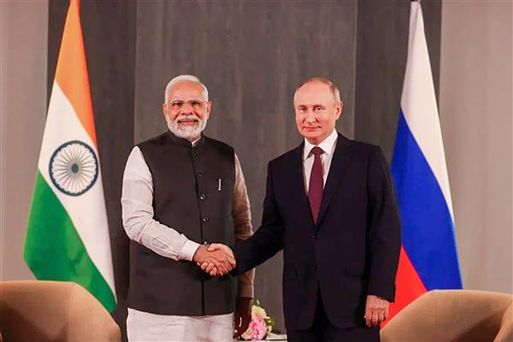
This week India and Russia reaffirmed the depth, resilience and strategic relevance of their decades-old partnership as Prime Minister Narendra Modi and President Vladimir Putin unveiled a series of initiatives aimed at expanding economic cooperation, addressing regional security challenges and reinforcing diplomatic coordination on global issues. The 23rd India–Russia Annual Summit, held in New Delhi amid intense international scrutiny, produced an ambitious economic roadmap, renewed commitments to defence collaboration and a strong reiteration of bilateral trust at a time when the global order is undergoing rapid transformation.
Economic Partnership At The Core Of Summit Diplomacy: A central outcome of the Modi–Putin meeting was the unveiling of a five-year roadmap to build a robust and balanced economic partnership, with a clear focus on resolving the trade imbalance that currently favours Moscow. Foreign Secretary Vikram Misri described economic cooperation as the “driving impulse” of the Russian President’s visit, reflecting a strategic shift toward commerce, investments and supply-chain diversification. Both nations aim to meet the USD 100 billion annual trade target by 2030, significantly up from USD 64 billion at present. The new framework prioritises increasing Indian exports—particularly in pharmaceuticals, agriculture, marine products and machinery—while simultaneously improving trade logistics, customs facilitation and regulatory coherence.
India Seeks To Correct Trade Imbalance: India’s trade deficit with Russia has widened sharply over the last two years due to a dramatic rise in discounted crude oil imports. New Delhi pressed for improved market access for Indian goods, removal of non-tariff barriers, and enhanced cooperation in sectors such as fertilisers, textiles, food products and IT services. Moscow responded affirmatively with President Putin assuring “greater market access for Indian products” and pledging deeper collaboration in areas beyond hydrocarbons, including civil aviation components, agro-products and pharmaceuticals.
From Oil To High Technology|A New Economic Grammar: The summit reflected a gradual transition in bilateral priorities—from traditional oil and defence cooperation to new-age sectors like artificial intelligence, critical minerals, nuclear technology and shipbuilding. Modi highlighted that energy security remained a “strong and important pillar” of India–Russia ties, noting the success of civil nuclear cooperation at Kudankulam and the potential of joint ventures in critical minerals that support clean-energy supply chains. Putin reiterated Russia’s role as a “reliable supplier of oil, gas and coal”, offering India uninterrupted fuel shipments despite mounting Western pressure. He also proposed joint development of small modular reactors (SMRs), floating nuclear power plants and advanced non-energy nuclear applications—including medical isotopes and agricultural technologies.
PM Modi Calls For Peaceful End To Ukraine War: The Ukraine conflict featured prominently in the leaders’ discussions. Modi reiterated India’s long-standing stance that the war must end through dialogue, diplomacy and peaceful means, stressing that New Delhi was willing to contribute constructively to peace efforts. “Since the beginning, India has consistently advocated for peace in Ukraine. We welcome all initiatives towards a lasting resolution. India has always been, and will always remain ready to contribute,” Modi said. Putin publicly acknowledged Modi’s diplomatic engagement, appreciating his “personal involvement” in efforts to explore pathways to peace. This recognition underscores the respect India enjoys in Moscow and the credibility New Delhi has built as a nation capable of balancing ties without compromising its strategic autonomy.
India’s Role As A Balancing Power: The summit occurred at a time of heightened India-US tensions and aggressive Western attempts to limit global energy trade with Russia. Against this backdrop, Putin’s visit and Modi’s warm personal reception at Palam airport—sent a clear signal that India will continue to pursue independent foreign policy grounded in national interest, not bloc pressures. For Moscow, New Delhi represents both a vital energy market and an indispensable diplomatic partner amid Western sanctions. For India, Russia remains a crucial player in defence, nuclear energy, space and critical mineral supply chains—sectors central to India’s long-term strategic ambitions.
Terrorism Figures Prominently In Talks: Counterterrorism cooperation formed a key part of the Modi–Putin dialogue. Modi invoked both the Pahalgam terror attack in India and the Crocus City Hall massacre in Moscow to underline shared security concerns. “The root of all these incidents is the same,” Modi said, stressing that terrorism is a “direct attack on the values of humanity” and that global unity is essential to defeat it. Russia and India have historically cooperated closely on intelligence sharing, counter-radicalisation measures, and anti-terror frameworks in multilateral bodies such as the SCO, BRICS, and the UN. The summit reaffirmed this synergy and hinted at deeper collaboration on cyber security, extremism monitoring and maritime security.
Connectivity|From INSTC To The Arctic : Connectivity and logistics were among the most substantive agenda points. Modi described enhanced connectivity as a “key priority”, outlining plans to accelerate work on: International North-South Transport Corridor (INSTC), Northern Sea Route (NSR) via the Arctic, Chennai–Vladivostok Eastern Maritime Corridor. The decision to jointly train Indian seafarers for polar waters marks a significant leap in India’s emerging Arctic engagement. This initiative not only boosts maritime cooperation but also opens opportunities for India’s youth in specialised global shipping markets.
People-To-People Ties|E-Visas, Mobility Pacts: Recognising the cultural and civilisational links between the two nations, Modi announced free 30-day e-tourist visas and group tourist visas for Russian citizens, aimed at boosting tourism, business travel and cultural exchanges. Two mobility agreements were also signed to facilitate the movement of skilled Indian workers to Russia, creating new avenues for employment and knowledge exchange in sectors like IT, healthcare, construction and engineering.
Shipbuilding | The ‘Make in India’ Push: Shipbuilding emerged as a strategic domain of convergence. India and Russia have substantial legacy cooperation in this field—from naval platforms to commercial vessels. Modi said that deepening cooperation in shipbuilding has the potential to strengthen India’s ‘Make in India’ programme, reduce import dependency and accelerate technological capacity-building for maritime defence and civilian applications. This ties into India’s broader ambition to become a regional shipbuilding hub, especially for LNG carriers, ice-class vessels and cargo ships designed for Arctic navigation.
Defence Synergy Persists Despite Global Pressures: While no major defence deal was announced publicly, both sides reaffirmed the importance of defence ties—a pillar of India–Russia relations for over 50 years. Current collaborations include: Production of AK-203 rifles in Uttar Pradesh, Joint development of BrahMos missiles, Additional spares and maintenance support for legacy platforms, Space cooperation for Gaganyaan and GLONASS compatibility. The discreet nature of defence discussions reflected the geopolitical sensitivity surrounding arms transfers, but officials indicated continued long-term defence planning and technology partnerships.
A Relationship Rooted in History, Trust : Modi described India–Russia ties as a “guiding star” that has endured global crises and geopolitical shifts for over eight decades. “Built on mutual respect and deep trust, our relationship has stood the test of time,” he said. Historical memory plays a central role in this partnership. During the Cold War and in moments of global isolation—particularly after India’s nuclear tests and during conflicts with Pakistan—it was the Soviet Union, and later Russia, that backed India in international forums. This historical continuity has created a reservoir of goodwill that continues to shape strategic cooperation.
Putin’s Ceremonial Welcome | Symbolism Of Host Diplomacy: Earlier in the day, Putin received a ceremonial welcome at Rashtrapati Bhavan, accompanied by Prime Minister Modi. The warmth between the two leaders was visible not only in official engagements but also in the private dinner hosted by Modi—a gesture that set the tone for candid, high-trust discussions. The timing of the visit, coming amid strained India-US ties and Western anxieties over Russia’s global outreach, has amplified its geopolitical significance. Western capitals are closely watching India’s deepening strategic engagement with Russia as New Delhi distances itself from bloc politics and asserts its role as a multi-aligned power.
India–Russia Relations|Beyond Optics, Towards Strategic Depth: While some foreign policy analysts had interpreted a period of relative quiet in India–Russia engagement as strategic drift, the summit demonstrated that both nations remained deeply committed to each other’s core interests. There has been no erosion of mutual trust, but rather a strategic recalibration shaped by changing global realities. The recent Western attempts to isolate Russia economically contrast sharply with Moscow’s continued support for India’s sovereignty and strategic priorities—including on Kashmir, nuclear energy, UN reforms and regional stability.
Geopolitical Context|The World Is Searching For New Alignments: Putin’s visit also comes at a moment of shifting global economic models. The international marketplace, disrupted by tariff wars, sanctions regimes and supply chain fractures, is increasingly looking for alternative frameworks that ensure stability. India and Russia appear determined to craft one such model—based on mutual benefit, resilient trade channels and long-term technological partnerships. Amid US-China competition and the Russia-West confrontation, the India–Russia axis is emerging as a balancing force, particularly in Eurasia, the Indo-Pacific and the Arctic.
“The summit reaffirmed that India–Russia ties remain strong, adaptable and rooted in long-standing trust. With both leaders emphasising peace, stability and economic expansion, the relationship now enters a more future-oriented phase. As cooperation widens across trade, technology and people-to-people movement, the partnership is set to play a meaningful role in shaping a balanced and multipolar global order.”
India’s Strategic Autonomy On Full Display: One of the most significant messages from the summit was India’s unwavering commitment to strategic autonomy. New Delhi continues to engage the US, EU, Russia and the Global South in parallel—refusing to be boxed into exclusive alliances. India’s engagement with Russia on energy, defence and high technology, despite Western pressure, underscores the credibility of its multi-alignment doctrine.
A New Dawn In Bilateral Relations: The two-day state visit concluded with a strong reaffirmation of long-term strategic partnership. Both nations are poised for deeper cooperation in: Artificial Intelligence and emerging technologies, Space and nuclear research, Defence manufacturing and maintenance, Critical minerals and clean energy, Maritime connectivity and Arctic engagement, Education, tourism, and cultural diplomacy. President Putin lauded Modi’s leadership, calling him a statesman whose “personal attention” has taken bilateral ties to “new heights under all circumstances.” This mutual confidence is expected to define the next phase of India–Russia relations.
Kashmir Horizon View: As India and Russia prepare to operationalise the newly unveiled Economic Cooperation Programme 2030, both sides face the challenge of translating political warmth into measurable outcomes. The immediate priority will be addressing structural bottlenecks—such as banking connectivity, logistics gaps and regulatory hurdles—that continue to impede balanced trade. Streamlining customs procedures, expanding rupee–rouble mechanisms, and improving shipping routes through the INSTC and Chennai–Vladivostok corridor are essential to sustaining the targeted USD 100 billion trade volume. Defence cooperation is also expected to evolve, shifting from a buyer–seller dynamic to deeper co-production, joint R&D and indigenisation under India’s Make in India and Aatmanirbhar Bharat programmes. Collaborations in emerging technologies—ranging from artificial intelligence to critical minerals, nuclear innovation, and Arctic exploration—are set to define the next decade of strategic engagement. On the geopolitical front, India’s diplomatic role in promoting dialogue on the Ukraine conflict will continue to be closely watched. New Delhi’s ability to engage all sides—while safeguarding its own interests—positions it uniquely as a potential facilitator of confidence-building measures. With global food, fuel and fertilizer markets still under stress, ensuring stable supply chains through Indo-Russian coordination will remain a strategic priority. As people-to-people ties expand through visa liberalisation and manpower mobility agreements, the human dimension of bilateral relations is expected to become a new strength. For India’s young workforce, the emerging opportunities in Russia’s energy, construction, healthcare and maritime sectors could open fresh economic avenues.
(“Team Kashmir Horizon” is committed to continuous improvement and invites feedback and suggestions from readers and its followers on social media sites. Reader insights are considered vital for enhancing content quality and empowering the community. The team encourages open communication and values the thoughts and ideas of its audience, believing that such input will enable them to serve the public more effectively. The initiative aims to ensure that readers have the best possible experience with “Kashmir Horizon”. Interested individuals can reach out to us via email at [email protected].)