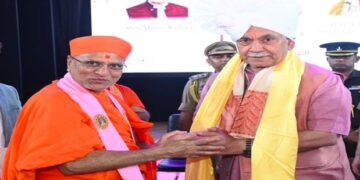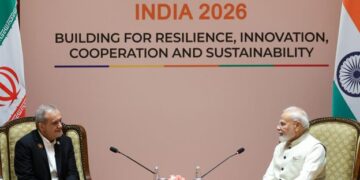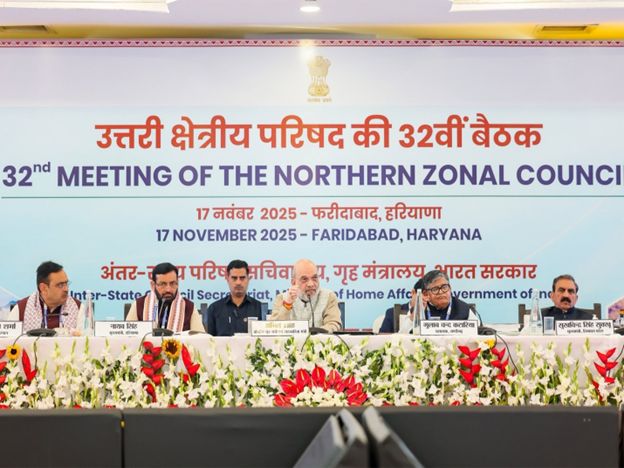
“HM Amit Shah, LG Manoj Sinha, and Chief Minister Omar Abdullah emerged from the Northern Zonal Council meeting with a unified message: cooperation is not a ceremonial phrase but the backbone of regional stability. Their interventions underscored the need for deeper intelligence-sharing, coordinated security actions against terror networks, and a governance model that places people’s trust at its core.”
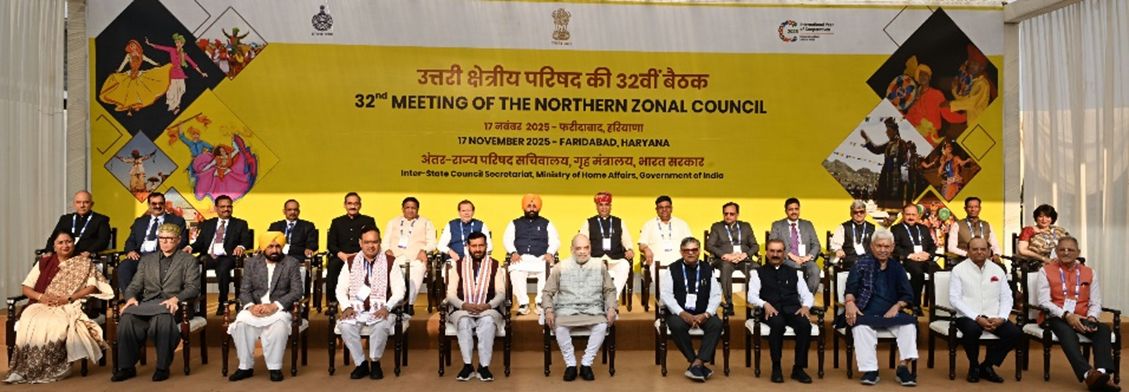
This week, Faridabad, the industrial heart of Haryana, became the centre of northern India’s most crucial political, administrative, and security deliberations as the 32nd Northern Zonal Council (NZC) convened under the chairmanship of Union Home Minister and Minister of Cooperation Amit Shah. The gathering brought together Chief Ministers, Lieutenant Governors, administrators, and top officials from eight states and Union Territories. With two recent terror incidents casting a long shadow—the Delhi car bomb blast and the Nowgam Police Station explosion in Jammu & Kashmir—the session opened on a sombre note with tributes to the victims and a two-minute silence that reminded everyone that development and security in the northern belt now move hand in hand.
Sombre Opening Amid Rising Security Concerns: From the very beginning, Amit Shah’s message was sharp and unambiguous. He asserted that those behind the Delhi blast would be hunted down “relentlessly” and brought to justice, reaffirming the Centre’s uncompromising stand against terror. When Shah stressed that eliminating terrorism at its roots remains a “collective commitment,” he pressed home the point that India’s evolving security landscape demands strong coordination and a unified administrative response. Shah also highlighted the increasing relevance of Zonal Councils, describing them as platforms essential not only for inter-state dialogue but for synergy, cooperation, and conflict resolution. He noted that since 2014, the number of Zonal Council meetings has more than doubled compared to the previous decade, with over 1,300 inter-state issues resolved. The message was unmistakable: coordinated federalism is becoming a backbone of policy execution in India.
Strengthening Justice|The Push For Fast Track Special Courts: While security was central to the meeting, Shah broadened the conversation by emphasising the need for systemic reform in criminal justice, especially concerning women and children. ‘He urged states to enhance Fast Track Special Courts (FTSCs) to ensure swift and effective prosecution in cases of sexual violence and exploitation. Shah pointed out that the implementation of new criminal laws has already resulted in a 25–40 percent rise in conviction rates, signalling that administrative efficiency and legal reform are beginning to intersect. For crime-prone regions such as Delhi, Haryana, and Rajasthan, the call for stronger legal infrastructure was both timely and necessary.
Cooperative Sector|A Vehicle For Rural Transformation : Shah devoted a significant portion of his address to the Centre’s cooperative-driven developmental model. Underlining PM Modi’s call for “Sahkar Se Samriddhi,” he detailed efforts to modernise and expand the cooperative ecosystem through the computerisation of Primary Agricultural Credit Societies (PACS), the establishment of national cooperative bodies, and the creation of Tribhuvan Sahkari University. These initiatives are meant to invigorate rural economies, support small farmers, and expand opportunities for fisherfolk, dairy workers, and rural women. Given the northern region’s heavy reliance on agriculture, this new cooperative push represents a potential structural shift in how rural credit and rural enterprise will evolve in the coming decade.
National Development Themes|Water, Cities, Power, Nutrition: The Home Minister also broadened the scope of deliberations to include larger national developmental priorities. He emphasised the urgent need for coordinated efforts in water resource management, urban master planning, power availability, and strengthening education and health systems. Shah commended Rajasthan for its model initiative promoting millets and encouraged all states to incorporate millets into government food grain schemes. This, he argued, would strengthen nutritional outcomes while promoting environment-friendly agricultural practices at a time when climate change is reshaping crop patterns across northern India. Invoking the 150th anniversary of “Vande Mataram,” Shah urged states to celebrate the occasion with programmes aimed at instilling patriotism among the youth—a cultural push woven into a broader national narrative.
J&K In Focus| Transformation, Security Post 2019: The presence of Lieutenant Governor Manoj Sinha and Chief Minister Omar Abdullah ensured that Jammu & Kashmir remained a central topic during the session. Sinha used his address to underscore what he described as a historic transformation in J&K since the abrogation of Article 370. According to him, the region has experienced deeper economic growth, improved infrastructure, expanded connectivity, and empowered grassroots democratic institutions. He emphasised that youth and women now have access to wider opportunities, aided by new investments and a more secure environment. Sinha claimed that the government’s “Zero Tolerance to Terrorism” policy had dramatically reduced incidents of stone pelting, shutdowns, and local recruitment into terror outfits. He stressed that not only individuals but the entire terror ecosystem is being dismantled through coordinated intelligence-based operations. He highlighted a recent J&K Police investigation that unearthed a Pan-India terror network, describing it as an example of the maturing security apparatus in the UT.
A Strengthened Intelligence Grid In J&K: The Lieutenant Governor also explained that a 360-degree security mechanism has been consolidated in the region, with seamless coordination between the Army, central agencies, police, and intelligence units. According to him, this integrated approach has foiled multiple attempts by hostile groups to destabilise the region. Sinha also noted that J&K ranked first in India in participation during the 150th anniversary commemoration of “Vande Mataram,” with nine out of India’s top ten districts belonging to the UT. For the administration, this was symbolic of an expanding culture of national participation, especially among young people.
Omar Abdullah’s Call for Balance| Fight Terror Without Alienating Citizens: Omar Abdullah’s address added nuance to the security narrative. While he strongly advocated fighting terror with determination, he cautioned against allowing fear to cast suspicion on every resident of J&K. He reminded the Council that the people of J&K are peace-loving and deeply invested in the broader vision of a developed India and a developed UT. The significant voter turnout in the recent Budgam and Nagrota by-elections, he said, reflected the democratic spirit of the region. Omar highlighted the launch of Mission YUVA—an ambitious programme to strengthen the education system, expand sports infrastructure, and build an entrepreneurial ecosystem. He expressed gratitude to the Centre for extending the SASCI Scheme to J&K and emphasised the importance of sustained financial support for long-term development. His message was clear: stability in J&K must be built not only on security operations but also on dignity, trust, and opportunity.
Northern States, Diverse Concerns|A Regional Mosaic : The deliberations reflected the wide spectrum of challenges across northern India. Haryana prioritised industrial expansion and cybercrime readiness. Punjab raised concerns over drug trafficking and border vulnerabilities. Himachal Pradesh stressed the need for robust disaster management, especially after the devastating monsoon-triggered landslides. Rajasthan reiterated its dual concerns of water scarcity and rural development. Delhi highlighted challenges related to pollution, urban congestion, water sharing, and law-and-order coordination with neighbouring states. Chandigarh, Ladakh, and J&K focused on administrative efficiency, infrastructure needs, and security imperatives shaped by their unique geographic and strategic contexts. This diversity of priorities underscored the importance of Zonal Councils as platforms where administrative boundaries dissolve and shared solutions emerge.
A Meeting Defined By Timing, Transition : The 32nd NZC meeting was significant not only for its agenda but for the political and security backdrop in which it was held. The recent terror attacks had reignited debates on security preparedness and inter-state intelligence coordination. The political landscape in J&K has entered a new phase with the return of an elected government working alongside the Lieutenant Governor’s administration. At the same time, the Centre’s push for collaborative federalism comes at a moment when political competition across India is intensifying. In this climate, the NZC served as one of the few spaces where inter-state cooperation could occur without the noise of electoral confrontation. Economically, the cooperative reforms discussed signal a major shift in rural financing and governance. As climate change alters agricultural patterns and rural households seek diversified incomes, these reforms could redefine the rural economy over the next decade. Meanwhile, the northern region’s urban and environmental challenges, air pollution, water scarcity, and unplanned expansion are growing faster than administrative systems can manage, making coordinated planning more urgent than ever.
A Collective Vision For Security, Development, Identity : The meeting at Surajkund became a convergence point for multiple narratives: security consolidation, developmental ambition, democratic reassurance, and cultural continuity. Shah’s strong call for eliminating terror, Sinha’s assertion of a transforming J&K, and Omar Abdullah’s reminder to safeguard citizen dignity together formed a complex but coherent vision for the region’s future. The location itself, Surajkund—known for its cultural heritage and historic significance—served as a symbolic backdrop. Amid its ancient contours and industrial surroundings, northern India’s leaders articulated a roadmap that sought to harmonise security with growth, state authority with public trust, and tradition with modern aspiration.
“Equally significant was their call to ensure that development, security, and social harmony advance together. Their combined stance suggested that northern India’s path forward must integrate safety with opportunity, and resilience with compassion—sending a clear signal that unity among leaders can shape a more secure and aspirational future for the region.”
Collaboration For Foundation Of A Stronger Northern India : As the delegates dispersed after hours of deliberations, one underlying message resonated: the strength of northern India will depend on the depth of cooperation between its states, administrators, communities, and institutions. The 32nd Northern Zonal Council meeting demonstrated that strong states indeed make a strong nation, but that strength must be built not only on infrastructure and growth metrics but on trust, coordination, empathy, resilience, and an unwavering commitment to safeguarding lives while enabling aspirations. If the commitments made at Faridabad translate into sustained ground action, northern India could well emerge as a model for integrated security, inclusive development, and cooperative governance, one that the rest of the country may look to in the years ahead.
Kashmir Horizon View: As the 32nd Northern Zonal Council meeting concluded, the roadmap ahead demands that the commitments made in Faridabad be translated into measurable action. While the rhetoric of cooperation was strong, the real test lies in transforming dialogue into durable institutional mechanisms that can withstand political shifts, security pressures, and socio-economic disparities across the northern region. The North Zone, with its diverse political compositions and varying administrative capacities, needs a permanent coordination architecture beyond annual council meetings. A structured inter-state intelligence-sharing grid, combined with real-time communication systems between police forces, disaster management units, and cybercrime cells, can enhance the region’s collective response to terrorism and security threats. The pledges made by the Home Minister and participating leaders must now materialize into joint security operations, standardized investigation protocols, and a common digital monitoring platform to track cross-border terror activities.
(“Team Kashmir Horizon” is committed to continuous improvement and invites feedback and suggestions from readers and its followers on social media sites. Reader insights are considered vital for enhancing content quality and empowering the community. The team encourages open communication and values the thoughts and ideas of its audience, believing that such input will enable them to serve the public more effectively. The initiative aims to ensure that readers have the best possible experience with “Kashmir Horizon”. Interested individuals can reach out to us via email at [email protected].)