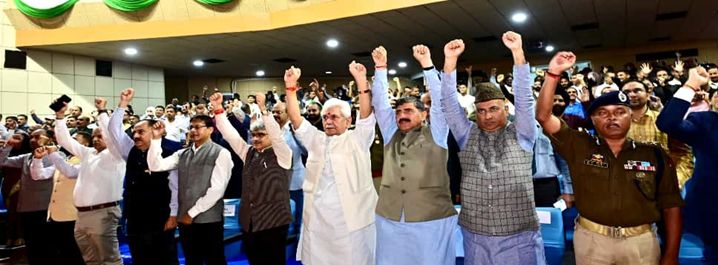
“Our commitment and dedication to the motherland will take our nation to its destiny of a Viksit Bharat. This song awakened the spirit of unity and pride during India’s freedom struggle and continues to inspire generations even today.”
By Mohammad Irfan
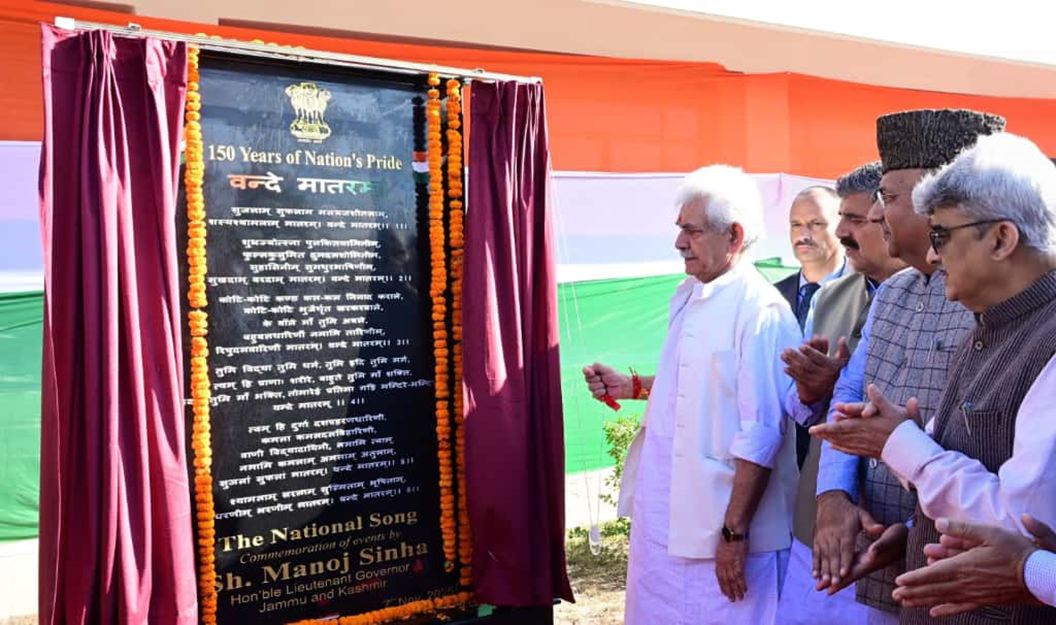
The 150th-year celebration of Vande Mataram was not merely an anniversary event; it was a revival of national consciousness deeply woven into India’s civilizational ethos. Lieutenant Governor Manoj Sinha, who attended the event organized by the Department of Culture, described the moment as “a sacred homage to the spirit that binds India as one nation — the spirit of Maa Bharti.” The Lieutenant Governor paid floral tributes to Rishi Bankim Chandra Chattopadhyay, the great patriot, philosopher, and author of Vande Mataram, and inaugurated an exhibition chronicling the song’s evolution — from its publication in Bangadarshan in 1875 to its transformation into a rallying cry for India’s freedom movement. “Rishi Bankim Chandra strengthened the bond between Maa Bharti and her sons and inspired generations to secure independence,” LG Sinha said, as attendees — students, officials, and cultural representatives — joined in the mass singing of the full version of the national song.
The Eternal Song Of India’s Spirit: In his address, Lieutenant Governor Manoj Sinha emphasized that Vande Mataram is not just a song but a living embodiment of India’s spiritual, cultural, and emotional unity. “Our commitment and dedication to the motherland will take our nation to its destiny of a Viksit Bharat,” he remarked, linking the historical power of the song to the aspirations of a modern, self-reliant India. He further reminded the youth of their vital role as carriers of India’s timeless values. “The young generation must remember that they are inheritors of this great civilization and their contribution to the progress and prosperity of society will be a fitting tribute to Maa Bharti,” the LG said. This call resonated deeply with the audience, underscoring the idea that nation-building is not a passive inheritance but an active duty rooted in gratitude, respect, and service.
From Anandamath To Viksit Bharat|The Journey Of A National Awakening: The event commemorated a landmark — 150 years since Bankim Chandra Chattopadhyay penned Vande Mataram on the sacred occasion of Akshaya Navami, November 7, 1875. First published in Bangadarshan as part of his novel Anandamath, the song invoked the motherland as the embodiment of divine power — nurturing, protective, and capable of righteous destruction when her children are endangered. Historically, Vande Mataram was more than literature — it was resistance in lyrical form. It captured India’s awakening against colonial subjugation and became the chant of freedom fighters, revolutionaries, and common citizens alike. The British viewed it as subversive, while Indians saw it as sacred. It symbolized what political slogans could not — love for the land, faith in her destiny, and unity across diversity. This historical resonance was echoed in LG Sinha’s speech, where he noted, “Every generation must rediscover the message of Vande Mataram — that our motherland is not just territory, but an idea, a consciousness, a divinity that commands our loyalty and service.”
Vande Mataram|A Symbol Of Unity Beyond Faith And Region : In his analytical reflection, LG Sinha underscored that Vande Mataram transcends all social, religious, and linguistic boundaries. “The song invokes the mother — the eternal nurturer — and that emotion unites all Indians. When we say Vande Mataram, we are not invoking division but celebrating unity through reverence,” he said. The Lieutenant Governor’s message carried a strong undertone of cultural integration. In an era where the idea of nationalism often becomes politicized, his emphasis restored the spiritual and inclusive nature of patriotism. He articulated that Vande Mataram belongs to every Indian, regardless of belief or background, because it celebrates the mother — the land that feeds, protects, and sustains. This viewpoint aligns closely with the philosophy of Vasudhaiva Kutumbakam — “the world is one family” — which forms the cornerstone of India’s cultural diplomacy and spiritual outlook. In LG Sinha’s words, “The emotional depth of Vande Mataram reminds us that our identity is larger than any boundary — it is civilizational, timeless, and rooted in universal compassion.”
The Celebration: A Confluence of Emotion, Music, Memory: The 150th-year commemoration brought together diverse voices from across Jammu and Kashmir. From schoolchildren to scholars, government officials to citizens, the event was a true people’s celebration. The highlight was the mass singing of the complete version of Vande Mataram, a moment charged with patriotic fervor. As voices resonated through the venue, the emotional power of the song was palpable — a reminder that even after a century and a half, Bankim Chandra’s words continue to evoke the same pride and reverence. The event also showcased a well-curated exhibition tracing the historical journey of Vande Mataram: manuscripts, early prints from Bangadarshan, photographs of freedom fighters, and archival recordings of the song. It was not merely a display of heritage but a narrative of resilience — a journey of how a song became synonymous with India’s soul.
Institutional Presence And The Message Of Cultural Continuity: The event saw the presence of dignitaries including Members of Parliament Jugal Kishore Sharma and Er. Gulam Ali Khatana, Chief Secretary Atal Dulloo, Principal Secretary (Home) Chandraker Bharti, IGP Jammu Bhim Sen Tuti, Principal Secretary (Culture) Brij Mohan Sharma, Divisional Commissioner Jammu Ramesh Kumar, and senior officials from the civil administration. In a symbolic gesture of inclusivity, officials and citizens from across Jammu and Kashmir joined the celebrations virtually, demonstrating that the message of Vande Mataram transcends geography and continues to unite the Union Territory’s diverse communities. The Department of Culture ensured that the event represented India’s plural ethos — classical renditions of Vande Mataram were followed by folk adaptations, bringing together Jammu’s Dogra traditions, Kashmir’s Sufi strains, and Ladakh’s devotional chants. It reflected the seamless blend of faiths and languages that form the living spirit of Indian unity.
Vande Mataram | A Call For Modern Nation-Building: Analytically, LG Sinha’s speech linked the cultural past with the developmental future. His message was that Vande Mataram is not confined to history but is a guiding principle for India’s transformation into a Viksit Bharat — a developed, self-reliant, and equitable nation. He reminded citizens that the sacrifices of those who sang Vande Mataram under colonial repression must inspire today’s citizens to dedicate themselves to the progress of the country. “True patriotism,” he said, “lies not only in words but in work — in building schools, nurturing innovation, empowering women, protecting our environment, and ensuring justice for all.” This analytical lens positioned Vande Mataram as an ethical framework for governance and civic responsibility. By invoking Maa Bharti, LG Sinha effectively translated the emotional vocabulary of the song into a practical vision for India’s 21st-century development.
Viksit Bharat|The New Form Of Patriotism: The Lieutenant Governor’s articulation of Viksit Bharat — a “developed India” — draws from Prime Minister Narendra Modi’s national vision. However, Sinha gave it a cultural foundation, implying that development cannot be merely economic; it must be moral, social, and spiritual. In his view, a Viksit Bharat is one where every citizen contributes meaningfully, where youth lead innovation with integrity, and where women — the living forms of Shakti — shape the nation’s destiny. “Our mothers and sisters have always been the protectors of cultural strength. Their empowerment is the empowerment of Bharat herself,” he noted. This integration of cultural heritage with modern aspirations made his message both reflective and forward-looking. It was not nostalgia for the past but a reawakening of its spirit in the context of modern nation-building.
Youth The Torchbearers Of India’s Future: One of the most striking aspects of LG Sinha’s address was his emphasis on the role of the youth. “The young generation must remember that they are inheritors of this great civilization,” he said. “Their contribution in the progress and prosperity of society will be a fitting tribute to Maa Bharti.” This statement transforms Vande Mataram from a historical song into a moral responsibility. The youth, in his view, must not see patriotism as ceremonial but as actionable — through education, social service, innovation, and nation-first thinking. He urged educational institutions to embed cultural literacy and civic consciousness in their curriculum. The aim, he suggested, should be to produce not just professionals but citizens — individuals who see national progress as their personal duty.
Bankim Chandra’s Vision And Its Relevance Today: Rishi Bankim Chandra Chattopadhyay’s Vande Mataram emerged at a time of national dormancy, awakening the spirit of resistance and self-respect. His depiction of the motherland as both compassionate and powerful was a metaphor for a nation that nurtures but also defends. In LG Sinha’s interpretation, this duality remains vital today — India as a compassionate democracy and a resolute nation. “The image of the mother in Vande Mataram represents both care and courage. That balance is what our governance and citizenship should reflect,” he observed. This analytical connection between cultural imagery and statecraft marks an evolution in how India’s historical symbols are interpreted in governance. Rather than viewing them as relics of the past, LG Sinha’s speech repositions them as sources of moral and philosophical guidance for the future.
“The young generation must remember that they are inheritors of this great civilization. Their contribution to the progress and prosperity of society will be a fitting tribute to Maa Bharti. Citizens should live by the message of Vande Mataram, turning devotion to the motherland into a collective effort toward nation-building.”
The Larger Message| From Devotion To Duty: The 150th anniversary celebrations were more than a cultural commemoration — they were a reminder that devotion must translate into duty. Vande Mataram, meaning “I bow to thee, Mother,” implies reverence not just in words but through service, honesty, and national contribution. LG Sinha’s speech captured this essence succinctly. He said, “Our motherland has given us everything — it is our duty to give back through our commitment, hard work, and integrity.” This message resonated across the gathering, emphasizing that patriotism in the 21st century must manifest in tangible progress. The celebration thus became both reflective and aspirational — connecting India’s literary heritage with its developmental goals.
A Shared Cultural Heritage For A United Future: The 150th-year celebration of Vande Mataram also acted as a bridge between the Union Territory of Jammu and Kashmir and the broader national fabric. By involving citizens virtually and encouraging participation across regions, the event underscored inclusivity as the foundation of unity. The Lieutenant Governor’s message was clear — culture is not ornamental but foundational to peace and progress. “When people sing together, divisions fade,” he remarked informally to reporters after the event, symbolizing how shared cultural moments can heal and unite.
Kashmir Horizon View: As India marks 150 years of Vande Mataram, the message from Jammu resounds nationwide — that the song’s essence lies in unity, respect, and tireless devotion to the nation. The event reaffirmed that the emotional force that once ignited India’s struggle for freedom now fuels its quest for a Viksit Bharat. Lieutenant Governor Manoj Sinha’s words summed up this continuity: “Our commitment and dedication to the motherland will take our nation to its destiny of a Viksit Bharat.” His message was not just a tribute to the past but a call to the present — for every citizen to make Vande Mataram a way of life. Through its combination of history, culture, and vision, the celebration turned remembrance into resolve — ensuring that the spirit of Vande Mataram continues to inspire India’s onward march, from freedom to prosperity, from devotion to destiny.
(“Team Kashmir Horizon” is committed to continuous improvement and invites feedback and suggestions from readers and its followers on social media sites. Reader insights are considered vital for enhancing content quality and empowering the community. The team encourages open communication and values the thoughts and ideas of its audience, believing that such input will enable them to serve the public more effectively. The initiative aims to ensure that readers have the best possible experience with “Kashmir Horizon”. Interested individuals can reach out to us via email at [email protected].)