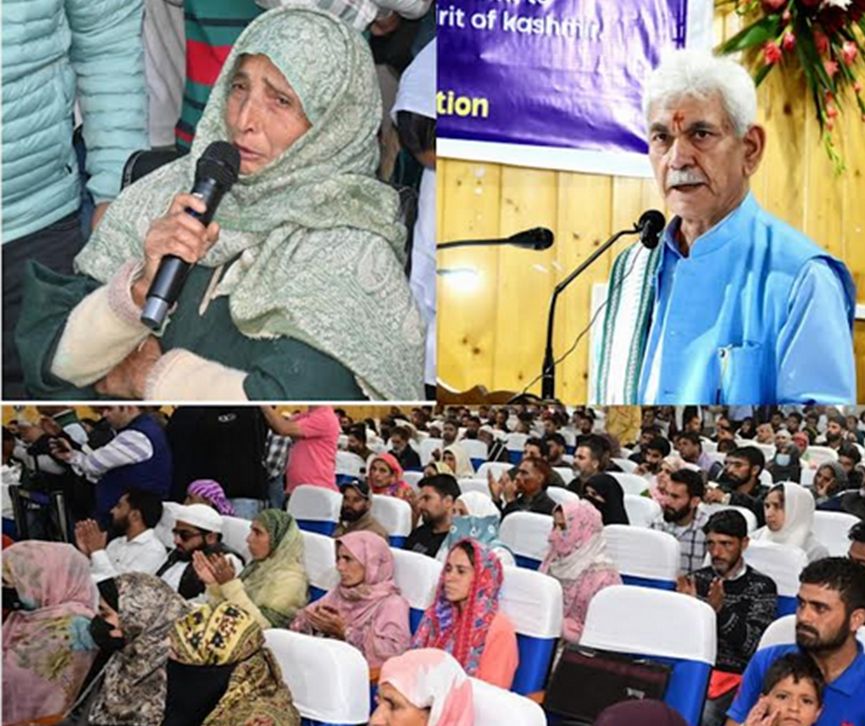
“Once known as the “village of pain” — LG met families of civilians killed by terrorists. Addressing the next of kin at GDC Kupwara, the LG said justice, respect and dignity for families of civilian martyrs is his top priority.”
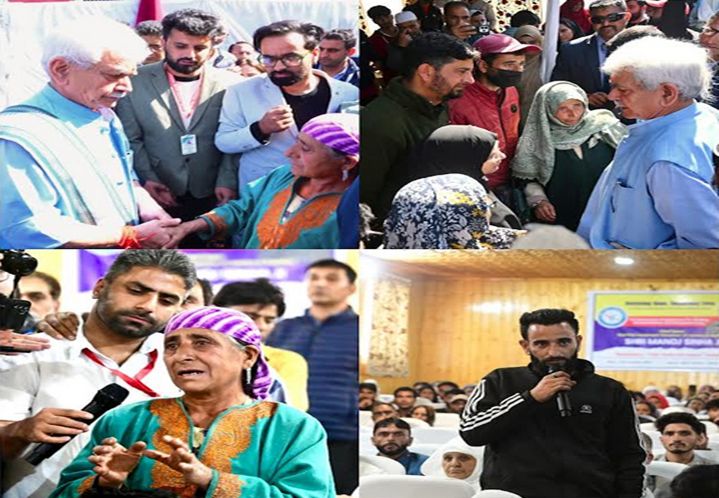
In the quiet village of Dardpora in north Kashmir’s Kupwara district once synonymous with tragedy and loss—emotions ran deep this week as Lieutenant Governor Manoj Sinha met families of those slain by Pakistan-backed terrorists during the dark years of insurgency. The Lieutenant Governor’s visit, part of a broader mission to deliver justice, dignity, and rehabilitation to the families of civilian martyrs, carried symbolic and emotional weight. For the first time in decades, many families who had suffered in silence felt seen—not merely as statistics of conflict, but as citizens with rights, dignity, and memories that demand respect. “Justice, respect and dignity to family members of civilian martyrs killed by Pakistan-backed terrorists is my top priority,” LG Sinha declared before a gathering at the Government Degree College, Kupwara. “Their decades-long trauma, torment, and suffering is over. We will ensure all the support so that they can reclaim their lives.” The words resonated across a hall filled with the families of victims, civil officials, security officers, and local residents. For many, this moment symbolized more than administrative outreach—it was an official acknowledgment of pain long neglected by the system.
Dardpora|A Village That Symbolizes Kashmir’s Unspoken Grief: Dardpora—literally “the village of pain”—lies close to the Line of Control. In the early 1990s, when terror erupted in Kashmir, this remote hamlet was turned into a theatre of bloodshed. Dozens of men, many of them daily wage workers, farmers, and teachers, were abducted and killed by Pakistan-backed terrorist outfits, often under fabricated charges of being “informers.” What followed was years of devastation. Widows were left to fend for children without financial or social support. Generations grew up under the shadow of loss, unable to complete education or access government resources due to bureaucratic indifference and stigma attached to being “victims of terror.” A woman in her fifties, Hameeda Begum, who lost her husband in 1996, spoke with quiet resilience: “We were forgotten. Nobody came for years. We raised our children with tears and borrowed money. Today, for the first time, the administration has come to our doorstep and said we matter.” The Lieutenant Governor’s meeting with Hameeda and others like her carried more than ceremonial significance. It represented a structural shift in how the Union Territory administration now approaches victims of terrorism—not merely as passive recipients of aid but as active citizens entitled to justice and state protection.
Restoring Faith|Justice, Jobs, Rehabilitation: During his address at Kupwara College, LG Sinha outlined the government’s multi-tiered plan for the rehabilitation and empowerment of terror victim families. He revealed that around 250 families have already been provided government jobs under the rehabilitation program and emphasized that the mission will continue “till justice is done to every affected family.” “This is the beginning of a new era of justice in Jammu and Kashmir,” he said. “We are dismantling the structures that denied these families their rights for decades.” Officials accompanying the LG—including Divisional Commissioner Kashmir Anshul Garg, DIG NKR Baramulla Maqsood-ul-Zaman, and Deputy Commissioner Kupwara Shrikant Suse—briefed him on the progress of rehabilitation schemes and educational assistance programs launched for the children of civilian martyrs. The administration has also tied up with High-range Rural Development Society (HRDS India) through a Memorandum of Understanding to rebuild houses destroyed by terrorists. Under this initiative, HRDS India, in collaboration with the Divisional Commissioners of Jammu and Kashmir, will identify and reconstruct homes for victims who possess land but lack resources. This model, combining non-governmental capacity with administrative oversight, marks a new phase of welfare delivery in post-insurgency Jammu and Kashmir.
Breaking The Silence Around Civilian Martyrs: For decades, narratives surrounding Kashmir’s violence remained politically charged and selectively told. While attention often focused on terrorists or counterinsurgency operations, civilian victims of terrorism—especially those targeted by Pakistan-backed outfits—were largely erased from the public discourse.
LG Sinha’s Remarks Sought To Reclaim That Narrative: “Families of civilians who were killed by Pakistan-backed terrorists also suffered systemic barriers which stifled their progress,” he said. “They were denied rights, dignity, and access to resources. All obstacles are now removed.”
His words highlight a crucial transformation in governance: acknowledging that victims of terrorism deserve the same recognition and compassion as any other victims of conflict. For years, social stigma and political polarization prevented open acknowledgment of Pakistan-sponsored atrocities. Many families avoided speaking publicly for fear of reprisal. Others felt that their pain did not align with the dominant political discourse. That silence, Sinha noted, was not accidental—it was part of a deliberate disinformation ecosystem created by Pakistan and its proxies to “absolve the terror country of its sins.” “The culprit Pakistani terrorists and their support system in the valley ran a false narrative for three decades,” the LG asserted. “Pakistan, the breeding ground for terrorism, is exposed now. Those involved in peddling this fake narrative will be brought to justice.”
His statement reflects a broader national security approach that couples counterterror operations with narrative correction and public accountability.
“Facing widows, orphans and survivors, LG Sinha assured them that the long years of pain and neglect were ending. We will ensure all possible support so that you can rebuild your lives. Emphasizing that 250 affected families have already been provided government jobs and that more would follow under a comprehensive rehabilitation plan.”
Administrative Sensitivity, Emotional Healing: While security and justice are tangible goals, healing the emotional and psychological trauma of terror victims remains a long-term challenge. The LG acknowledged this with rare candor: “It is difficult to articulate the pain and suffering of terror victim families due to their profound emotional and psychological trauma. The administration will handle each case with full sensitivity and responsibility.” Officials in Kupwara say that beyond jobs and compensation, efforts are being made to provide mental health counseling, educational scholarships, and community reintegration programs for widows and children affected by terror. “We are not just disbursing aid. We are rebuilding lives. Many of these families were isolated socially and economically. Our goal is to ensure they feel part of mainstream society again.” The Lieutenant Governor’s visit also included personal interactions—off-record conversations with mothers, widows, and orphans—underscoring an empathetic governance model that seeks to rebuild trust between citizens and institutions.
Kupwara|The Symbolism Of A Border Distt: Kupwara, bordering Pakistan-occupied territories, has borne the brunt of infiltration, cross-border firing, and terror violence for decades. Yet it is also a district of resilience—where security forces and civilians co-exist amid persistent threats. The choice of Kupwara for this outreach is not accidental. It serves as a microcosm of Jammu and Kashmir’s counter-terror transformation: from being a theatre of violence to becoming a symbol of renewal. The Government’s visible engagement here carries strategic significance. By delivering justice at the border, the government signals that the wounds inflicted by terrorism are being addressed not just in rhetoric but through institutional action. Chairman of the Save Youth, Save Future Foundation, Wajahat Farooq Bhat, who was present during the event, noted that the outreach has rekindled faith in the state’s commitment to ordinary people. “When the head of the Union Territory comes here to listen, it restores people’s confidence that the system stands with them, not above them,” he said.
Rewriting A Narrative Of Hope: Analysts see LG Sinha’s Kupwara visit as part of a larger effort to shift the narrative of Jammu and Kashmir from victimhood to empowerment. In the post-2019 landscape, where constitutional and political frameworks have undergone significant reorganization, such interventions represent grassroots reconciliation through justice. Security experts argue that acknowledging civilian suffering also serves a counterterror purpose—it delegitimizes extremist propaganda and restores the moral legitimacy of state institutions.
Retired Security Analyst Col. R K Sharma Explains: “Pakistan’s terror factories thrived on narratives that painted terrorists as ‘freedom fighters.’ When the administration gives voice to the actual victims—the civilians murdered by these so-called fighters—it dismantles decades of psychological warfare.” This reframing aligns with India’s broader counterterrorism policy—exposing Pakistan’s duplicity at both diplomatic and local levels. The LG’s assertion that “Pakistan is exposed now” underscores this dual messaging: holding the external perpetrator accountable while empowering internal victims.
A New Governance Template For Conflict-Affected Regions: Beyond symbolism, the Kupwara visit reflects a policy template—how governance can operate in post-conflict zones where trauma, politics, and justice intersect.
Three Pillars Underpin This Approach: Recognition: Publicly acknowledging the suffering of terror victims and bringing their stories into official narratives.
Rehabilitation: Providing tangible support—jobs, housing, education—to rebuild livelihoods.
Restoration Of Dignity: Ensuring victims are treated as citizens with agency, not passive beneficiaries. The administration’s decision to involve civil society organizations like HRDS India marks a shift toward participatory governance. It decentralizes rehabilitation efforts and ensures transparency in implementation. A senior bureaucrat at Divisional Commissioner’s office observed: “We are bridging governance with compassion. Development and justice must move together if peace has to be sustainable.”
The Unfinished Work Ahead: Despite progress, challenges remain. Many families still await job appointments or financial compensation. Legal and bureaucratic hurdles continue to delay benefits in certain cases. Experts also point to the need for institutionalized trauma care, scholarship pipelines, and vocational training for widows and orphans. Kupwara resident Nisar Ahmad, whose brother was killed in 1994, said: “We are thankful for the recognition, but rehabilitation should be faster. We want to rebuild, not just remember.” The LG’s assurance that “all obstacles are now removed” will now be tested on the ground—through consistent follow-up, transparency, and accountability mechanisms.
A Turning Point In Kashmir’s Conflict Memory: For over three decades, Pakistan-backed terrorism has claimed tens of thousands of civilian lives across Jammu and Kashmir. Yet, for a long time, the narratives of those killed by terrorists remained politically inconvenient and socially marginalized. By visiting Dardpora and meeting families face-to-face, LG Manoj Sinha has effectively brought the focus back to the real victims of terror. His insistence that this marks “the beginning of a new era of justice” underscores a moral pivot in Jammu and Kashmir’s official policy—from counterinsurgency to restorative governance. As Dardpora’s residents watched the LG’s convoy leave their valley, many expressed cautious optimism. “We have heard many promises before,” said Fatima, whose son was killed in 2002. “But today, at least, someone came to listen.” Listening—perhaps the most powerful form of justice in a place that has endured so much silence.
Kashmir Horizon View: The Kupwara outreach signals a broader transformation in Jammu and Kashmir’s administrative mindset—one that recognizes pain as a policy concern, not just a political talking point. Justice, in this context, extends beyond punishment—it means restoration of dignity, acknowledgment of truth, and empowerment of those long excluded from the developmental narrative. As the Lieutenant Governor put it,“This is the beginning of a new era of justice in Jammu and Kashmir.” If this promise is matched by sustained action, Dardpora—the “village of pain”—may yet become a symbol of healing, not just for Kupwara, but for the entire Union Territory.
(“Team Kashmir Horizon” is committed to continuous improvement and invites feedback and suggestions from readers and its followers on social media sites. Reader insights are considered vital for enhancing content quality and empowering the community. The team encourages open communication and values the thoughts and ideas of its audience, believing that such input will enable them to serve the public more effectively. The initiative aims to ensure that readers have the best possible experience with “Kashmir Horizon”. Interested individuals can reach out to us via email at [email protected].)