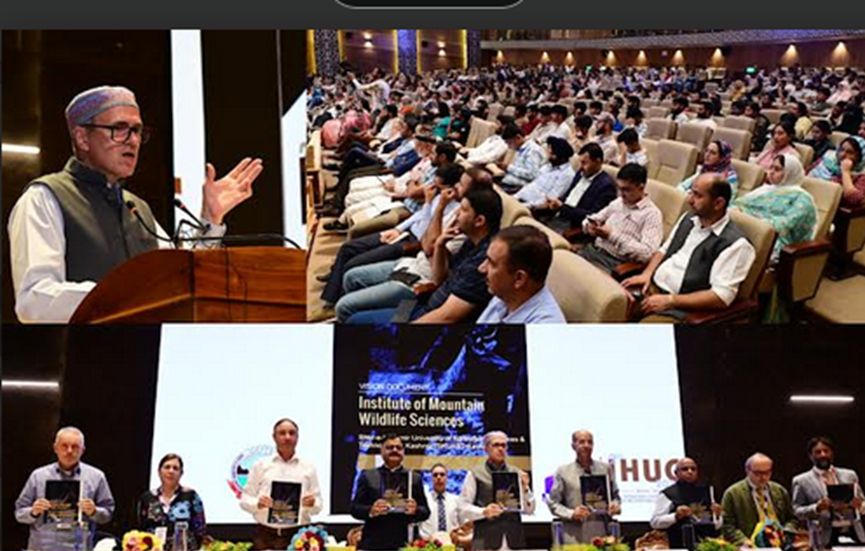
- 2nd Int’l Conference Brings Global Experts to SKUAST-K
“Kashmir’s iconic Hangul, teetering on the brink of extinction, received renewed hope as Chief Minister Omar Abdullah pledged swift action on conservation measures at the Second International Conference on Hangul and Other Threatened Ungulates Conservation (2IHUC-25) at SKUAST-K. Addressing global experts and policymakers, he stressed that protecting wildlife is not just about saving animals but about securing human survival and ecological balance.”
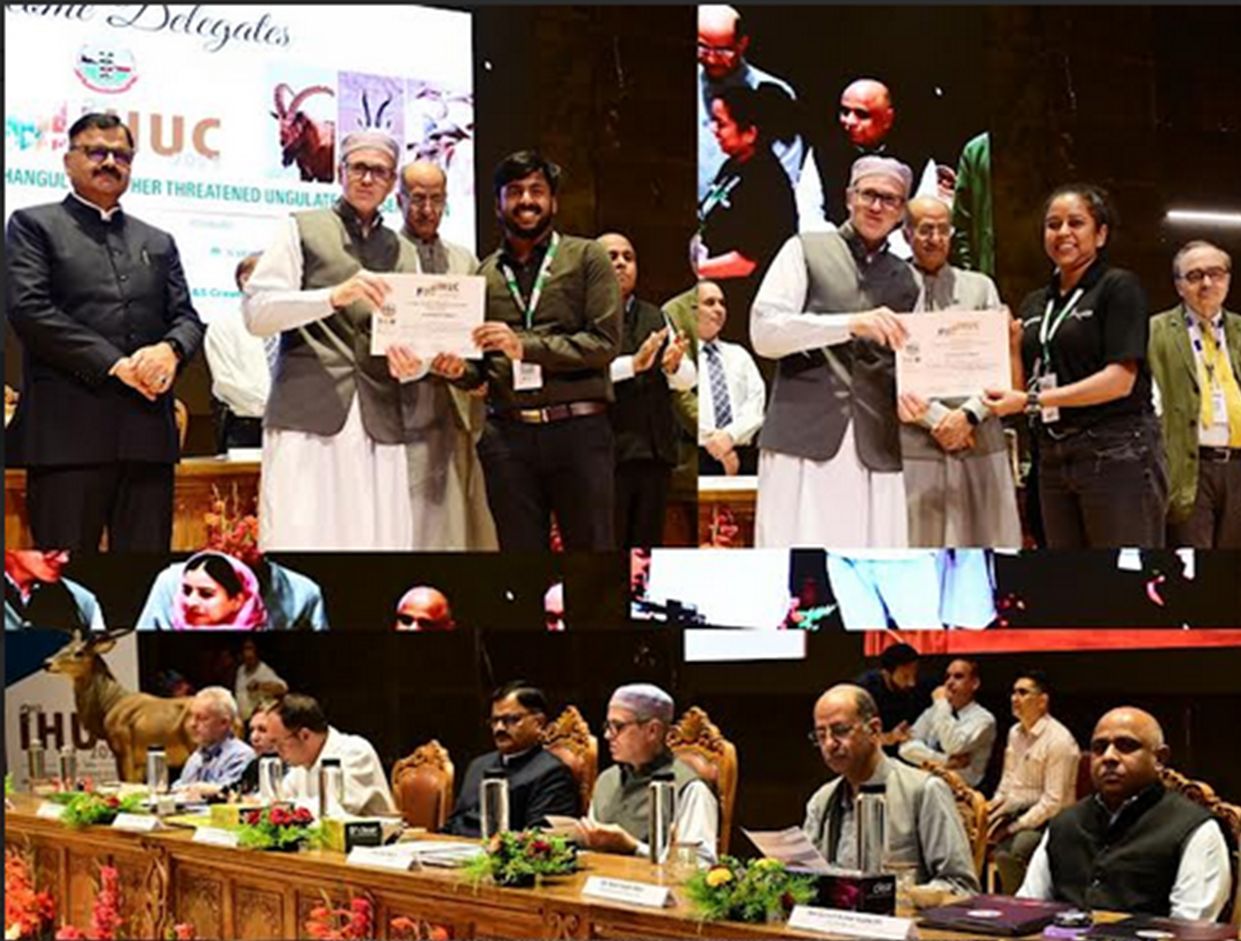
Chief Minister Omar Abdullah today pledged that his government would act promptly on the recommendations of the Second International Conference on Hangul Protection and Other Threatened Ungulates Conservation (2IHUC-25). He said his administration would ensure measurable progress in the population of Hangul and Markhor before the next such gathering is convened. Speaking as Pro-Chancellor of Sher-e-Kashmir University of Agricultural Sciences and Technology of Kashmir (SKUAST-K), Omar Abdullah addressed the valedictory session of the three-day conference at the university’s Shalimar campus. He assured conservation experts, scientists, policymakers, and delegates from India and abroad that the State Government would treat the outcomes of the event with “utmost seriousness and urgency.”
Conservation The Issue Of Human Survival: The Chief Minister noted that conservation was not merely about safeguarding wildlife for aesthetic or recreational purposes but was fundamentally tied to human existence. He drew upon the words of eminent conservationist M.K. Ranjitsinh, saying that the fate of human beings is deeply connected to the survival of other species. “Conservation is not only about animals—it is about human survival itself. Protecting Hangul, Markhor, or any threatened species is essentially about protecting life and the delicate ecological balance we depend upon,” he remarked. Abdullah’s words resonated with the audience as he underlined that thriving ecosystems sustain communities, livelihoods, and overall environmental health.
A Personal Regret And A Cautionary Note: In a rare personal disclosure, Omar Abdullah admitted that despite living close to Dachigam National Park, he had never seen a Hangul in the wild with his own eyes. The admission was followed by a warning that if urgent action was not taken, the iconic Kashmir Stag might vanish from the Valley’s forests, leaving behind only photographs and stories. “I don’t want a situation where our children and grandchildren know these species only through photographs in books, like the dodo or woolly mammoth. That would be a tragedy we must not allow,” he cautioned. His words reflected the sense of urgency that conservationists have long expressed about the precarious survival of the Hangul.
Need For Research–Government Synergy: Chief Minister Omar Abdullah emphasized that conferences and research findings would be futile unless translated into policy and on-ground action. He called for a close partnership between universities, research institutions, and government agencies to ensure that conservation goals are met effectively. “Unless there is synergy between academic research and government implementation, we risk losing magnificent animals like the Hangul. These conferences provide ideas, but it is on us to transform those ideas into ground realities,” he stated. The Chief Minister further cautioned against bureaucratic delays, asserting that endangered species could not wait for files to move from one desk to another. He urged officials to adopt a results-oriented approach and promised that his government would fast-track the recommendations.
Gathering Of Global, National Experts: The international conference brought together more than 200 delegates, including eminent wildlife experts, conservationists, and biologists from countries such as the United States, United Kingdom, Canada, the Middle East, Central Asia, and South Asia. The diverse participation reflected the global significance of Himalayan biodiversity and the shared responsibility for its protection. The three-day event provided a platform for sharing research and strategies related to the conservation of Hangul, Markhor, and other threatened ungulates of the Himalayan belt. Several papers highlighted innovative practices from other regions that could be adapted to Kashmir. On the final day, Omar Abdullah released a Vision Document titled ‘Institute of Mountain Wildlife Sciences’, which outlines plans for a dedicated research institute focused on high-altitude species. He also distributed awards and appreciation certificates to participants who contributed significantly to the proceedings.
Other Voices Of Commitment: Apart from the Chief Minister, the valedictory session was addressed by several dignitaries including Forest Minister Javed Ahmed Rana, Advisor to the Chief Minister Nasir Aslam Wani, Vice Chancellor of SKUAST-K Prof. Nazir A. Ganie, Principal Chief Conservator of Forests Suresh Gupta, and international expert Dr. Gonzalez. Each speaker stressed the importance of balancing conservation with community engagement. Forest Minister Rana said that without active participation from local communities, no conservation project could succeed. Prof. Nazir A. Ganie highlighted the role of academic institutions in providing scientific backing to policy decisions. Dr. Gonzalez brought global perspectives to the table, sharing success stories from Central Asia where community-based models had reversed wildlife decline.
Hangul The Kashmir’s Endangered Icon: The Hangul, or Kashmir Stag (Cervus hanglu hanglu), is the only surviving subspecies of the Red Deer in the Indian subcontinent. Known for its imposing antlers that may carry up to 16 tines, the Hangul has long been an emblem of Kashmir’s rich biodiversity. Its cultural symbolism is deeply rooted in the Valley, often appearing in folklore, art, and heritage. Yet, despite this iconic status, the Hangul’s survival has been hanging by a thread. Confined primarily to Dachigam National Park near Srinagar, its population has shrunk alarmingly over the past century. From thousands roaming freely across Kashmir and even parts of Himachal Pradesh a century ago, today the numbers hover precariously around 150 to 200.
History Of Hangul Preservation In J&K: The struggle to save the Hangul spans more than seven decades. During the princely era of Kashmir, excessive hunting and habitat loss pushed the species into decline. By the 1940s, its population was already dwindling dangerously. In 1951, Dachigam was declared a wildlife sanctuary primarily to safeguard this endangered deer. In 1970, the state government, with support from the International Union for Conservation of Nature (IUCN) and the World Wide Fund for Nature (WWF), launched Project Hangul, inspired by the earlier success of Project Tiger. This was the first concentrated effort aimed specifically at Hangul conservation. Initially, the project yielded promising results. By the mid-1980s, the population had climbed to nearly 340 individuals. However, the gains were not sustained. The 1990s brought severe setbacks due to political turmoil, habitat encroachment, illegal grazing, and reduced monitoring. By the early 2000s, the population had again dropped to alarmingly low levels, triggering fresh international concern. Despite multiple surveys, studies, and management plans, the Hangul has continued to struggle against habitat fragmentation, predation pressure, and inbreeding risks. Conservationists argue that without radical habitat restoration and stricter regulation, the species may face extinction within decades.
“The conference closed with a clear message: promises must now turn into action. With the government, scientists, and communities working together, the Hangul’s decline can still be reversed. If the commitments made at SKUAST-K are honoured, future generations may inherit not just stories and pictures, but thriving herds of Kashmir’s most treasured deer.”
Challenges Facing Hangul Conservation: One of the central threats remains habitat fragmentation. Expansion of human settlements, farming activities, and infrastructure projects have drastically reduced the Hangul’s natural range. Overgrazing by domestic livestock inside Dachigam not only reduces available forage but also damages delicate ecosystems that Hangul depend upon. Poaching, though less rampant than in the past, has not been entirely eradicated. Furthermore, the small population size poses a serious genetic bottleneck, increasing vulnerability to disease and reducing resilience. Predation by leopards and bears has also intensified, with fawns being the most affected. Environmentalists also highlight the conflict between conservation and development. Hydroelectric projects, road construction, and tourism infrastructure often fragment wildlife corridors, making it harder for Hangul to migrate or expand into former ranges.
Spotlight On The Markhor: The conference also focused on the Markhor (Capra falconeri), another threatened ungulate native to high-altitude regions of Jammu and Kashmir. Known for its spectacular spiral horns, the Markhor is a flagship species for mountain ecosystems. In many parts of Central Asia, community-led programs have successfully increased Markhor numbers, offering models that could be replicated in Kashmir. Speakers underlined that protecting the Markhor was not only about saving a species but also about conserving fragile mountain habitats that provide essential ecosystem services, from water security to soil stability.
Towards A Vision For Mountain Wildlife: The release of the Vision Document for the Institute of Mountain Wildlife Sciences was hailed as a milestone of the conference. The proposed institute will serve as a regional hub for specialized research on Himalayan fauna, policy guidance, and training of young wildlife professionals. It is expected to facilitate international collaborations and provide data-driven recommendations to governments. By institutionalizing research and conservation under one umbrella, the institute aims to bridge the long-standing gap between academia and administration—a gap that Chief Minister Omar Abdullah himself pointed out in his address.
CM Omar’s Closing Commitment: Reiterating his government’s dedication, Omar Abdullah concluded his speech on an optimistic note. “That is my hope, that is my belief, and I am sure that if we approach it the right way—as we saw success with Project Tiger and encouraging signs with Hangul and Markhor—that success will continue to grow,” he said. He assured conservationists and the wider public that the work initiated through the conference would not end with resolutions on paper but would translate into visible, measurable action on the ground. His remarks were met with applause, reflecting the collective aspiration of all participants that the Hangul’s story of survival should one day be counted among conservation’s great successes.
Kashmir Horizon View: The 2nd International Conference on Hangul and Other Threatened Ungulates has ended with renewed hope, but also with a sharper realization of the immense challenges ahead. The pledges made by Chief Minister Omar Abdullah, along with the insights of scientists and conservationists, underline the urgency of saving the Hangul, the Markhor, and other vulnerable species of the Himalayas. Yet, as history shows, pledges must be backed by sustained action, adequate funding, and political will. The way forward requires a multi-pronged strategy. First, habitat restoration must be prioritized. Dachigam National Park and its adjoining landscapes need stricter protection from encroachment, overgrazing, and infrastructure projects that fragment the ecosystem. Establishing wildlife corridors to connect Dachigam with other habitats will give the Hangul a chance to expand its range and overcome genetic isolation. Second, science-driven management must be at the heart of policy. The proposed Institute of Mountain Wildlife Sciences can become a hub for advanced research and long-term monitoring. Breeding programs, predator-prey assessments, and genetic studies will provide tools to secure the Hangul’s survival. Third, community involvement is essential. Local communities living near protected areas must be made stakeholders in conservation through incentives, awareness campaigns, and livelihood programs that reduce dependence on forest resources. Successful models from Central Asia for Markhor protection prove that community-led approaches can yield tangible results. Fourth, conservation must be insulated from bureaucratic delays. Fast-tracking of recommendations, steady budget allocations, and inter-departmental coordination will determine whether promises translate into results. The conference has provided a roadmap, but it is the journey that now matters. If words turn into action, the Hangul and Markhor may yet reclaim their rightful space in Kashmir’s wilderness, ensuring that future generations inherit not just photographs, but living symbols of resilience and natural heritage.
(“Team Kashmir Horizon” is committed to continuous improvement and invites feedback and suggestions from readers and its followers on social media sites. Reader insights are considered vital for enhancing content quality and empowering the community. The team encourages open communication and values the thoughts and ideas of its audience, believing that such input will enable them to serve the public more effectively. The initiative aims to ensure that readers have the best possible experience with “Kashmir Horizon”. Interested individuals can reach out to us via email at [email protected].)