- Omar Showcases Kashmir’s Tourism, Culture On Ahmedabad’s Riverfront
“Jammu & Kashmir Chief Minister Omar Abdullah’s recent visit to Gujarat marked a significant blend of tourism promotion and quiet political symbolism. From inaugurating roadshows and trade fairs to visiting Sabarmati Ashram and engaging with the local business community, the tour showcased J&K’s growing outreach beyond regional boundaries—projecting it as both a travel destination and a vibrant economic partner.”
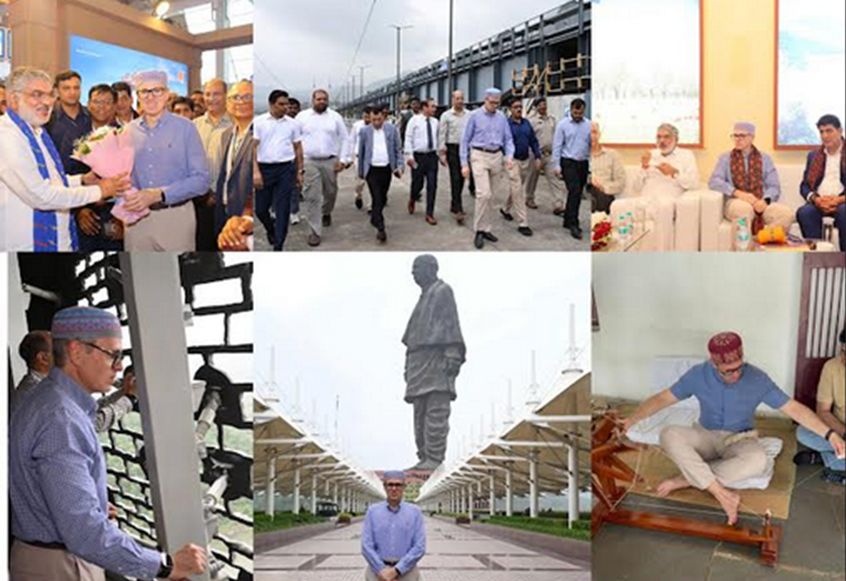
In a politically charged yet development-centric outreach, Jammu and Kashmir Chief Minister Omar Abdullah visited Gujarat this week, merging his mission to promote tourism with a subtle but powerful political message drawn from the legacy of Mahatma Gandhi. His trip, spanning visits to the iconic Sabarmati Ashram, a jog along the Riverfront, and the inauguration of key tourism and trade events, marked a significant effort to forge national unity while asserting Jammu and Kashmir’s evolving aspirations within the Indian Union. On Friday, Omar Abdullah visited the Sabarmati Ashram in Ahmedabad and posted a quote from Mahatma Gandhi that sent ripples through political and administrative circles alike: “True democracy cannot be worked by twenty men sitting at the centre. It has to be worked from below by the people of every village.” The timing of this statement—amid an ongoing debate on decentralisation and Jammu and Kashmir’s unique governance model—was seen by many as a respectful nudge to the Union Government to restore full democratic functionality to the region.
Gandhian Ideals, Modern Context: “I feel both humbled and privileged to have been shown around the Sabarmati Ashram of the Father of the Nation, Mahatma Gandhi,” Omar Abdullah said after his visit. “His teachings ring true even today and point us in the direction we should take but seldom do.” The Chief Minister’s reflections came at a time when the political discourse in Jammu and Kashmir continues to be framed by the Centre’s decisions post-August 5, 2019—when Article 370 was abrogated, stripping the region of its special constitutional status. While Abdullah made no direct political statements on Article 370 during his Gujarat visit, the invocation of Gandhian democracy and bottom-up governance was widely interpreted as a call for deeper democratic restoration in the Union Territory. At the Ashram, Abdullah tried his hand at the charkha—a symbol of self-reliance and resistance in India’s independence movement—further deepening the symbolic weight of his visit. His social media post featuring the Gandhian quote garnered significant engagement and sparked conversation among political observers and civil society leaders alike.
PM Modi Responds|”Kashmir To Kevadia”: In a rare and politically significant gesture, Prime Minister Narendra Modi acknowledged Omar Abdullah’s Gujarat visit in a post on X (formerly Twitter), stating: “Kashmir to Kevadia! Good to see Shri Omar Abdullah Ji enjoying his run at the Sabarmati Riverfront and visiting the Statue of Unity. His visit to SoU gives an important message of unity and will inspire our fellow Indians to travel to different parts of India.” This endorsement by the Prime Minister, especially at a time when the BJP and the National Conference have often been at ideological odds, was seen as a subtle message of reconciliation and mutual respect. Abdullah, in return, had earlier posted about his early morning run at the famed Sabarmati Riverfront promenade, praising it as “one of the nicest places I’ve been able to run.” “While in Ahmedabad for a tourism event, I took advantage of being here to get my morning run at the famed Sabarmati River Front promenade. It was a pleasure to get to share it with so many other walkers/runners,” Abdullah wrote.
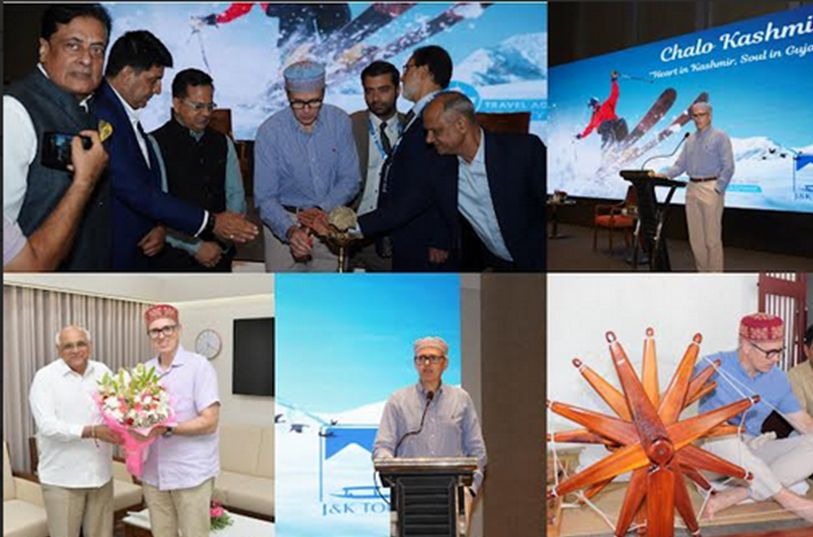
Promoting Kashmir As An All-Season Destination: While the symbolic and political aspects of Abdullah’s Gujarat visit caught national headlines, the core objective of the trip was to promote Jammu and Kashmir as a premium tourism and investment destination. On July 31, the Chief Minister inaugurated a high-profile Road Show and Business Meet in Ahmedabad, targeting tourism and trade partnerships between the two regions. Organised jointly by the Travel Agents Society of Kashmir (TASK), the Kashmir Chamber of Commerce and Industry (KCCI), and the South Gujarat Chamber of Commerce & Industry (SGCCI), the event brought together stakeholders from both states to explore opportunities in hospitality, adventure tourism, handicrafts, and infrastructure. “Jammu & Kashmir is open for business,” declared Chief Minister Abdullah in his keynote address. “We welcome our friends from Gujarat to explore, invest, and be part of our growth story.” Accompanied by top officials from his Government, including Advisor Nasir Aslam Wani and MLAs Farooq Ahmad Shah (Gulmarg) and Altaf Ahmad Wani (Pahalgam), Abdullah also highlighted the specific sectors where J&K seeks investment—luxury resorts, eco-tourism, heritage restoration, and infrastructure development. Presentations by prominent tourism players like Khyber Resorts, Ahad Hotels, and the Mushtaq Group illustrated the Union Territory’s growing capacity for high-value tourism experiences. Business-to-business networking sessions during the roadshow established crucial linkages between Gujarati entrepreneurs and Kashmiri businesses, reinforcing the message of unity through commerce.
Opening The Travel & Tourism Fair In Gandhinagar: On the same day, the Chief Minister also inaugurated the Travel & Tourism Fair (TTF) at the Mahatma Mandir Convention & Exhibition Centre in Gandhinagar. Speaking at the opening ceremony, Omar Abdullah extended a warm invitation to travellers across the country, particularly from Gujarat, to explore Kashmir’s beauty and diversity. He underscored Jammu & Kashmir’s offerings across all seasons—snow-capped mountains in winter, lush valleys in spring and summer, and vibrant cultural festivals year-round. “We’re not just a winter destination. We’re an all-season experience,” said Abdullah. “Whether it’s skiing in Gulmarg, the tulips of Srinagar, or the pilgrimage routes of Amarnath and Vaishno Devi, J&K has something to offer to every traveller.” The Chief Minister’s pitch was well received, especially among Gujarat’s travel industry leaders. Also present at the inauguration were Gujarat’s Tourism Minister Mulubhai Bera, Additional Chief Secretary to the CM Dheeraj Gupta, and Dr. Ashish Chandra Verma, Additional Chief Secretary, Tourism Department J&K. The three-day TTF event drew participation from over 900 exhibitors, including more than 70 stakeholders from Jammu & Kashmir and international representation from Sri Lanka. The event positioned Gujarat as a key hub for domestic travel and highlighted J&K’s growing presence in the national tourism landscape.
“While the visit focused largely on tourism and investment, Omar Abdullah’s gestures—invoking Gandhi, engaging with citizens, and avoiding partisan rhetoric—signaled a broader message of reconciliation and national unity. Subtle but strategic, the Gujarat tour underscored J&K’s evolving role in India’s developmental and democratic landscape.”
Strengthening Inter-State Cooperation: During his Gujarat visit, Omar Abdullah also held a one-on-one meeting with Gujarat Chief Minister Bhupendra Patel. The two leaders discussed inter-state collaboration on tourism promotion, administrative best practices, and inclusive development. The meeting was seen as an example of regional cooperation beyond party lines. While Gujarat is governed by the BJP and Jammu & Kashmir by the National Conference, the interaction between the two CMs symbolised a bipartisan approach to common developmental goals. Notably, officials from both governments—Rajender Kumar, Secretary Tourism, Government of Gujarat, and Prabhav Joshi, Commissioner of Tourism & MD, Gujarat Tourism Corporation—participated in the deliberations and agreed to consider joint promotional campaigns and cultural exchange programs in the near future.
A Showcase Of J&K’s Diversity: The Jammu and Kashmir Pavilion at TTF Ahmedabad stood out for its dynamic presentation of the Union Territory’s diverse tourism offerings. From handcrafted exhibits representing Kashmiri artistry to multimedia displays showcasing adventure travel, the pavilion attracted thousands of visitors and industry professionals. The participation of senior officials such as Raja Yaqoob (Director, Tourism Kashmir), Shreya Singhal (MD, JKTDC), and Vikas Gupta (Director, Tourism Jammu) further boosted the visibility of the region. The message was clear: Kashmir was ready—not just to host tourists, but to partner with India’s business ecosystem on equal terms. The TTF event coincided with the onset of India’s festive and winter travel season. With Ahmedabad and Gandhinagar emerging as key urban hubs in Western India, the presence of J&K Tourism in this edition of TTF was strategically vital. Industry watchers believe that the new outreach strategy—blending political messaging with cultural and economic promotion—could redefine how Jammu & Kashmir positions itself in post-370 India.
Kashmir Horizon View: While Omar Abdullah’s Gujarat visit focused largely on tourism and development, it came at a politically sensitive juncture. The J&K Legislative Assembly recently passed a resolution seeking the restoration of Article 370 and full statehood. In such a backdrop, Abdullah’s decision to promote Jammu and Kashmir within Gujarat, the home turf of Prime Minister Narendra Modi, signals a nuanced shift in strategy—less confrontation, more conversation. The use of Gandhian imagery and references during his trip served both as a reminder of Kashmir’s deep historical ties to India’s freedom movement and as a call for introspection in contemporary governance. Political analysts suggest that Abdullah’s move to couch his appeal within Gandhi’s words was not accidental. By invoking democracy “from below” and visiting the Sabarmati Ashram, the Chief Minister sought to claim moral high ground while reinforcing his belief in federalism and people-centric governance. Chief Minister Omar Abdullah’s visit to Gujarat was far more than a promotional tour. It was a careful blend of diplomacy, tourism, symbolism, and strategic messaging. By invoking Gandhi at Sabarmati, jogging freely along the Riverfront, meeting with business leaders, and addressing the nation from Gujarat’s heartland, Abdullah presented a vision of Jammu and Kashmir that is confident, inclusive, and firmly anchored in democratic values. Whether his visit will spark political change or enhanced investment remains to be seen. But one thing is clear—Abdullah managed to turn a tourism fair into a platform for political outreach, national integration, and hopeful storytelling. In a time when Jammu and Kashmir often finds itself framed by security challenges or political contention, this visit was a reminder that the region has much more to offer: not just as a destination, but as a dialogue.
(“Team Kashmir Horizon” is committed to continuous improvement and invites feedback and suggestions from readers and its followers on social media sites. Reader insights are considered vital for enhancing content quality and empowering the community. The team encourages open communication and values the thoughts and ideas of its audience, believing that such input will enable them to serve the public more effectively. The initiative aims to ensure that readers have the best possible experience with “Kashmir Horizon”. Interested individuals can reach out to us via email at [email protected].)