- J&K ‘s Transition From Terror, Trauma To Peace, Youth Empowement Unveiled at Bharat Sanrachna J&K 2025
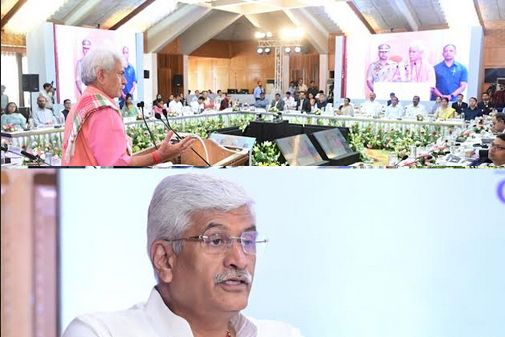
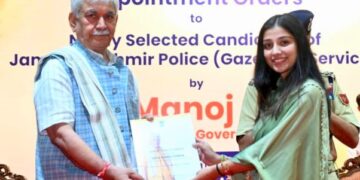
“Lieutenant Governor Manoj Sinha delivered an impactful address at the inauguration of the Bharat Sanrachna J&K 2025 exhibition in Srinagar, emphasizing a vision for a peaceful, progressive, and inclusive Jammu and Kashmir. The exhibition aimed to showcase developmental initiatives and strengthen the connection between the government and the populace, symbolizing the region’s reintegration into the national developmental framework. Sinha declared an end to fear, division, and stagnation, envisioning a future where children prioritize education over conflict, schools operate year-round, and societal disruptions are minimized. His remarks underscored the government’s dedication to inclusive development, youth empowerment, and justice for victims of terrorism, highlighting the importance of unity in fostering a brighter future. The speech conveyed a message of hope, growth, and resilience, reinforcing the commitment to transforming Jammu and Kashmir into a region that aligns with the aspirations of New India.”
At a time when Jammu and Kashmir is undergoing one of the most dynamic transitions in its recent history, Lieutenant Governor Manoj Sinha this week delivered a stirring and forward-looking address during the inauguration of the Bharat Sanrachna J&K 2025 exhibition in Srinagar. The event, designed to highlight developmental initiatives and bridge the gap between government and the people, became the stage for articulating a broader vision—of a peaceful, progressive, and inclusive Jammu and Kashmir that is fully integrated with the aspirations of New India. Far from being just an exhibition, Bharat Sanrachna was a symbol of how the UT is reclaiming its place in the national developmental landscape. And LG Sinha made it clear that the time for fear, division, and stagnation is over. “This is the new Jammu and Kashmir where children hold pens instead of stones, where schools remain open year-round, where international calendars replace shutdown calendars,” he said, setting an optimistic tone for the future. Lieutenant Governor’s remarks served as a strong reaffirmation of the government’s commitment to inclusive development, youth empowerment, justice for victims of terrorism, and the power of unity in shaping a better tomorrow. His speech wasn’t just policy—it was a message of hope, growth, and resilience.
Dispelling Fear, Reclaiming Harmony: One of the central messages of LG Sinha’s address was a heartfelt appeal for social harmony and unity. Recent statements by certain groups, questioning the influx of tourists or alleging cultural dilution, were addressed directly by the LG, who emphasized the importance of peace, openness, and shared cultural values. “There are some who say that outsiders are spoiling the culture of Jammu and Kashmir. They speak of demographic change and alcoholism. These claims are misleading and dangerous. This narrative only creates fear and echoes voices that seek to divide us,” LG Sinha said, cautioning against misinformation. He called upon all citizens regardless of background or belief to stand together in safeguarding the dignity and diversity of Jammu and Kashmir. By comparing such fear-driven narratives with those spread by extremist outfits in the past, he underlined how critical it is to maintain peace and not fall prey to divisive propaganda. More importantly, his message aimed to instill confidence among residents that the real essence of Kashmir its culture, its hospitality, its resilience will only grow stronger with national integration and economic development.
Delivering Justice;A New Approach To The Past: In one of the most significant sections of his speech, LG Sinha turned the spotlight on long-ignored victims of terrorism. With deep empathy and resolve, he shared his recent interaction with victim families in Anantnag, reaffirming that justice, not appeasement, would guide the administration’s approach. “Under SRO-43, jobs and compensations meant for the victims were at times misused in the past. That will not be allowed anymore. We are here to ensure justice reaches those who truly deserve it,” he said. This marks a substantial shift in the UT’s governance philosophy—one that is based not just on economic growth, but also on moral clarity. By prioritizing the needs of victims and making accountability a non-negotiable value, the administration is reinforcing trust in institutions and rectifying historical imbalances. For hundreds of families whose voices were long unheard, this is more than a promise. It is recognition. And for the broader society, it is a reminder that fairness and transparency are the new foundations of governance in Jammu and Kashmir.
New Economic Horizon For J&K: In what was arguably the most upbeat part of his address, the Lieutenant Governor presented an inspiring snapshot of J&K’s economic transformation in recent years. The numbers spoke for themselves. “In the last five to six years, the economy of Jammu and Kashmir has doubled,” Sinha declared. “J&K Bank, once suffering a loss of ₹1300 crore, is now recording a profit of ₹1700 crore. And the journey has just begun.” These achievements are not isolated—they are part of a broader economic revival rooted in good governance, improved infrastructure, policy support, and a secure environment that is attracting investments from across the country. From IT and BPOs to agriculture and tourism, various sectors are now flourishing. Importantly, this economic momentum is not limited to urban centres. Rural development, support to farmers, and the upliftment of traditionally marginalized communities have also received focused attention. “What was once thought impossible is now becoming reality in Jammu and Kashmir,” Sinha said proudly. This spirit of possibility is further reflected in the rising number of women-led startups, the increase in youth entrepreneurship, and the successful integration of central welfare schemes that are empowering grassroots communities.
Youth, Innovation; Building The Future From The Ground Up: In a powerful message to the younger generation, LG Sinha declared that the next two decades could be the golden years for Jammu and Kashmir—provided the youth are empowered, included, and inspired to lead. “Youth of Jammu and Kashmir are no longer confined to slogans. They are innovating, launching startups, and looking at the sky with dreams of becoming astronauts. That is the change we are witnessing,” he said. The UT administration’s focus on skill development, vocational training, digital literacy, and support for innovation has already yielded visible results. Several centrally sponsored schemes like Mission Youth, Mumkin, and Tejaswini have gained momentum. Students are being exposed to national and global platforms, and many are now securing jobs, grants, and fellowships once deemed out of reach. “Under the leadership of Hon’ble Prime Minister Narendra Modi, our schemes and innovations are enabling dreams. I look forward to the day when our young people from Kashmir become leaders in space, AI, agriculture, and beyond,” Sinha said. What makes this vision credible is the groundwork already being laid: the growing presence of technology hubs, incubators, and knowledge partnerships across the UT. With a population where over 60% are below 35 years of age, the possibilities are limitless.
Bharat Sanrachna J&K 2025;An Exhibition Of Aspirations: The Bharat Sanrachna J&K 2025 exhibition itself embodied the LG’s vision. Featuring participation from key Central Government ministries—Defence, Space, Tourism, MSME, Commerce, Mines—and institutions like ICMR, ICAR, BIS, the event was a celebration of integrated development. From live demonstrations to career guidance zones, from innovation showcases to interactive booths for farmers and artisans, the exhibition was designed to engage every section of society. It wasn’t just about showcasing policy—it was about inviting the public to become partners in progress. LG Sinha urged schools and colleges to send students in large numbers so they could gain real-time exposure to how governance works and where opportunities lie. “Let the youth see what is possible. Let them interact with ministries, learn about schemes, and visualize their future,” he said. By including local artisans and entrepreneurs, the exhibition also created a platform for showcasing Kashmiri talent and craftsmanship to a national audience—proving that while change may be driven from the top, its roots lie firmly in the culture and creativity of the people.
From Possibility To Participation; A Call To Action: One of the most refreshing elements of LG Sinha’s address was its tone of inclusivity. Far from being a top-down lecture, it was a sincere call for collaboration. The Lieutenant Governor acknowledged the presence of students, entrepreneurs, bureaucrats, and innovators, and emphasized that real development cannot happen without people’s participation. This participatory approach is key to the UT’s ongoing transformation. Policies alone cannot change societies—people must feel invested in them. And Sinha’s message reinforced this point. He also lauded the efforts of the central ministries and departments who came together for the exhibition. Their involvement was not just symbolic—it reflected a new style of governance where transparency, visibility, and accessibility are prioritized. Importantly, the LG emphasized that this was only the beginning. “If we give our new generation an opportunity to play a big role in the development journey, the next 22 years will be the golden years for Jammu and Kashmir,” he declared.
“Lieutenant Governor Manoj Sinha’s address was not just about what J&K has achieved, but what it is poised to become—a beacon of possibility, resilience, and unity. Bharat Sanrachna J&K 2025 was a reminder that while progress may begin with infrastructure, it is completed only through trust, justice, and democratic empowerment. For Kashmir, the journey from pain to promise is well underway—but its success will ultimately depend on how inclusively that promise is delivered.”
From Promise To Transformation: As Lieutenant Governor Manoj Sinha’s address at the Bharat Sanrachna J&K 2025 event highlighted, Jammu and Kashmir today stands at a historic juncture—caught between the legacy of conflict and the potential of transformative growth. The path ahead, while full of opportunities, also requires careful navigation to ensure that progress is inclusive, sustainable, and rooted in the democratic aspirations of the people. One of the foremost priorities must be deepening democratic processes in the Union Territory. While development projects and central schemes have been rolled out at an unprecedented scale, the absence of an elected legislative assembly continues to fuel skepticism among sections of the population. Holding assembly elections will not only restore public confidence but will also enable local stakeholders to become active participants in decision-making. Genuine representation will be key to ensuring that governance remains accountable and reflective of local realities. Equally important is the need to build and sustain social cohesion. As LG Sinha rightly pointed out, divisive narratives and conspiracy theories about cultural and demographic invasion can undo years of hard-won peace. The government must therefore invest in public awareness campaigns, intercultural dialogues, and community engagement programs that reaffirm the pluralistic character of Jammu and Kashmir. Local religious leaders, educators, and civil society actors must be empowered to foster trust and bridge the growing gap between perception and reality. Another critical area is youth empowerment beyond symbolism. While schemes like Mission Youth and Tejaswini have had a visible impact, there is a need to institutionalize these efforts through long-term strategies. This includes strengthening vocational training infrastructure in rural areas, ensuring consistent internet and digital access, promoting mental health support, and creating incentives for local job creation. Collaboration with private industry, academia, and global innovation hubs will be crucial to building a knowledge-based economy in Kashmir. In parallel, the administration must safeguard cultural heritage while embracing modernity. The fear of cultural erasure cannot be countered with denial; instead, it must be addressed through robust investment in local language preservation, arts, and traditional crafts. Incorporating Kashmiri culture into tourism, curriculum, and public festivals can ensure that development and identity go hand in hand.
Kashmir Horizon View: Lieutenant Governor Manoj Sinha’s speech at the Bharat Sanrachna J&K 2025 event was more than an administrative statement. It was a heartfelt articulation of a renewed Kashmir—a Kashmir that is no longer trapped by fear or defined by conflict, but one that looks to the future with hope, energy, and ambition. From dispelling misinformation to championing justice, from highlighting economic achievements to empowering youth, the address touched every vital nerve of Jammu and Kashmir’s transformation story. And it did so with clarity, confidence, and compassion.Yes, challenges remain. But for the first time in decades, there is a visible roadmap, a functioning governance model, and a clear vision that connects Kashmir’s potential to the national mainstream. As LG Sinha said, “This is a new J&K where instead of slogans of separatism, the noise of factories, tourists, and people’s laughter is being heard.” And if the mood of the exhibition, the determination of the youth, and the resolve of the administration are any indication, then the journey towards a prosperous, peaceful, and empowered Jammu and Kashmir has well and truly begun.
(“Team Kashmir Horizon” is committed to continuous improvement and invites feedback and suggestions from readers and its followers on social media sites. Reader insights are considered vital for enhancing content quality and empowering the community. The team encourages open communication and values the thoughts and ideas of its audience, believing that such input will enable them to serve the public more effectively. The initiative aims to ensure that readers have the best possible experience with “Kashmir Horizon”. Interested individuals can reach out to us via email at [email protected].)