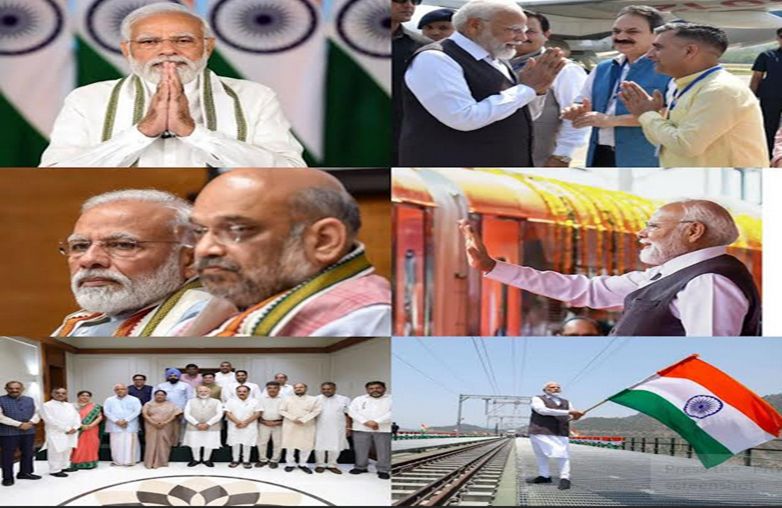
As Prime Minister Narendra Modi’s government marked its 11th year in power on June 9, 2025, India stands as a shining testament to more than a decade of transformative governance. The journey from 2014 to 2025 has been defined by a consistent commitment to inclusive development, strategic reforms, self-reliance, and a bold reimagining of India’s future. Whether in infrastructure, economy, digital innovation, welfare, or national security, the Modi-led National Democratic Alliance (NDA) has fundamentally reshaped the trajectory of the country. From engineering marvels like the Chenab Railway Bridge to impactful welfare schemes like Ayushman Bharat, the Modi government has delivered results that resonate with every section of society. The philosophy of “Sabka Saath, Sabka Vikas, Sabka Vishwas, Sabka Prayas” (Together with All, Development for All, Trust of All, Efforts of All) has not only become a slogan but the foundation of India’s socio-political and economic progress.

Infra Revolution; Building The Backbone Of A New India: Infrastructure development has been a pillar of Modi’s governance model. India’s national highway network has expanded from 91,000 km in 2014 to over 146,000 km by 2025, opening up remote regions and energizing local economies. Railway infrastructure too has received a facelift, with high-speed trains, electrification, and modernization redefining travel. A symbol of this revolution is the Udhampur-Srinagar-Baramulla Rail Link (USBRL), completed in 2025. The Chenab Bridge—the world’s highest railway arch bridge—and the launch of the Katra-Srinagar Vande Bharat Express have brought Kashmir closer to the rest of India. These engineering feats have reduced travel time, promoted tourism, and showcased India’s technical prowess. Chief Minister Omar Abdullah praised the Vande Bharat project as a “game-changer,” while Lieutenant Governor Manoj Sinha described it as a project that “connects the aspirations of Jammu and Kashmir” with the rest of the country. Prime Minister Modi’s inauguration of these projects on June 6, 2025, was a powerful signal of his commitment to integrating every corner of the nation. Across urban India, the Smart Cities Mission has transformed cities with better housing, clean drinking water, and sustainable transport systems. Union Minister Nitin Gadkari recently noted infrastructure investments worth Rs 5 lakh crore in Maharashtra alone, including the under-construction Vadhavan Port, which will become the world’s second-largest container port.
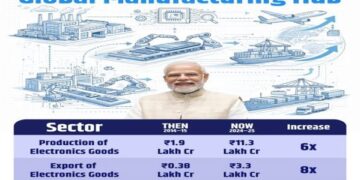
Economic Renaissance; From Fragile To Fearless: When the Modi government took office in 2014, India was among the “Fragile Five” economies. Eleven years later, India is the world’s fifth-largest economy, with a GDP of $4.2 trillion. By all indicators, the country is poised to surpass Japan and Germany soon, becoming the third-largest economy. Reforms like the Goods and Services Tax (GST), Insolvency and Bankruptcy Code (IBC), and corporate tax rationalization have streamlined business and trade. Initiatives like Startup India and Atmanirbhar Bharat have inspired an entrepreneurial wave. Union Jal Shakti Minister C.R. Paatil highlighted Operation Sindoor as proof that India now manufactures its own defense arsenal—a feat unthinkable a decade ago. The Production-Linked Incentive (PLI) scheme has given a massive boost to sectors like electronics and automobiles. India’s clean energy capacity has surpassed 228 GW, with over 105 GW from solar power alone. According to Gadkari, logistics costs are set to fall to 9%, making Indian products more competitive globally.
Social Welfare And Inclusion; Transforming Lives At The Grassroots: A defining feature of the Modi era has been the government’s pro-poor orientation. Over 25 crore Indians have been lifted out of poverty in the last 11 years. Schemes like Pradhan Mantri Awas Yojana, Ayushman Bharat, and PM-KISAN have reached the most marginalized. More than 4 crore homes have been built under the housing scheme. Ayushman Bharat has covered over 50 crore citizens, and over 10 crore LPG connections have been provided under the Ujjwala Scheme. The JAM (Jan Dhan-Aadhaar-Mobile) trinity has revolutionized welfare delivery, cutting out middlemen and leakages. Uttarakhand Chief Minister Pushkar Singh Dhami called these 11 years a “golden period of governance,” citing how Self-Help Groups and women-led initiatives like ‘Lakhpati Didi’ have improved gender parity. The National Family Health Survey (NFHS-5) now reports a sex ratio of 1,020 women per 1,000 men—a milestone for a country that has long struggled with gender inequality.
Digital India;Empowering A Billion Dreams: India’s digital journey has accelerated beyond expectations. With over 530 million Jan Dhan accounts and the world’s most advanced digital payment system in UPI, financial inclusion has reached every corner of India. Union Home Minister Amit Shah lauded the “democratization of technology,” which has empowered even the most remote villages. The National Education Policy (NEP) 2020 has modernized the education system, replacing outdated curricula with forward-looking, skill-oriented modules. The PM SHRI schools are nurturing future-ready students. The Atal Innovation Mission has supported hundreds of startups and innovation labs, making India a global innovation hub.
Defense,National Security;From Passive To Proactive: India’s defense capabilities have expanded significantly. The successful test of the extended-range BrahMos missile from a Su-30 MKI fighter jet, announced by Modi on June 10, 2025, reflects India’s self-reliance in advanced weaponry. Operation Sindoor, executed with surgical precision in response to the April 22 Pahalgam terror attack, demonstrated India’s proactive security posture. Union Minister C.R. Paatil emphasized that India is now capable of “taking the battle to enemy territory.” Home Minister Amit Shah, in a social media post, credited the Modi government with restoring peace in Jammu and Kashmir and the Northeast. He noted that Naxalism is on its last legs, and India has shifted from a reactive to a preventive approach in national security.
India On The World Stage; A Global Voice: Under Modi’s leadership, India has risen as a key global player. From hosting the 2023 G20 Summit to forging global digital partnerships, India is now a voice that matters in world affairs. In May 2025, Modi met with delegations from 33 countries to discuss India’s stance on cross-border terrorism, digital sovereignty, and clean energy. Foreign policy has been assertive yet balanced. India has forged deep partnerships with nations across continents while maintaining its strategic autonomy. Whether it’s climate leadership or vaccine diplomacy, the world now sees India as a responsible and resilient power.
Cultural Reawakening, Social Transformation: From the inauguration of the Ram Mandir in Ayodhya to the preservation of classical languages through the NEP, the Modi era has balanced progress with heritage. Social reforms such as the abolition of triple talaq and promotion of women’s reservation (33% proposed ahead of 2029 elections) signal a shift toward a more just society. Schemes like the Subhadra Yojana have elevated women’s economic participation, while caste-inclusive programs have enabled SCs, STs, and OBCs to contribute meaningfully to the nation’s growth. These policies are not just about inclusion but about empowerment.
Jammu & Kashmir; A Story of Integration, Aspiration: Perhaps no region reflects Modi’s vision more vividly than Jammu and Kashmir. Post the abrogation of Article 370 in 2019, the government has focused on development, connectivity, and security. Projects like the USBRL and the Vande Bharat Express have boosted tourism and integrated the region. The recent terror attack in Pahalgam on April 22, 2025, was met with firm resolve. PM Modi, speaking in Reasi, said, “Pakistan attacked both ‘insaniyat’ and ‘Kashmiriyat’. They want to obstruct the earnings of the hardworking people of Kashmir.” He lauded the bravery of local worker Adil, who tried to stop the attackers and paid with his life. “Jammu and Kashmir’s development will not be shaken by the Pahalgam attack. If anyone tries to block the youth here from fulfilling their dream, they will have to face Modi first,” the Prime Minister declared, earning thunderous applause.
Celebrating 11 Years; A Nationwide Festivity: The BJP launched the “Sankalp se Siddhi” (From Resolve to Achievement) campaign to mark this milestone, organizing exhibitions, cultural events, and public interactions. In Jamshedpur, Babulal Marandi inaugurated an exhibition on Modi’s achievements. In Sriganganagar, Santosh Ahlawat praised the PM’s “strategic foresight,” and in Jaunpur, Girish Chandra Yadav emphasized the importance of Article 370’s removal. A government e-book released on June 9 detailed the NDA’s 11-year journey, while a celebratory anthem, “Safar chal raha hai, desh badal raha hai” (The journey continues, the nation is changing), echoed across party offices.
“The roadmap for “Viksit Bharat” (Developed India) envisions positioning India as a global leader in various domains, including economy, technology, and diplomacy. The emphasis is on implementing deeper reforms in critical sectors such as education, judiciary, and health. To achieve this vision, India must modernize its defense capabilities, invest in research and innovation, and ensure that economic growth is sustainable and equitable. Key areas of focus include enhancing climate resilience, promoting green energy, and establishing digital sovereignty, which will significantly influence India’s global standing in the future. Addressing rural development and creating job opportunities for the large youth demographic is crucial, necessitating the scaling up of skilling programs and targeted investments in infrastructure for Tier 2 and Tier 3 cities. Additionally, strengthening federalism, preserving democratic institutions, and upholding the Constitution’s spirit are vital as India undergoes rapid transformation. The achievements of the past 11 years under Prime Minister Modi’s leadership demonstrate the potential for progress and the realization of these ambitious goals.”
Towards Viksit Bharat 2047: Challenges remain—inflation, unemployment, and climate resilience among them—but the government’s track record shows it is both capable and determined. The administration’s pandemic response, including administering over 220 crore vaccine doses, displayed its crisis management strength. BJP President J.P. Nadda summed it up aptly: “This decade will be the foundation of Viksit Bharat.” Prime Minister Modi continues to inspire a nation to dream bigger, act bolder, and rise higher. As India steps confidently into the future, the Modi government’s 11-year journey stands as a beacon of hope, resilience, and possibility. A journey not just of numbers and policies, but of lives touched, dreams nurtured, and a nation transformed. As India reflects on these 11 years of governance under Prime Minister Narendra Modi, it becomes evident that the country has undergone a historic transformation. The Modi era has been marked by decisive leadership, deep-rooted reforms, and an unwavering commitment to national development. From reducing poverty and improving infrastructure to empowering women and strengthening the defense sector, the government has touched almost every aspect of Indian life. The numbers speak for themselves—India has emerged as the world’s fifth-largest economy, over 25 crore people have risen out of poverty, and connectivity from Kashmir to Kanyakumari is no longer a dream but a reality. Welfare schemes, once marred by inefficiencies, now reach millions through direct benefit transfers. Initiatives like Digital India, Startup India, and Make in India have not only positioned India as a global hub of innovation but also made growth more inclusive and accessible. What stands out most is the confidence of a nation that now believes in its abilities. A decade ago, India looked outward for validation; today, it leads with a clear sense of purpose and pride. The journey so far has not just been about policy—it has been about people, progress, and possibilities.
Kashmir Horizon View: As India prepares for its centenary of independence in 2047, the next two decades hold even greater promise. The roadmap ahead, envisioned under the theme of “Viksit Bharat” (Developed India), aims to position India not just as a regional power but as a global leader in economy, technology, and diplomacy. The focus now shifts to deeper reforms in education, judiciary, and health. India must continue modernizing its defense capabilities, investing in research and innovation, and ensuring that growth is both sustainable and equitable. Climate resilience, green energy, and digital sovereignty will shape the country’s global role in the coming years. Rural development and job creation for India’s massive youth population will be key. Skilling programs must be scaled up, and infrastructure in Tier 2 and Tier 3 cities needs targeted investments. Strengthening federalism, preserving democratic institutions, and upholding the spirit of the Constitution will also be essential as India navigates rapid change. Under Prime Minister Modi’s leadership, the last 11 years have proven what is possible. The challenge now is to convert that momentum into irreversible transformation. The vision is clear. The resolve is stronger than ever. And with 1.4 billion people striving together, a developed India by 2047 is not just a dream—it’s an approaching reality.
(In commitment to continuous improvement the “Team Kashmir Horizon” invites it’s valuable readers to share their valuable feedback and suggestions with the “Team Kashmir Horizon”. The insights of readers will surely play a vital role in improving the content quality of “Kashmir Horizon” and contribute more for the empowerment of people. Please feel free to reach out to us at editor@ thekashmirhorizon.com. Team “Kashmir Horizon” eagerly anticipates thoughts and ideas of it’s readers, which will help us serve people and even more effectively. The inputs of valuable readers are highly valued as “Kashmir Horizon” strives to provide it’s readers the best possible experience.)