“This direct and uncompromising stance reinforces India’s refusal to tolerate proxy warfare waged against its citizens. LG Sinha underscored the government’s resolve: “Pakistan is a terrorist country, and there is no difference between this country and the masterminds of terrorism who sit there.” The Lieutenant Governor’s comments echoed those of India’s Defence Minister Rajnath Singh, who called for international oversight of Pakistan’s nuclear arsenal by the International Atomic Energy Agency (IAEA). “Pakistan’s nuclear blackmail won’t work now,” LG Sinha quoted Singh, highlighting India’s commitment to neutralizing threats without succumbing to intimidation.”
In a defining moment for India’s security and military resolve, Lieutenant Governor (LG) Manoj Sinha has lauded the Indian Armed Forces for executing the bold and meticulously planned ‘Operation Sindoor’—a powerful retaliation to the brutal Pahalgam terror attack that shook the nation. The operation has not only avenged the tragic loss of innocent lives but has also marked a decisive shift in India’s counterterrorism doctrine, sending a clear message to terror sponsors across the border. Speaking from Srinagar, LG Manoj Sinha commended the “unwavering bravery and strategic clarity” demonstrated by the armed forces in dismantling terror infrastructure deep inside Pakistan. “Our nation is immensely proud of the armed forces for scripting a historic victory saga with ‘Operation Sindoor,’” he stated, emphasizing that the operation was both a measured and focused military strike designed to change the course of the fight against terrorism in Jammu and Kashmir and beyond.
Operation Sindoor; A Game-Changer in Counter Terrorism: “Operation Sindoor has dismantled nine major terror camps and struck eleven Pakistani air bases,” LG Sinha detailed, highlighting the scale and precision of the operation. High-profile terrorists, long responsible for orchestrating violence and unrest in the Union Territory, were eliminated. “Our armed forces have not only destroyed terror factories within Pakistan but are now hunting terrorists one by one,” he added, pointing to recent successes in South Kashmir where six terrorists were neutralized within a week through joint operations. LG Sinha made it clear that the operation was not only a military victory but a strategic recalibration. “This marks a decisive shift in our military doctrine,” he explained, “where future acts of terror will be treated as acts of war.” This new posture reflects India’s readiness to respond with full force to any threats to its sovereignty and citizens.
The Role Of Pakistan in Terrorism: The Lieutenant Governor did not mince words in holding Pakistan accountable for terrorism in Jammu and Kashmir. “The world has seen that terrorism in J&K Union Territory is engineered and executed by Pakistan,” he said emphatically. “Our mighty forces have ensured that now we will enter deep into Pakistan’s heartland and kill terrorists at their source.” This direct and uncompromising stance reinforces India’s refusal to tolerate proxy warfare waged against its citizens. LG Sinha underscored the government’s resolve: “Pakistan is a terrorist country, and there is no difference between this country and the masterminds of terrorism who sit there.” The Lieutenant Governor’s comments echoed those of India’s Defence Minister Rajnath Singh, who called for international oversight of Pakistan’s nuclear arsenal by the International Atomic Energy Agency (IAEA). “Pakistan’s nuclear blackmail won’t work now,” LG Sinha quoted Singh, highlighting India’s commitment to neutralizing threats without succumbing to intimidation.
Remembering The Victims Of The Pahalgam Attack: The genesis of ‘Operation Sindoor’ traces back to the brutal terror attack in Pahalgam that claimed the lives of innocent civilians, including tourists and foreign nationals. LG Sinha solemnly remarked, “India always advocated peace and never wanted war, but what happened in Pahalgam was an act of war by terror state Pakistan. With Operation Sindoor, we have avenged Pahalgam.” He praised the armed forces’ bravery and resilience, recognizing their role in restoring security and national pride. “Our war was to teach Pakistan a lesson,” he declared.
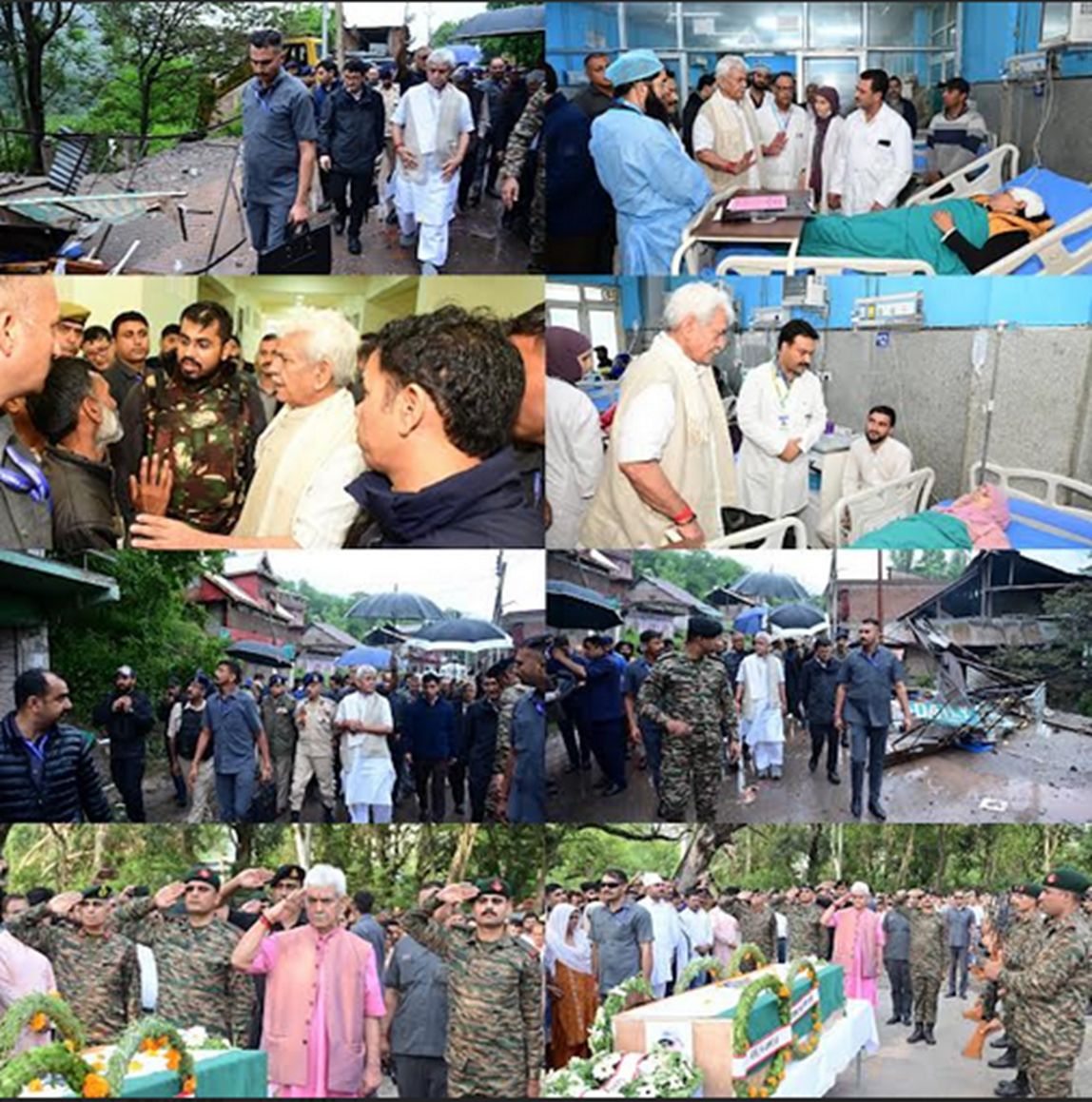
Supporting Families Affected By Cross-Border Shelling: LG Manoj Sinha has also shown compassion and proactive leadership by visiting families affected by cross-border shelling in border villages like Lagama and Gingal in Uri, as well as the shelter and lodgement centers in Jammu. During these visits, he interacted closely with displaced families, ensuring them of the government’s full support. “The entire nation stands in solidarity with the affected families,” he said, affirming the commitment of both the Government of India and the Jammu and Kashmir administration to their safety and well-being. The Lieutenant Governor assured residents that measures, including the construction of new bunkers based on updated security assessments, are underway to safeguard border communities. “We will avenge their suffering by defeating the enemy,” he vowed.
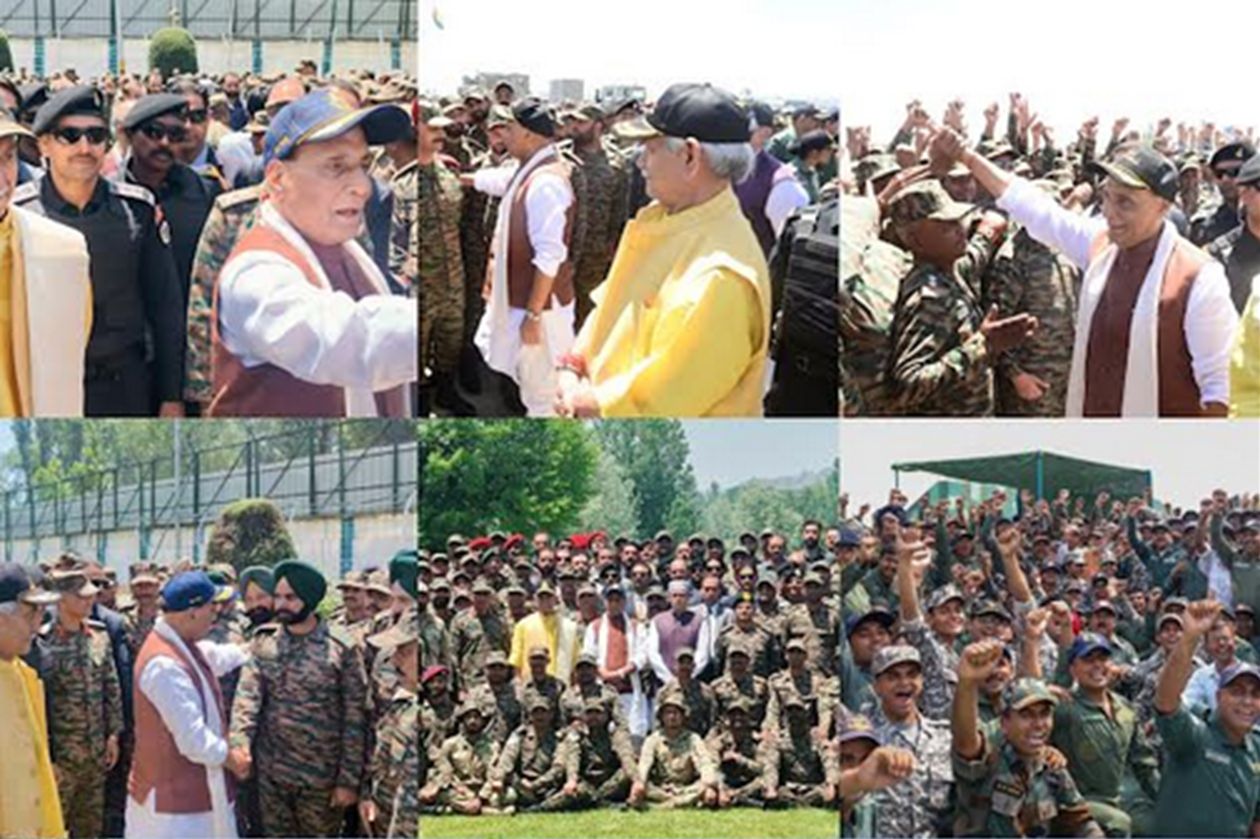
Boosting Morale of Troops On The Frontlines: On the frontline, LG Sinha’s visit to the soldiers stationed in the Uri and Baramulla sectors reflected his intent to bolster morale. Addressing the troops, he famously asked, “How’s the Josh?”—to which the soldiers replied with an energetic “High, Saheb!” signaling their readiness to confront any threat. “Our soldiers have one resolve—to destroy the enemy and its capability to attack Bharat, and to safeguard our citizens and our sovereignty,” he told the troops. “The entire nation is drawing inspiration from your valour.” The Lieutenant Governor expressed his prayers for the soldiers’ strength and safety, invoking blessings to help them “write the saga of India’s bravery.”
Defence Minister Rajnath Singh’s Endorsement: Complementing the LG’s statements, Defence Minister Rajnath Singh underscored India’s firm stance against terrorism in his address to troops at Badami Bagh Cantonment in Srinagar, shortly after Operation Sindoor. “Operation Sindoor has sent a loud and clear message to terrorist organizations and their masters that they are not safe anywhere,” Singh said, praising the precision and decisiveness of the strikes. Singh also condemned Pakistan’s irresponsible nuclear threats, questioning the safety of nuclear weapons in Islamabad’s hands and calling for their supervision under the IAEA. “Are nuclear weapons safe in the hands of such an irresponsible and rogue nation?” he asked, reflecting India’s concerns over regional security. Highlighting the moral clarity behind Operation Sindoor, the Defence Minister said, “Terrorists killed Indians based on their religion; we killed them for their deeds. It was our dharma to eliminate them.” He hailed the forces’ courage and discretion in avenging the Pahalgam attack and reaffirmed India’s commitment to peace, warning Pakistan against further provocations.
CM Abdullah’s Support To Modi’s Anti-Terror Doctrine: Chief Minister Omar Abdullah also expressed solidarity with affected families and paid visits to areas impacted by shelling in Uri. He emphasized that the government’s focus remains on restoring normalcy and ensuring the welfare of residents living along the Line of Control. “We are committed to the safety, security, and development of Jammu and Kashmir,” Abdullah said, reiterating that peace is the foundation for prosperity in the region.
The National Narrative; Unity And Resolve: The combined statements of the Lieutenant Governor, Defence Minister, and Chief Minister reflect a unified national resolve. India stands firm in the face of terror, ready to protect its citizens, and determined to dismantle the entire terror ecosystem that threatens its peace. “Whenever the country has faced crisis, our soldiers have boosted the pride of Mother India by making supreme sacrifices,” LG Sinha remarked, paying tribute to the legacy of courage and valor that Indian forces embody. This spirit has galvanized public sentiment across the nation. Citizens from all walks of life have expressed solidarity with the armed forces and the families affected by terrorism and cross-border aggression.
Strategic Implications, Military Doctrine: Operation Sindoor signifies more than just a retaliation—it represents a paradigm shift in how India approaches counterterrorism and cross-border hostility. The operation’s success demonstrated the Indian military’s capability to conduct precise, intelligence-driven strikes on terror bases beyond the Line of Control, altering the calculus of terror groups and their sponsors. “The message is clear: India will not tolerate attacks on its soil, and will meet aggression with overwhelming and decisive force,” said an army official who wished to remain unnamed. This new doctrine aims to dismantle terror infrastructure at its root, cutting off support and supply lines to terrorists. Moreover, the public affirmation by top leadership that terror acts will now be treated as acts of war signals a tougher stance that may redefine India’s military and diplomatic engagements in the region.
Humanitarian Considerations Amid Conflict: While the focus remains firmly on security, LG Sinha and other leaders have emphasized the importance of humanitarian care for those affected by violence. Visits to shelter homes and hospitals treating injured civilians and soldiers underscore the government’s commitment to relief and rehabilitation. The government has pledged to expedite assistance to displaced families, provide medical care to the injured, and rebuild damaged infrastructure in border villages. These efforts aim to restore normal life and alleviate the hardships caused by unprovoked shelling and terror attacks.
A Message To The World: India’s leadership is also sending a strong diplomatic message. By calling for international oversight of Pakistan’s nuclear weapons and highlighting Pakistan’s role as a terror hub, India is rallying global attention to the ongoing threats in South Asia. This assertive diplomacy, paired with surgical military operations, portrays India as a nation that values peace but is fully prepared to defend its sovereignty and citizens at any cost.
Way Forward, Conclusion: The success of Operation Sindoor represents not just a military triumph but a significant turning point in India’s approach towards counterterrorism and national security, particularly in Jammu and Kashmir. While the operation has sent a powerful message to terror networks and their patrons in Pakistan, it also marks the beginning of a sustained, multifaceted effort required to secure peace and stability in the region.
Consolidating Military Gains, Enhancing Security Measures: First and foremost, the Indian Armed Forces must continue their vigilant and proactive stance along the Line of Control (LoC) and within the Union Territory. The precision strikes of Operation Sindoor dismantled terror camps and eliminated high-profile terrorists, but the challenge remains to prevent reconstitution of these terror infrastructures. This calls for enhanced intelligence sharing, continuous surveillance, and rapid response capabilities. Equally critical is strengthening the resilience of border communities. The repeated shelling and cross-border provocations have inflicted immense human suffering, as witnessed in Uri, Baramulla, and surrounding villages.
Political Resolve , Diplomatic Engagement: Operation Sindoor should be seen within the broader context of India’s diplomatic posture. The Lieutenant Governor and Defence Minister’s unequivocal statements affirm that India will not tolerate terrorism or any threats to its sovereignty. This clarity must be coupled with persistent diplomatic efforts to isolate Pakistan on the international stage, particularly spotlighting its role as a state sponsor of terrorism. India’s call for International Atomic Energy Agency (IAEA) supervision of Pakistan’s nuclear arsenal is a strategic move that underscores global security concerns regarding nuclear proliferation.
“The operation Sindoor marked a decisive shift in military doctrine, demonstrating that terrorism will be met with unwavering resolve and precision. Looking ahead, the path to lasting peace in Jammu and Kashmir requires a balanced approach—combining robust security measures with development and diplomacy. It necessitates vigilance against emerging threats, continued pressure on terror sponsors, and inclusive governance that addresses local aspirations. Ultimately, the success of Operation Sindoor is a call to action for every Indian—to uphold the values of courage, unity, and resilience. The nation honors its armed forces for their historic victory, and together, India stands ready to build a future where peace prevails, terror is eradicated, and every citizen lives in safety and dignity.”
Strengthening Governance, Development in J&K: Beyond the military and diplomatic fronts, sustainable peace hinges on socio-economic development and good governance within Jammu and Kashmir. The Union Territory Administration must accelerate initiatives aimed at improving infrastructure, creating employment opportunities, and fostering inclusive growth. Development acts as a powerful antidote to the appeal of militancy by addressing grievances and providing alternatives for youth.
Unified National Resolve: Operation Sindoor has ignited a wave of national pride and unity. The calls by Lieutenant Governor Manoj Sinha and Defence Minister Rajnath Singh echo a collective resolve that transcends politics, religion, and regional divides. This unity is India’s greatest strength in the fight against terrorism and must be nurtured continuously through education, awareness, and national integration initiatives. The brave soldiers at the frontline represent the country’s unwavering spirit. Their sacrifices and victories must be honored through sustained support—material, moral, and political. Equally, the nation must stand firm behind the families affected by terror and conflict, ensuring they receive all necessary care and justice.
Kashmir Horizon View: The narrative of Operation Sindoor is not simply one of retribution but a reaffirmation of India’s commitment to protecting its citizens, defending its sovereignty, and promoting peace. The operation Sindoor marked a decisive shift in military doctrine, demonstrating that terrorism will be met with unwavering resolve and precision. Looking ahead, the path to lasting peace in Jammu and Kashmir requires a balanced approach—combining robust security measures with development and diplomacy. It necessitates vigilance against emerging threats, continued pressure on terror sponsors, and inclusive governance that addresses local aspirations. Ultimately, the success of Operation Sindoor is a call to action for every Indian—to uphold the values of courage, unity, and resilience. The nation honors its armed forces for their historic victory, and together, India stands ready to build a future where peace prevails, terror is eradicated, and every citizen lives in safety and dignity.
(In commitment to continuous improvement the “Team Kashmir Horizon” invites it’s valuable readers to share their valuable feedback and suggestions with the “Team Kashmir Horizon”. The insights of readers will surely play a vital role in improving the content quality of “Kashmir Horizon” and contribute more for the empowerment of people. Please feel free to reach out to us at editor@ thekashmirhorizon.com. Team “Kashmir Horizon” eagerly anticipates thoughts and ideas of it’s readers, which will help us serve people and even more effectively. The inputs of valuable readers are highly valued as “Kashmir Horizon” strives to provide it’s readers the best possible experience.)