- Says “No Politics on Martyrs’ Blood, Public Sympathy Lost For Terror In Kashmir”
“Omar Abdullah’s refusal to politicize tragedy, Speaker Rather’s dignified leadership, and the rare unanimity in the Assembly all signaled a maturity that Kashmir’s polity desperately needed. Prime Minister Modi’s and Home Minister Shah’s responses, though sharp and security-focused, also acknowledged the emotional and human dimensions of the crisis. Their outreach to Abdullah — a political rival — underlined the gravity of the moment and the need for a united national front against terror. But the most resounding message came from the people of Kashmir — who rejected the violence not with slogans, but with silence, solidarity, and sacrifice.”
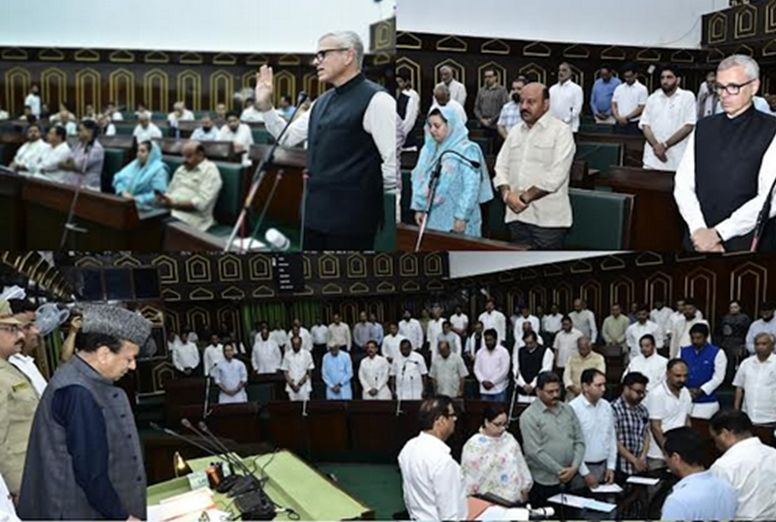
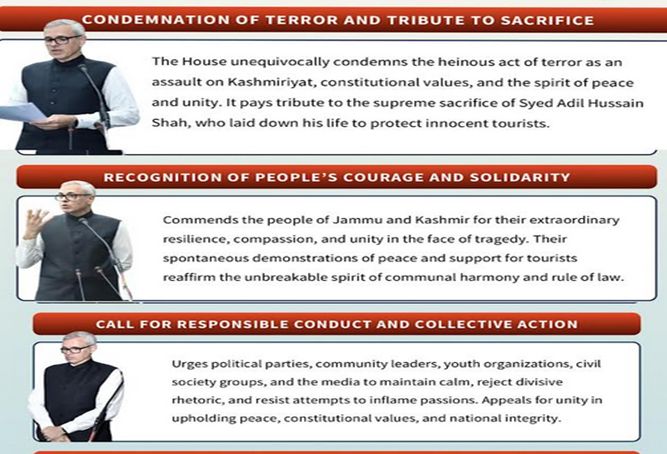
On April 22, 2025, a brutal act of terrorism at the serene Baisaran meadows near Pahalgam shattered the calm of the Kashmir Valley, claiming 26 innocent lives — most of them tourists who had come to experience the beauty and peace of the region. It was a moment that jolted not just Jammu and Kashmir, but the entire country. What followed was an extraordinary display of political unity, emotional outpouring, and institutional resolve during a special daylong session of the Jammu and Kashmir Legislative Assembly, convened on April 28, to honor the dead and confront the grim reality of terrorism yet again raising its head in the region. Presiding over the session, Speaker Abdul Rahim Rather delivered what was perhaps one of the most poignant addresses in the legislature’s recent history. “This is not just an attack on people,” he said solemnly, “but an assault on the very idea of humanity.” His voice trembling with emotion, the Speaker read out the names of all 26 victims — including a local pony-walla, Syed Adil Hussain Shah, who died while rescuing tourists — before asking the House to observe a two-minute silence. The Legislative Assembly, a space usually alive with heated debates and political one-upmanship, stood united in grief and outrage. There were no party lines, no ideological divides — only a collective sense of pain and purpose. Deputy Chief Minister Surinder Kumar Choudhary moved a resolution condemning the “heinous, cowardly and inhuman” act, and the House passed it unanimously. “Let the world know,” said Speaker Rather, “that Jammu and Kashmir does not bend to the designs of terrorists.”
CM Omar’s Moral Stand; “No Statehood Demand on Martyrs’ Blood”: In what may be remembered as a defining speech of his political career, Chief Minister Omar Abdullah refused to politicize the tragedy. “Meri kya itni sasti siyasat hai?” he asked, standing at the well of the House. “How can I, in the name of these 26 martyrs, demand statehood today? Their sacrifice is too sacred for politics.” Omar’s statement came as a surprise even to his critics, many of whom had expected him to revive the long-standing demand for full statehood in the wake of such a high-profile tragedy. Instead, Abdullah focused entirely on mourning the dead and uniting the region in grief. “There will be a time to talk about our political aspirations. That time is not now. Today, we grieve. Today, we reject terror. Today, we reaffirm our commitment to peace.” The Chief Minister, who also holds the Tourism portfolio, accepted personal responsibility for the failure to protect the tourists. “As the host, it was my duty to ensure their safe return,” he said. “I couldn’t do it. What apology will ever be enough?” He shared harrowing details from his visit to the police control room on the night of the attack. “The bodies were lined up. A young bride kept asking, ‘What was our fault?’ What answer could I give her?” His words resonated deeply across the House and beyond.
The National Response; PM Modi, HM Shah Extend Condolences, Support: From New Delhi, Prime Minister Narendra Modi condemned the attack in the strongest possible terms, calling it “a barbaric assault on the values of India.” He praised the unity shown by the people of Kashmir and expressed condolences to the families of the victims. “Terrorists will never succeed in breaking our resolve,” Modi said in a televised address. “The entire country stands with Jammu and Kashmir.” Union Home Minister Amit Shah, in a statement to the media, said the Ministry of Home Affairs had already dispatched a high-level team to investigate the security lapses and identify the perpetrators. “We will go to the root of this conspiracy,” Shah said. “Terrorism has no place in our society, and those responsible for this bloodshed will face the full force of the law.” Shah also chaired a high-level security review meeting that included representatives from the Intelligence Bureau, NIA, CRPF, and Jammu and Kashmir Police. The meeting decided to bolster security infrastructure in tourist hubs and pilgrimage routes in the Valley. In a rare gesture of cross-party unity, both Modi and Shah reached out personally to Chief Minister Abdullah and Speaker Rather, assuring full support from the Centre. “This is not a moment to score political points,” Shah reportedly told Abdullah. “This is a moment to stand as one nation.”
Kashmiriyat On Display; People’s Spontaneous Condemnation: Perhaps the most powerful repudiation of the terrorists’ objectives came not from politicians, but from ordinary Kashmiris. From Kupwara in the north to Kathua in the south, candlelight vigils, silent marches, and prayer meetings were held to honor the victims. Placards reading “Not In My Name” were held aloft by young and old alike — a rare and genuine expression of civil solidarity that went far beyond orchestrated protests. The historic Jamia Masjid in Srinagar, often at the heart of political turbulence, fell silent before Friday prayers to mourn the dead. The Imam led a two-minute silence in the mosque courtyard — a symbolic gesture that conveyed the depth of public sentiment. “Despite all odds, Kashmir still knows how to grieve with grace,” said Ghulam Ahmad Mir, MLA from Anantnag. “Terrorists failed to incite fear this time; instead, they ignited empathy.” Local communities in Pahalgam opened their homes to stranded tourists. A fruit vendor offered free meals. A shikara owner gave shelter. A pony-walla died trying to save others. These, Omar Abdullah noted, are “the real stories of Kashmir.”
Inside The Assembly; Across The Aisle Unity: What stood out in the special session was the absence of rancor. Even Leader of Opposition Sunil Sharma praised the Chief Minister’s statesmanship. “Today, we speak as Kashmiris and as Indians — not as ruling or opposition parties,” he said. Sharma described the incident as “an assault on paradise itself.” Sajad Lone, Waheed Ur Rehman Parra, Mohammad Yousuf Tarigami, and Altaf Ahmad Wani also offered moving tributes. Wani, representing Pahalgam, lamented that “after 25 years of relative peace, we are again counting bodies.” He proposed the establishment of a memorial for the victims at Baisaran — a motion that found unanimous support. Sheikh Khursheed went a step further and suggested that all MLAs contribute a portion of their salaries to fund the memorial. “Let the families know their loss will not be forgotten,” he said.
Institutional Responsibility, the Path Forward: The Assembly resolution passed on April 28 did more than just condemn an act of terror. It reaffirmed Jammu and Kashmir’s commitment to the values of Kashmiriyat, secularism, and democracy. “This House,” it read, “stands united against violence and pledges to uphold peace, harmony, and dignity for all citizens.” It also called on all Indian states and Union Territories to ensure the safety of Kashmiri students, professionals, and travelers in their jurisdictions — a crucial appeal in the face of rising tensions outside the UT. The Chief Minister also announced plans to enhance the state’s emergency response infrastructure, strengthen tourist security protocols, and establish a rapid victim-assistance mechanism. “No government can stop every bullet,” Omar said. “But we can and must be prepared to respond with compassion, clarity, and competence.”
The Larger Message; A Test of Leadership and Identity: The events following the April 22 attack will be remembered not just for the lives lost but for the moral clarity they brought to a region often mired in ambiguity. Omar Abdullah’s refusal to politicize tragedy, Speaker Rather’s dignified leadership, and the rare unanimity in the Assembly all signaled a maturity that Kashmir’s polity desperately needed. Prime Minister Modi’s and Home Minister Shah’s responses, though sharp and security-focused, also acknowledged the emotional and human dimensions of the crisis. Their outreach to Abdullah — a political rival — underlined the gravity of the moment and the need for a united national front against terror. But the most resounding message came from the people of Kashmir — who rejected the violence not with slogans, but with silence, solidarity, and sacrifice.
“The government, civil society, and religious institutions must come together to proactively challenge radical narratives through youth engagement, religious harmony campaigns, and community policing. The April 22 attack must not be allowed to alienate Kashmiris further, but instead become the reason to strengthen internal solidarity. On the political front, the unity displayed in the Assembly must not end with this session. The dignity shown by Chief Minister Omar Abdullah and Speaker Abdul Rahim Rather should set a new standard for Kashmir’s political discourse — one that prioritizes people over parties, victims over vote banks. If this tragedy leads to sustained cooperation between Srinagar and New Delhi, it may just give meaning to lives lost. Finally, remembrance must translate into reform. Monuments and mourning are important, but so is measurable change. The victims of April 22 deserve more than tears; they deserve a safer, more humane, and more united Jammu and Kashmir. The road ahead is difficult, but the direction is clear — peace must be pursued not only as a hope but as a responsibility.”
_________________________________________________________
A Closing Note; Mourning with Purpose: As the special session concluded with an adjournment sine die, there was a palpable shift in tone across the political spectrum. The day had not been about statements and speeches alone; it had been about remembrance, remorse, and reaffirmation. “The best tribute we can pay to these 26 souls,” Speaker Rather said in his closing remarks, “is to ensure that peace is not just a slogan but a lived reality for every Kashmiri and every Indian who comes to this land of beauty and pain.” For a Valley that has seen too much bloodshed, the April 22 attack was another dark chapter. But the response — dignified, determined, and deeply human — offered a glimmer of hope. A hope that the idea of Kashmir as a place of peace, hospitality, and harmony is not dead — merely wounded, and now, finally healing.
Kashmir Horizon View: The April 22 Pahalgam terror attack has made it painfully clear that despite years of relative calm, the threat of terrorism still looms over Jammu and Kashmir. As the Union Territory attempts to rebuild its image as a safe and welcoming destination, the path forward must be shaped by a comprehensive blend of security reforms, social healing, and political stability. This tragedy, while horrifying, presents an opportunity for the region’s leadership and people to redefine their collective response — not just in grief, but in policy, governance, and communal resilience. First and foremost, the state must revamp its security apparatus in sensitive and tourist-heavy zones. Despite prior intelligence inputs of increased terrorist activity in South Kashmir, the failure to secure a popular location like Baisaran signals gaps in inter-agency coordination and real-time threat response. The deployment of modern surveillance tools — including drones, AI-enabled CCTV networks, and biometric access control in high-risk areas — must become non-negotiable. Intelligence-sharing mechanisms between central and local agencies should be institutionalized rather than depend on ad-hoc arrangements. Second, the tourism sector — which has been a critical pillar of Kashmir’s economic recovery — needs immediate and long-term support. Affected families, local guides, pony-wallas, and hospitality workers must be compensated generously and transparently. At the same time, a dedicated ‘Tourist Safety Task Force’ should be constituted, trained in counter-terror response, and deployed across vulnerable circuits. Tourist confidence will return only when safety is felt, not just promised. Third, education and counter-radicalization programs must be intensified. Extremism festers in isolation, misinformation, and marginalization. The government, civil society, and religious institutions must come together to proactively challenge radical narratives through youth engagement, religious harmony campaigns, and community policing. The April 22 attack must not be allowed to alienate Kashmiris further, but instead become the reason to strengthen internal solidarity. On the political front, the unity displayed in the Assembly must not end with this session. The dignity shown by Chief Minister Omar Abdullah and Speaker Abdul Rahim Rather should set a new standard for Kashmir’s political discourse — one that prioritizes people over parties, victims over vote banks. If this tragedy leads to sustained cooperation between Srinagar and New Delhi, it may just give meaning to lives lost. Finally, remembrance must translate into reform. Monuments and mourning are important, but so is measurable change. The victims of April 22 deserve more than tears; they deserve a safer, more humane, and more united Jammu and Kashmir. The road ahead is difficult, but the direction is clear — peace must be pursued not only as a hope but as a responsibility.
(In commitment to continuous improvement the “Team Kashmir Horizon” invites it’s valuable readers to share their valuable feedback and suggestions with the “Team Kashmir Horizon”. The insights of readers will surely play a vital role in improving the content quality of “Kashmir Horizon” and contribute more for the empowerment of people. Please feel free to reach out to us at editor@ thekashmirhorizon.com. Team “Kashmir Horizon” eagerly anticipates thoughts and ideas of it’s readers, which will help us serve people and even more effectively. The inputs of valuable readers are highly valued as “Kashmir Horizon” strives to provide it’s readers the best possible experience.)