“Seamless integration of ethics and value in education is crucial to create an enlightened society and a powerful nation. Without the fine balance of ancient value system and modern skills, it is impossible to sustain and further long-run economic growth”
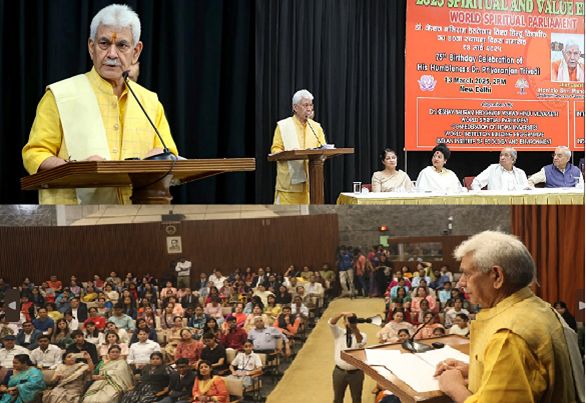
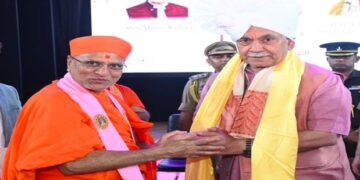
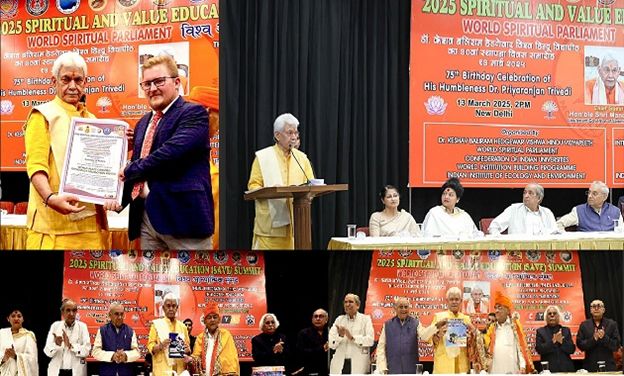
This week, Lieutenant Governor Manoj Sinha addressed the Spiritual and Value Education Summit in New Delhi, emphasizing the need for a holistic transformation of the education system. In his inaugural address, he urged distinguished scholars and educators to integrate ethics and values into education to nurture intellectual growth and moral integrity among students. “Seamless integration of ethics and value in education is crucial to create an enlightened society and a powerful nation. Without the fine balance of our ancient value system and modern skills, it is impossible to sustain and further long-run economic growth,” the Lieutenant Governor said. He elaborated on the importance of value-based education in enabling students to explore their true strengths, emphasizing character building and inspiring righteous living. According to him, a holistic education system is necessary to place the nation on a growth trajectory and bring about the changes required for a developed India.
Role of Ethics, Morals in Education: The Lieutenant Governor emphasized the necessity of imparting ethical, moral, and social values alongside academic knowledge and skills. “Our youth should have Science in one hand and Samskara in the other. Along with the advancement of science and technology, the teachings of traditional values, our cultural heritage, and the vision of great personalities should also be included in the main curriculum of education,” he said. Highlighting the importance of a balanced approach in education, he stressed that scientists, artists, and spiritualists must work together to prevent education from being one-sided. Only through this integration can education be truly holistic and transformative.
Future-Ready Education, Skill Development: Speaking on the need for a future-ready education system, the Lieutenant Governor underscored the necessity of a skill-driven learning environment. With the rapid pace of change in various industries, he noted that constant skilling and reskilling are required to keep up with industry demands. He encouraged teachers to go beyond traditional subjects and curriculums and equip students with skills that will help them succeed in their professional lives. “The real power of education is its ability to transform. We can fulfill the demands of a modern society and build Viksit Bharat if we fully utilize the power of education and skilled human resources of the nation,” he asserted. The Lieutenant Governor urged students to embrace lifelong learning, self-exploration, and self-awareness, emphasizing that true education leads to personal and professional liberation.
Education Beyond Education Achievements: The Lt Governor further elaborated on the deeper meaning of education, beyond mere academic achievement. “True education shows the path to liberation. Liberation enables you to know yourself better so that you can achieve all the goals of your life. Education is not just about rote learning and exchange of information. Rather, education is a method, a medium. Through education, you can achieve your individuality, awaken your consciousness, your passion, learn the modern skills to make your place in the world, and achieve new heights in your chosen fields.” He pointed out that education should not be confined to achieving high marks but should focus on lifelong learning skills. Encouraging students to follow their passions, he noted that creativity and adaptability are the keys to success in today’s dynamic world. “Nowadays, the real aim of education is misunderstood. It is not about youth achieving the number one position or marks. Instead of numbers, students should focus on lifelong learning skills. Students should follow their passion and aim to reach the pinnacle of their creativity so that they can learn new skills according to the changing demand of the industry and achieve success,” he added.
Stress-Free Learning, Parental Support: The Lieutenant Governor also emphasized the need for stress-free education environments. He urged educational institutions to work towards establishing “Zero Stress Campuses” to nurture the unique strengths and talents of students. “I would also like to request all the parents to help their children develop a strong personality according to their passion. I am sure that if youth are given the opportunity to choose subjects as per their passion, they will be able to achieve new heights,” he said.
J&K Leading In NEP Implementation: The Lieutenant Governor highlighted that Jammu and Kashmir was leading the country in implementing the recommendations of the National Education Policy (NEP)-2020. “I am proud that J&K is leading the country in implementing the recommendations of the National Education Policy 2020,” LG Sinha said. He noted that a revolution was taking place in J&K in the education sector in the past few years. Under the leadership of Prime Minister Narendra Modi, Jammu and Kashmir was witnessing a cultural resurgence.
Promoting Cultural, Artistic Heritage: Emphasizing the role of enlightened citizens and stakeholders in developing an artistic mindset in the new generation, the Lieutenant Governor stated that the creative potential of the youth would benefit other sectors of society. “The folk tradition of Jammu has been the source of values and ideals that have sustained society through the ages, and I believe the IGNCA’s regional center will create a framework for nurturing the virtues of culture for enhancing quality of life,” he said. He called upon the intelligentsia to work with organizations like IGNCA for the promotion of J&K’s rich artistic heritage and to preserve and propagate the Vedic oral tradition. “Our civilizational heritage represents a culture that is all-embracing and based on the concept of ‘Vasudhaiva Kutumbakam’—the world as one family. This mantra continues to be of great significance to the world even today,” the LG said. He emphasized that in the future, the IGNCA Center in Jammu would further strengthen the government’s efforts for the promotion, development, and enrichment of folk traditions.
“The way forward lies in embracing a multi-faceted approach to education that harmonizes ethics, culture, skills, and modern knowledge. By implementing the principles outlined by the Lieutenant Governor, India can create an education system that not only produces skilled professionals but also nurtures compassionate, visionary leaders capable of steering the nation toward a brighter future.”
Recognizing Literary, Cultural Contributions: The Lieutenant Governor called for committed efforts to disseminate the works of great thinkers and writers like Yogini Lalleshwari, Nund Rishi, Habba Khatoon, Parmanand, Dattu, Thakur Raghunath Singh, Pandit Hardutt, Gangaram, and Padma Sachdev, especially to the younger generation. “In this era of rapid change, it is also our collective responsibility to ensure that the articles, monographs, and books on regional literature, folk music, drama, and Pahari art become a part of every household,” he said. The LG also applauded the IGNCA and J&K Council of Educational Research and Training (SCERT) for organizing the Toycathon, which provides an opportunity for youngsters to engage in grassroots innovation by designing and developing toys based on local cultural ethos and the lives of local heroes.
Felicitations, Acknowledgments: Concluding his speech, the Lieutenant Governor congratulated and extended his felicitations to Dr. Priyaranjan Trivedi, all members of Dr. Keshav Baliram Hedgewar Vishwa Hindu Vidyapeeth, the Indian Institute of Ecology and Environment (IEE), and all individuals associated with the summit. His address highlighted the pivotal role of ethics, skills, and holistic development in shaping a value-based, future-ready education system, which can drive the nation toward progress and enlightenment.
Kashmir Horizon View: The Lieutenant Governor’s address at the Spiritual and Value Education Summit underscored the critical role of holistic education in shaping the future of the nation. Education is not merely about academic excellence; it is about fostering moral integrity, intellectual curiosity, and lifelong learning. A value-driven education system ensures that students grow into responsible citizens who contribute positively to society while excelling in their professional lives. Looking ahead, it is imperative for policymakers, educators, and stakeholders to work collectively to integrate ethical and moral education into mainstream academics. Schools and universities should actively incorporate teachings on cultural heritage, traditional wisdom, and moral values alongside scientific and technological advancements. This integration will ensure a balanced approach that empowers students with both contemporary knowledge and timeless principles. Furthermore, the need for a stress-free learning environment must be prioritized. The Zero Stress Campus initiative advocated by the Lieutenant Governor should be widely implemented, ensuring that students develop resilience, emotional intelligence, and critical thinking skills in a supportive atmosphere. Reducing academic pressure and fostering a culture of curiosity will enable students to explore their full potential without undue stress. Skill development must also remain a key focus area in education reform. As industries continue to evolve rapidly, equipping students with practical, future-ready skills will be essential. Educational institutions should collaborate with industry leaders to provide hands-on training, internships, and exposure to emerging technologies, ensuring that students remain adaptable and competitive in a globalized workforce. Parents also have a crucial role to play in shaping the educational journey of their children. By encouraging students to follow their passions rather than societal expectations, they can foster a generation of confident, self-aware individuals who are motivated to excel in their chosen fields. A supportive home environment, coupled with an education system that values creativity and holistic growth, will lay the foundation for a prosperous and enlightened society. In conclusion, the way forward lies in embracing a multi-faceted approach to education that harmonizes ethics, culture, skills, and modern knowledge. By implementing the principles outlined by the Lieutenant Governor, India can create an education system that not only produces skilled professionals but also nurtures compassionate, visionary leaders capable of steering the nation toward a brighter future.
(In commitment to continuous improvement the “Team Kashmir Horizon” invites it’s valuable readers to share their valuable feedback and suggestions with the “Team Kashmir Horizon”. The insights of readers will surely play a vital role in improving the content quality of “Kashmir Horizon” and contribute more for the empowerment of people. Please feel free to reach out to us at editor@ thekashmirhorizon.com. Team “Kashmir Horizon” eagerly anticipates thoughts and ideas of it’s readers, which will help us serve people and even more effectively. The inputs of valuable readers are highly valued as “Kashmir Horizon” strives to provide it’s readers the best possible experience.)