“Home Minister Amit Shah’s words underscored a unique perspective on India’s history and unity, challenging past distortions and emphasizing the cultural cohesion of the nation. His statements raised several key themes about India’s historical identity, the role of Jammu and Kashmir in Indian civilization, and the significant changes post-abrogation of Article 370. This piece delves deeper into these aspects to understand the undercurrents of Shah’s remarks and the broader implications they have for India’s future.”

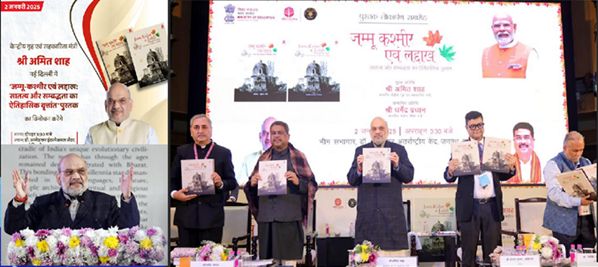
This week, Union Home Minister Amit Shah launched the book Jammu Kashmir & Ladakh Through the Ages: A Visual Narrative of Continuities and Linkages. The book seeks to dismantle historical distortions and myths, offering evidence-based insights into how the region has been an integral part of India’s cultural and spiritual evolution for millennia. This analytical exploration delves into the broader implications of the book’s content, reflecting on its role in shaping national identity and bridging the gaps between history, culture, and modern development in Jammu, Kashmir, and Ladakh. The function was attended by dignitaries including Union Minister of Education Dharmendra Pradhan and Prof. Raghuvendra Tanwar, the Chairman of the Indian Council of Historical Research (ICHR), This book aims to counter several long-standing historical misconceptions, focusing on the deep-rooted cultural, spiritual, and geographical ties of Jammu, Kashmir, and Ladakh with the rest of India. In his address, Home Minister Amit Shah’s words underscored a unique perspective on India’s history and unity, challenging past distortions and emphasizing the cultural cohesion of the nation. His statements raised several key themes about India’s historical identity, the role of Jammu and Kashmir in Indian civilization, and the significant changes post-abrogation of Article 370. This piece delves deeper into these aspects to understand the undercurrents of Shah’s remarks and the broader implications they have for India’s future.
Challenging Historical Misconceptions: One of the key points in Amit Shah’s address was his criticism of a long-standing myth about India’s unity. He rejected the notion that India was never united or that its fight for independence lacked significance. Shah sought to dismantle this misconception, suggesting it had been perpetuated by historians with a narrow perspective. He argued that India’s true essence lies in its geo-cultural identity, rather than just its geopolitical boundaries. According to Shah, India’s unity is rooted in its cultural expanse, which connects regions from Kashmir to Kanyakumari and from Bengal to Gujarat. This perspective highlights that India’s unity is not merely the result of political borders but stems from a deep, historical continuity of cultural practices, emphasizing the importance of accurate historical research to understand the nation’s true identity.
Kashmir: The Cultural Hub of India’s Heritage: Shah’s address also emphasized the rich historical legacy of Kashmir and its integral role in shaping Indian civilization. Through the publication, the Home Minister sought to re-establish Kashmir as a cultural and spiritual hub, with deep ties to India’s heritage. According to Shah, Kashmir’s history is intertwined with the cultural practices, languages, and philosophical traditions that define India. From the ancient scriptures to the spread of Buddhism, Kashmir’s historical significance spans thousands of years, he argued. This idea was articulated by Shah with particular focus on Kashmir’s role in the development of Buddhism, which he described as a crucial part of the region’s cultural legacy. Notably, the book highlights Kashmir’s contribution to Buddhist philosophy and spirituality, noting that Kashmir was instrumental in the evolution of post-Buddha teachings. Shah also pointed to Kashmir’s involvement in trade, languages, and art forms—fields where its influence resonated across India and beyond. In this way, the region’s historical identity as a cultural and spiritual crossroads is essential in understanding its longstanding connection to India. The integration of such evidence into historical narratives not only asserts the cultural significance of Kashmir but also questions the legitimacy of those who attempt to sever these ties.
The Dangers Of Distorted Historical Narratives: A key theme that emerged from Shah’s address was the notion that distorting Kashmir’s history is not just an intellectual exercise but a dangerous endeavor with real-world consequences. According to Shah, historians with a limited view of India’s history have attempted to misinterpret or erase the deep cultural linkages between Kashmir and the rest of the nation. He pointed out that these historical inaccuracies have served as a basis for separatist ideologies in the region. Shah’s remarks suggest that such distortions have contributed to the belief that Kashmir’s connection to India is temporary or tenuous, rather than a longstanding cultural and historical bond.
The Role of Article 370 In Creating Divisions: In a crucial section of his speech, Amit Shah addressed the implications of Article 370, which had for decades allowed Jammu and Kashmir to operate under a separate set of laws. Shah argued that Article 370 had perpetuated a dangerous misconception that Kashmir’s connection to India was temporary, fueling separatism and contributing to the rise of militancy in the region. The abrogation of this provision in August 2019, he claimed, was a turning point in the fight against the forces of division, as it brought the region closer to the political and constitutional fabric of India. The Home Minister underscored the devastating consequences of Article 370, emphasizing how it contributed to a generation of youth in Kashmir who grew up with the belief that their region was distinct from the rest of India. He also noted that this legal provision acted as a breeding ground for terrorism, which had claimed thousands of lives over the years. The dramatic decline in militant activity following the repeal of Article 370—Shah pointed to a 70 percent reduction in incidents—serves as evidence, in his view, that the abrogation was necessary to restore peace and stability to the region. Furthermore, Shah articulated that the abrogation of Article 370 facilitated economic and infrastructural development in Kashmir, including the growth of industries, the establishment of educational institutions, and the arrival of millions of tourists. These developments, he argued, were a direct result of integrating Kashmir more fully with the rest of India. The contrast with the lack of progress during the previous seven decades before the abrogation of Article 370 only served to highlight the government’s success in unlocking Kashmir’s potential post-repeal.
A Vision for the Future; Kashmir’s Role in India’s Geo-Cultural Identity: HM Shah’s remarks also highlighted the government’s broader vision for Kashmir’s future. By referencing developments such as the construction of the world’s largest railway arch bridge and Asia’s largest tunnel, he illustrated the tangible progress made in the region. These achievements, he contended, represent not just physical infrastructure but also a symbolic restoration of Kashmir’s central role in India’s cultural and economic landscape. Shah’s words reflect the government’s broader narrative that Jammu and Kashmir, along with Ladakh, are key to India’s geo-cultural identity. Through the development of this region, he suggested, India would reclaim the historical and cultural glory that has been lost over the years. His emphasis on democracy taking root in the region, as evidenced by the increased participation in local elections and the strengthening of grassroots governance, further underscores the government’s focus on integrating Kashmir into the democratic fabric of India.
“In recognizing the region’s historical importance, we also understand that its journey into the future must be rooted in a balanced and inclusive approach, where the preservation of history and culture goes hand in hand with contemporary development and progress. The challenge for the future is to ensure that the unique identity of these regions is both celebrated and integrated into the broader national narrative.”
The Resilience Of Kashmir’s Cultural Diversity: A significant aspect of Shah’s address was the recognition of Kashmir’s linguistic and cultural diversity. He praised Prime Minister Modi for his efforts to preserve and promote regional languages, including Kashmiri, Ladakhi, and Dogri, alongside Hindi, English, and Sanskrit. This, Shah argued, reflects the government’s commitment to preserving the rich cultural heritage of Jammu, Kashmir, and Ladakh, particularly for smaller linguistic communities. By integrating these languages into governance, the Modi administration has made strides in ensuring the survival and growth of these languages, which are an integral part of the region’s cultural identity. Shah’s reflection on the diverse religious traditions that have thrived in Kashmir—whether Buddhism, Shaivism, or Sufism—further illustrates the inclusivity that characterizes the region. Kashmir’s long history as a place of spiritual convergence remains central to its cultural and historical significance, and Shah’s acknowledgment of this inclusive legacy serves as a reminder of the region’s potential to foster peace and unity in a diverse nation.
Reaffirming Kashmir’s Place In India: Amit Shah’s address was more than just an introduction to a book; it was a bold statement about the historical, cultural, and political significance of Jammu, Kashmir, and Ladakh in the broader narrative of India’s unity. By addressing the distortions in Kashmir’s history and the political implications of Article 370, Shah made a compelling case for the region’s inseparability from India. His emphasis on Kashmir’s historical and cultural connections to the nation, as well as the strides made in its development post-abrogation, underscores the government’s vision for a unified and prosperous India. Shah’s words, and the book itself, aim to restore Kashmir’s rightful place in the history of India, countering the forces that have sought to divide the nation. As the region continues to evolve and embrace its historical identity, the future of Jammu, Kashmir, and Ladakh seems bright—rooted in the rich cultural heritage that has always defined it as an inseparable part of India.
Kashmir Horizon View: The launch of the book Jammu Kashmir & Ladakh Through the Ages: A Visual Narrative of Continuities and Linkages by Union Home Minister Amit Shah is a significant scholarly endeavor that sheds light on the deep historical, cultural, and spiritual connections of Jammu, Kashmir, and Ladakh with the larger Indian subcontinent. By offering a rich, visual narrative spanning thousands of years, this book highlights the region’s integral role in shaping the cultural, spiritual, and intellectual fabric of India. The book’s emphasis on cultural unity and historical continuity helps strengthen the understanding that Jammu, Kashmir, and Ladakh have long been connected to the broader Indian civilization, not just politically but culturally and spiritually, as well. The central argument of the book is that the region’s heritage and traditions, whether through religion, language, or culture, have been part of the Indian civilization for millennia. This message is key for future generations, as it emphasizes the unity that ties these regions together with the rest of the nation. In this context, the focus remains on acknowledging and preserving the region’s rich history, while also recognizing the modern strides made in bringing the region closer to the national mainstream. The publication of Jammu Kashmir & Ladakh Through the Ages is a powerful reminder that Jammu, Kashmir, and Ladakh are not just defined by their contemporary political issues but also by a cultural and spiritual lineage that extends back over thousands of years. By documenting this heritage through an evidence-based narrative, the book serves as an important counterpoint to historical distortions that have sometimes clouded the region’s relationship with the rest of India. It stresses that, while the region’s political landscape has evolved over time, its cultural, spiritual, and historical ties to India have remained steadfast. As Union Home Minister Amit Shah highlighted, India’s unity lies in its diverse yet deeply interconnected cultural fabric, and understanding this unity is essential for the future. Jammu, Kashmir, and Ladakh, with their long history of interaction with other parts of India, represent the geographical and cultural continuum that has shaped the nation. In recognizing the region’s historical importance, we also understand that its journey into the future must be rooted in a balanced and inclusive approach, where the preservation of history and culture goes hand in hand with contemporary development and progress. The challenge for the future is to ensure that the unique identity of these regions is both celebrated and integrated into the broader national narrative.
(In commitment to continuous improvement the “Team Kashmir Horizon” invites it’s valuable readers to share their valuable feedback and suggestions with the “Team Kashmir Horizon”. The insights of readers will surely play a vital role in improving the content quality of “Kashmir Horizon” and contribute more for the empowerment of people. Please feel free to reach out to us at editor@ thekashmirhorizon.com. Team “Kashmir Horizon” eagerly anticipates thoughts and ideas of it’s readers, which will help us serve people and even more effectively. The inputs of valuable readers are highly valued as “Kashmir Horizon” strives to provide it’s readers the best possible experience. Thank you for being a part of the reader community!)