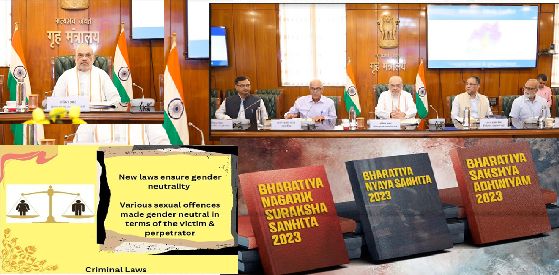
“The new laws aim to address contemporary challenges such as mob lynching and cross-border militancy, while also incorporating technological advancements to ensure efficiency and transparency in law enforcement.”
Three new criminal laws—the Bharatiya Nyaya Sanhita, 2023, the Bharatiya Sakshya Adhiniyam, 2023, and the Bharatiya Nagarik Suraksha Sanhita, 2023—came into effect on July 1, replacing the Indian Penal Code, 1860, the Indian Evidence Act, 1872, and the Code of Criminal Procedure, 1973.
Justice-Oriented Approach: Union Home Minister and Minister of Cooperation Amit Shah described the new criminal laws as justice-oriented rather than punishment-focused, and victim-centric. He emphasized that the new laws prioritize justice over punishment, ensure speedy trials and justice, and protect victims’ rights.
Addressing Misconceptions: Shah noted that misconceptions are being spread about these laws to create confusion among the public. He stated that every aspect of the new laws was extensively discussed with various stakeholders over four years, marking them as some of the most thoroughly debated laws in independent India.
Indigenous Criminal Justice System: Home Minister highlighted that after 77 years of independence, India’s criminal justice system is becoming completely indigenous. The new laws have been implemented in every police station across the country. He mentioned that these laws replace punishment with justice, prioritize speedy trials over delays, and protect the rights of victims and complainants, not just the police.
Constitutional Alignment And Prioritization: The Home Minister also stated that the sections and chapters of the new laws are prioritized in accordance with the spirit of the Indian Constitution. Crimes against women and children are given the highest priority, with a new chapter dedicated to these offenses, comprising 35 sections and 13 provisions.
Addressing Mob Lynching And Anti-National Activities: For the first time, mob lynching has been defined, with severe punishments prescribed. The new laws also abolish the colonial-era sedition law, replacing it with provisions for severe punishment for anti-national activities that threaten India’s unity and integrity. Shah asserted that these laws will create a modern judicial system, incorporating technology not only from the present but also accommodating advancements for the next 50 years. He mentioned that 99.9% of police stations across the country have been computerized, with the process of generating e-records having started in 2019.
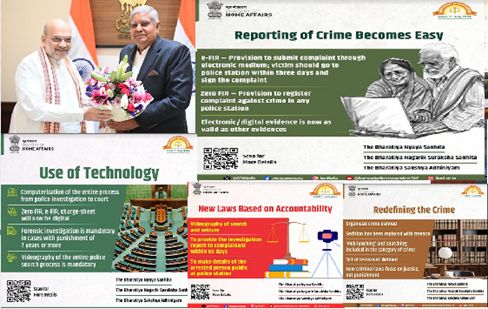
Technological Integration: The new laws will see Zero-FIR, e-FIR, and charge sheets all being digital. Shah also highlighted that the laws set deadlines for completing procedures, aiming to end the endless wait for justice, with the potential for cases to reach the Supreme Court within three years of filing an FIR.
Implementation in Jammu and Kashmir: In Jammu and Kashmir, Chief Secretary Atal Dulloo convened a high-level meeting to assess the Union Territory’s readiness for implementing the new criminal laws from July. The meeting included key stakeholders such as the DG Police, Principal Secretary Home, DG Prisons, DG Prosecution, SDG Crime, ADGP Headquarters, Secretary Health, Secretary Law, Director FSL, and other relevant officers, with some joining virtually. Dulloo emphasized the need for a conducive environment and robust infrastructure to ensure smooth implementation, highlighting the importance of issuing notifications and Statutory Orders in advance and urging the National Informatics Centre (NIC) to expedite software development.
Tackling Cross-Border Militancy: Director General of Police R. R. Swain noted that the Bharatiya Nyaya Sanhita provides a clear legal mandate to tackle cross-border militancy in Jammu and Kashmir. He mentioned that the new laws have dedicated sections to combat organized crime, ensuring no room for unlawful activities by syndicates threatening internal security. Swain emphasized the responsibility on the J&K Police to ensure the reforms achieve their full potential, given their long-standing fight against terrorism. DGP Swain also highlighted the importance of a stable environment for effective law enforcement, ensuring public peace, security, and order, allowing investigators, witnesses, prosecutors, and trial courts to perform their duties without fear. He mentioned ongoing investments in quality training for Investigating Officers and prioritizing good investigations, with districts ranked on various law enforcement parameters to encourage healthy competition. Swain requested the Home Department to strengthen their resources with 321 Law Officers at various levels to meet the demands of the new laws.
Enhancing Accountability And Transparency: Meanwhile, Additional Director General of Police (ADGP) Jammu zone Anand Jain told Kashmir Horizon that new criminal laws would enhance accountability and transparency in police functioning and effectively deal with terrorism in J&K. “The two important things of the new criminal laws are justice in place of punishment and security which means that the new laws will not only punish the guilty but also provide justice to the victims,” he added.
Upholding Public Safety: Inspector General of Police Kashmir Zone, V. K. Birdi, reviewed the implementation of the new laws and the Evidence Act during his visit to police stations in Srinagar, emphasizing high standards in law enforcement to uphold public safety and security. Birdi expressed satisfaction with the dedication of police personnel and reiterated the commitment of the J&K Police to uphold the rule of law and ensure justice for all citizens.
First FIRs Under New Laws: On the first day of implementing the new criminal laws, Jammu & Kashmir Police registered the first FIRs under the Bharatiya Nyaya Sanhita in Anantnag, Srinagar, Baramulla, Kulgam, and Police District Sopore. This marks the beginning of a new era in the justice delivery system within the Kashmir Zone.
“Robust infrastructure is vital for the smooth implementation of new criminal laws. Investments should be made in modernizing police stations, courts, and forensic labs, ensuring they are equipped with the necessary resources and technology. Establishing a mechanism for regular monitoring and evaluation of the new laws’ implementation will help identify challenges and areas for improvement. Feedback from various stakeholders, including law enforcement officials, legal professionals, and the public, should be incorporated to refine the processes continuously. Emphasis should be placed on strengthening victim support systems to ensure their rights are protected, and they receive timely justice. This includes setting up dedicated victim assistance units, providing legal aid, and ensuring psychological support for victims and their families.”
Kashmir Horizon View: The implementation of the Bharatiya Nyaya Sanhita, 2023, the Bharatiya Sakshya Adhiniyam, 2023, and the Bharatiya Nagarik Suraksha Sanhita, 2023 marks a significant milestone in India’s legal history, replacing colonial-era laws with modern, justice-oriented, and victim-centric statutes. Union Home Minister Amit Shah highlighted the extensive deliberation that went into crafting these laws, emphasizing their focus on justice over punishment, speedy trials, and protecting victims’ rights. The new laws aim to address contemporary challenges such as mob lynching and cross-border militancy, while also incorporating technological advancements to ensure efficiency and transparency in law enforcement.
Way Forward: To ensure the effective implementation of the new laws, continuous training programs should be conducted for police officers, investigators, and judicial staff. This will help them understand the nuances of the new legal framework and adapt to the technological advancements incorporated into the system. It is crucial to educate the public about the new laws to dispel any misconceptions and build trust in the new justice system. Awareness campaigns can help citizens understand their rights and the new legal processes, fostering greater cooperation with law enforcement agencies. The integration of technology in law enforcement should be continually upgraded to stay ahead of evolving criminal activities. Developing and deploying advanced software tools, enhancing the Crime and Criminal Tracking Network & Systems (CCTNS), and ensuring seamless digital documentation and e-governance are essential steps forward. Robust infrastructure is vital for the smooth implementation of new criminal laws. Investments should be made in modernizing police stations, courts, and forensic labs, ensuring they are equipped with the necessary resources and technology. Establishing a mechanism for regular monitoring and evaluation of the new laws’ implementation will help identify challenges and areas for improvement. Feedback from various stakeholders, including law enforcement officials, legal professionals, and the public, should be incorporated to refine the processes continuously. Emphasis should be placed on strengthening victim support systems to ensure their rights are protected, and they receive timely justice. This includes setting up dedicated victim assistance units, providing legal aid, and ensuring psychological support for victims and their families. By focusing on these areas, India can ensure that the new criminal laws achieve their intended objectives of providing timely justice, protecting victims’ rights, and creating a modern, efficient, and transparent criminal justice system.
(In commitment to continuous improvement the “Team Kashmir Horizon” invites it’s valuable readers to share their valuable feedback and suggestions with the “Team Kashmir Horizon”. The insights of readers will surely play a vital role in improving the content quality of “Kashmir Horizon” and contribute more for the empowerment of people. Please feel free to reach out to us at editor@ thekashmirhorizon.com. Team “Kashmir Horizon” eagerly anticipates thoughts and ideas of it’s readers, which will help us serve people and even more effectively. The inputs of valuable readers are highly valued as “Kashmir Horizon” strives to provide it’s readers the best possible experience. Thank you for being a part of the reader community!)