Ahmedabad, June 7:Riding on the momentum generated by the inaugural World Yogasana Championship, organisers of the sport on Saturday said the India-led yogasana movement has expanded its footprint to more than 100 countries and is now actively pursuing inclusion in major international sporting events, including the Commonwealth Games, Asian Games and eventually the Olympics.
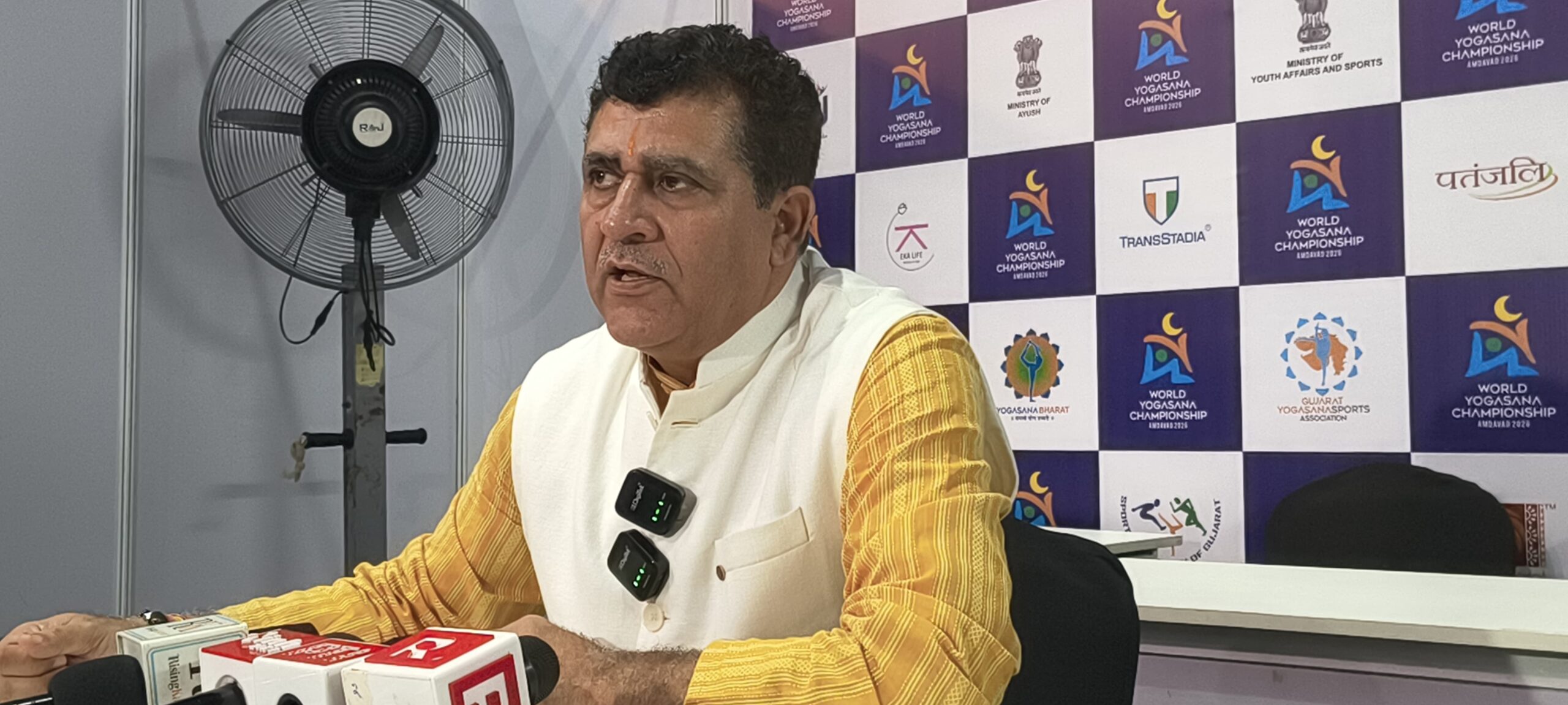
Addressing a press conference on the sidelines of the championship in Ahmedabad, Dr. Jaydeep Arya, General Secretary of World Yogasana and Yogasana Bharat, said the discipline had evolved into a competitive sport distinct from traditional yoga, with an emphasis on athletic performance, endurance, flexibility and fitness.
“Yoga is a journey towards self-realisation and spiritual growth, while yogasana is a competitive sport. Fitness, endurance and flexibility form the foundation of yogasana. Athletes compete on technical parameters, much like in any other sport,” Arya said.
The remarks come amid growing efforts by Indian organisations to establish yogasana as a globally recognised sporting discipline.
Arya said the first World Yogasana Championship had helped clarify the distinction between yoga as a holistic practice and yogasana as a competitive event, a differentiation that organisers believe is essential for securing international sporting recognition.
“yogasana has already gained traction within the Commonwealth Games movement and is steadily progressing towards broader acceptance by international sporting bodies”, he said.
Arya said that they have entered the Commonwealth Games ecosystem and are actively pursuing our Olympic journey. It is a matter of pride that an indigenous Indian discipline is moving towards global sporting recognition,” he said.
The championship, which brought together nearly 500 participants from different countries, was held against the backdrop of significant logistical challenges. Arya said geopolitical tensions in parts of the Middle East, airport closures, rising airfares and health concerns in some African nations had affected travel plans for several delegations.
“Travel costs increased two to three times in some regions because of disruptions, but athletes remained committed and travelled to Ahmedabad. Their dedication has made this championship successful,” he said.
Arya also highlighted the support extended by Yoga Guru Baba Ramdev, whose presence at the championship, he said, reflected growing acceptance of yogasana as a competitive discipline alongside its traditional roots.
As organisers seek wider recognition, educational institutions have emerged as a key focus area. Arya said the National Education Policy (NEP) had created opportunities for integrating yoga and yogasana into schools and colleges across the country.
He pointed to Haryana’s decision to include yoga and yogasana in its education curriculum, describing it as a model that other states could follow. Several school boards, including CBSE and ICSE, have already introduced yoga-related subjects and skill-based courses, he added.
“We are creating an ecosystem where yoga and yogasana become part of students’ development, fitness and skill-building process,” Arya said.
The movement’s international outreach has also accelerated through digital platforms. According to Arya, World Yogasana and Yogasana Bharat are currently active in more than 700 districts across India and have been conducting training programmes in over 100 countries through online coaching and distance-learning initiatives.
The shift towards digital training gained momentum during the COVID-19 pandemic and has since become a major tool for global expansion, he said.
“Online platforms have enabled us to train athletes across continents. Today, more than 100 countries are connected with yogasana training programmes,” Arya said.
Organisers now plan to expand their presence to at least 50 additional countries through collaborations with educational institutions, sports bodies and governments. Mauritius, which has already incorporated yogasana into its curriculum, is scheduled to host the next World Yogasana Championship in 2028.
To support this growth, World Yogasana has begun deploying coaches internationally and training athletes, technical officials, judges and administrators in areas ranging from competition management to digital scoring systems.
Gen Sec, Arya argued that yogasana’s value extends beyond competition, describing it as a complementary discipline that can improve performance in other sports by enhancing concentration, mental resilience and physical conditioning.
Several countries, including Bangladesh and Nepal, have already formally recognised yogasana as a sport, while India continues to drive its global expansion, he said.
India currently has more than 10 lakh yogasana athletes, over 2,000 trained coaches and thousands of academies and training centres, according to data shared by the organisation. Institutions such as sports universities, Patanjali University and the National Institute of Sports in Patiala are also contributing to the development of trained professionals in the discipline.
Looking ahead, Arya expressed confidence that yogasana would continue to attract young athletes and evolve into a viable sporting career.
“The enthusiasm among youth is growing rapidly. Yogasana is becoming a platform for fitness, discipline and professional opportunities. Today’s athletes will become tomorrow’s coaches, mentors and ambassadors of the sport,” he said.
Invoking the philosophy of Vasudhaiva Kutumbakam, Arya said the movement’s broader objective was not merely sporting success but promoting health and well-being through international cooperation.
“We are not competing against countries. We are working together to make the world healthier and better. Our guiding principle remains that the world is one family,” he said.