“The expansion aligns infrastructure with the Valley’s growth aspirations and strengthens its long-term economic future. He added that enhanced connectivity through world-class airport facilities will not only improve passenger experience but also catalyse trade, tourism and employment, positioning J&K firmly on the path of sustained development,” LG Sinha
Mohammad Irfan
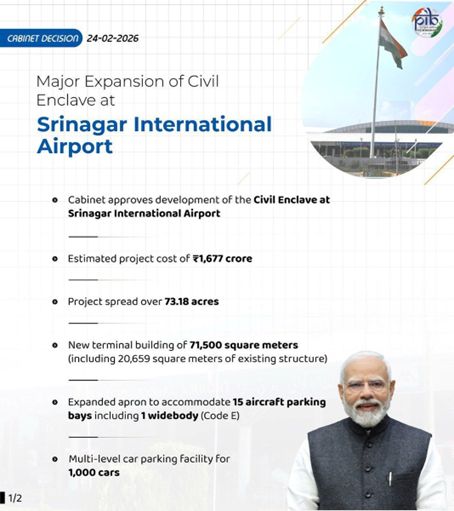
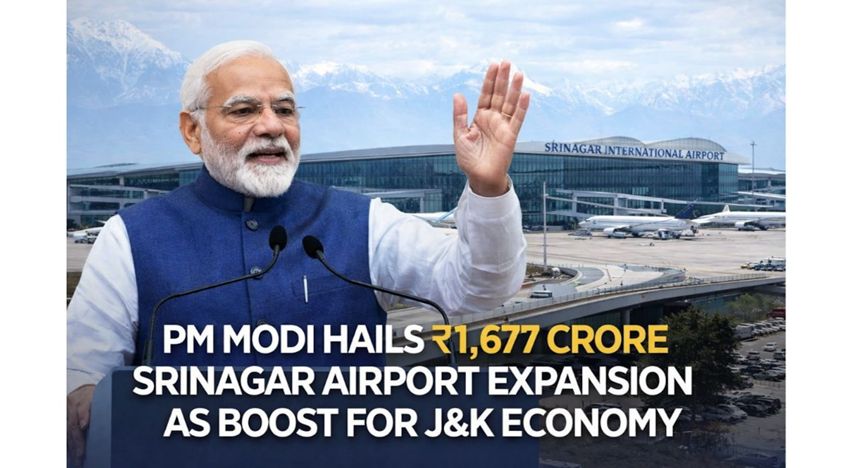
This week, in a landmark decision poised to redefine connectivity and economic momentum in Jammu and Kashmir, the Cabinet Committee on Economic Affairs (CCEA), chaired by Prime Minister Narendra Modi, has approved the development of a new Civil Enclave at Srinagar International Airport at an estimated cost of Rs 1,677 crore. The project, ambitious in scale and strategic in timing, signals more than an infrastructural expansion; it marks a structural recalibration of the Valley’s primary air gateway to match long-term tourism, investment and mobility aspirations.
Scaling Ahead Of Demand: At the heart of the project lies a new state-of-the-art terminal building to be developed over 73.18 acres, with a total built-up area of 71,500 square metres, including 20,659 square metres of the existing structure. The facility is designed to handle 2,900 passengers during peak hours and support an annual capacity of 10 million passengers per annum (MPPA)—more than double the airport’s present operational capacity. The urgency for expansion is rooted in traffic realities. Srinagar airport is currently approaching saturation at roughly 3 MPPA. Yet actual passenger throughput has already exceeded that benchmark, touching 4.50 million in 2024–25 after a strong post-pandemic rebound. Historical data indicates a compound annual growth rate (CAGR) of 9.76 per cent between 2019–20 and 2024–25, while projections estimate a sustained growth rate of around 9.40 per cent over the next five years. By 2034–35, passenger traffic is expected to cross 10 million. Such numbers underscore a crucial policy choice: build ahead of demand rather than chase it. Aviation infrastructure typically requires long gestation periods; reactive expansion often leads to congestion, service bottlenecks and reputational setbacks. By approving the new Civil Enclave before severe strain sets in, policymakers are attempting to institutionalise anticipatory governance.
Dual-Use Complexity, Strategic Sensitivity: Srinagar airport operates within the Budgam Airbase of the Indian Air Force (IAF), making it a dual-use facility. While the Airports Authority of India (AAI) manages the civil terminal, the 3,658-metre runway remains under IAF operational control. This arrangement adds layers of coordination and security to expansion planning. The new Civil Enclave design incorporates strengthened safety and security measures, including construction of barracks for CISF and security personnel. These additions recognise the airport’s unique position at the intersection of civilian mobility and strategic defence imperatives. Unlike greenfield civilian airports, Srinagar’s upgrade must harmonise commercial growth with military oversight—a balancing act that underscores its national importance.
Airside Expansion | Preparing for Int’l Scale: One of the most consequential elements of the project is the proposed expansion of the apron area from nine to 15 aircraft bays. Significantly, provision is included for one Code E widebody aircraft, enabling the handling of larger international jets. Although Srinagar was designated an international airport in 2005, global connectivity has remained limited. The ability to park and service widebody aircraft creates new operational possibilities—direct long-haul routes, charter flights from international markets and potential cargo expansion. In aviation economics, apron capacity directly influences route viability. Without adequate aircraft parking and turnaround space, airlines are reluctant to commit to higher frequencies. This upgrade positions Srinagar not merely as a seasonal domestic tourism node but as a potential international aviation gateway.
Economic Multiplier Effects: LG Sinha: Airports are catalysts for regional economies. Enhanced passenger throughput translates into expanded retail zones, hospitality services, logistics chains and ancillary employment. Lieutenant Governor Manoj Sinha characterised the approval as a “defining leap in connectivity” and the dawn of a bold aviation era for J&K. In his remarks, he emphasised that improved connectivity would bring “more tourists, more investment and more jobs,” transforming Srinagar from a beautiful destination into a thriving one. The multiplier effect of air connectivity is well documented. Reduced travel friction encourages conference tourism, film shoots, corporate travel and real estate development. For sectors like horticulture—particularly apples and saffron—faster and more reliable air links can support premium export channels. Moreover, a 10 MPPA capacity aligns infrastructure with projected tourism growth. Kashmir’s hospitality industry has seen record footfalls in recent years. Ensuring that the airport can absorb peak-season surges without congestion enhances visitor experience and repeat travel likelihood.
“Efforts to strengthen safety mechanisms, provide employment opportunities and create infrastructure that supports sustainable rehabilitation. By framing nativity as both emotional belonging and active participation in public life, he conveyed optimism that return can evolve from aspiration to reality. The lasting peace, transparent governance and inclusive development are the foundations upon which the confidence of the Kashmiri Pandit community can be fully rebuilt,” LG Sinha.
Architectural Identity|A Cultural Gateway: Beyond functional metrics, the new terminal is envisioned as an architectural expression of Kashmir’s heritage. Plans include incorporation of intricate woodwork and locally inspired craftsmanship, integrated with streamlined passenger processing zones and modern check-in systems. Airports serve as symbolic gateways. Embedding local aesthetics within high-efficiency infrastructure allows Srinagar to project cultural identity alongside operational competence. The terminal thus becomes both transit hub and narrative device—introducing visitors to Kashmir’s artisanal traditions from the moment they disembark.
Sustainability, A Strategy: Environmental sustainability is central to the design framework. The Civil Enclave aims to achieve a 5-star GRIHA rating, one of India’s highest benchmarks for green buildings. Proposed features include advanced water harvesting systems, maximised natural lighting to reduce electricity consumption and the use of eco-friendly, locally sourced materials. Given aviation’s carbon-intensive profile, integrating green architecture mitigates environmental impact while lowering long-term operating costs. Energy-efficient design reduces dependence on conventional power grids, while water harvesting addresses resource stress—particularly relevant in ecologically sensitive mountain regions.
Urban Impact, Decongestion: The project also includes a multi-level car parking facility capable of accommodating 1,000 vehicles, addressing congestion that often characterises peak travel seasons. Improved landside infrastructure enhances passenger convenience and reduces spillover traffic into adjoining areas. Urban planning implications are significant. As passenger volumes grow, peripheral commercial development—hotels, logistics hubs, retail outlets—is likely to cluster around the airport. Strategic zoning and transport integration will be crucial to prevent haphazard sprawl.
Regional Synergy| Jammu And Srinagar: Parallel upgrades at Jammu Airport, slated for completion later this year, indicate a broader regional connectivity blueprint. While Srinagar anchors tourism and horticulture exports, Jammu functions as a gateway to pilgrimage circuits and administrative hubs. Together, the two upgraded airports could create a complementary aviation ecosystem—distributing passenger loads, enhancing resilience and supporting balanced economic growth across the Union Territory.
Tourism Reinforcement: Improved air connectivity is expected to reinforce tourist flows to landmarks such as Dal Lake, the Shankaracharya Temple and the Mughal Gardens. However, tourism’s economic contribution extends beyond sightseeing. Houseboats, handicraft markets, transport operators and culinary enterprises all depend on consistent visitor inflows. Reliable airport capacity ensures that seasonal peaks—particularly summer vacations and winter tourism—do not overwhelm infrastructure. For international travellers, efficient terminals and seamless processing significantly influence destination choice.
Investment Signalling: Large-scale infrastructure approvals also serve as investment signals. A Rs 1,677 crore commitment from the CCEA communicates long-term confidence in the region’s growth trajectory. Investors in hospitality, real estate and services interpret such signals as assurance of policy stability and future demand. The decision aligns with broader efforts to integrate Jammu and Kashmir into national economic circuits. Enhanced connectivity reduces perceived remoteness, positioning Srinagar within mainstream corporate travel networks.
Security Architecture: Given the airport’s strategic location and dual-use status, strengthening security architecture is critical. Dedicated barracks for CISF personnel enhance readiness and coordination. In regions with sensitive security histories, robust safety frameworks are essential for sustaining airline confidence and passenger trust. Balancing openness with vigilance will remain an ongoing challenge. However, embedding security infrastructure within expansion plans from the outset minimises retrofitting costs and operational disruption.
Anticipatory Governance: Perhaps the most compelling aspect of the Civil Enclave project is its anticipatory logic. Rather than waiting for systemic congestion or service decline, authorities have opted for proactive expansion. Infrastructure built ahead of demand allows for smoother operational scaling and avoids reputational damage associated with overcrowded facilities. This approach reflects a maturing policy orientation—where planning cycles account for decade-long projections rather than immediate electoral timelines.
Transforming From Destination To Hub: In his statement, the Lieutenant Governor articulated a vision of transforming Srinagar “from a beautiful destination into a thriving one.” The distinction is subtle but profound. A destination implies episodic visitation; a thriving hub suggests sustained economic dynamism. For Srinagar to evolve into an aviation hub, connectivity must support year-round traffic, diversified travel purposes and international linkages. The new Civil Enclave lays the groundwork for such transformation, though complementary investments in urban mobility, hospitality and skill development will be equally vital.
Building For The Next Decade: The Rs 1,677 crore approval for the new Civil Enclave at Srinagar International Airport represents a decisive infrastructure intervention. It addresses immediate capacity constraints while anticipating future demand. It balances military sensitivity with civilian growth, integrates sustainability with scale and merges cultural identity with modern efficiency. If executed on schedule and supported by coherent tourism and investment policies, the expansion could redefine Kashmir’s connectivity narrative. By 2034–35, when passenger traffic is projected to cross 10 million, the Valley’s primary gateway may stand not as a bottleneck but as a benchmark—an airport prepared for the next decade of aspiration, mobility and economic resurgence.
Kashmir Horizon View: The approval of the new Civil Enclave at Srinagar International Airport marks a decisive step, but its long-term success will depend on timely execution, coordinated planning and complementary policy support. The first priority must be adherence to project timelines and cost discipline, ensuring that the Rs 1,677 crore investment translates into operational capacity without delays that often afflict large infrastructure ventures. Seamless coordination between the Airports Authority of India, the Indian Air Force and security agencies will be essential to maintain operational efficiency within the dual-use framework. Beyond construction, strategic route development should become a parallel focus. Expanding apron capacity and accommodating Code E aircraft will only yield dividends if airlines are incentivised to introduce new domestic and international routes. Targeted engagement with carriers, tourism boards and trade bodies can help convert infrastructure readiness into actual traffic growth. At the same time, integrated urban planning around the airport—improved road connectivity, public transport links and regulated commercial development—will be necessary to prevent congestion and ensure a smooth passenger experience. Sustainability commitments, including the 5-star GRIHA rating target, must be rigorously implemented rather than remaining aspirational. Efficient water management, renewable energy integration and green building practices will be critical for balancing growth with ecological responsibility in a fragile Himalayan ecosystem.
(“Team Kashmir Horizon” is committed to continuous improvement and invites feedback and suggestions from readers and its followers on social media sites. Reader insights are considered vital for enhancing content quality and empowering the community. The team encourages open communication and values the thoughts and ideas of its audience, believing that such input will enable them to serve the public more effectively. The initiative aims to ensure that readers have the best possible experience with “Kashmir Horizon”. Interested individuals can reach out to us via email at [email protected].)