[Amit Shah’s revelation that BSF troops had eliminated Pakistan’s surveillance infrastructure along the Jammu and Rajasthan frontiers, and even in the remote Kutch sector, marks a rare acknowledgment of the paramilitary force’s offensive capabilities. “Whenever there is an attack on India’s borders, it is the chest of a BSF jawan that absorbs the first blow,” Shah said, adding that their valor during Operation Sindoor ensured that damage to Indian civilian infrastructure was minimized. This public acknowledgement of BSF’s aggressive posture during a retaliatory operation could signal a doctrinal shift in how India uses its paramilitary forces in grey-zone conflict scenarios.]
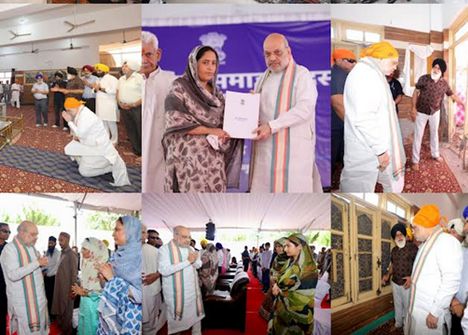
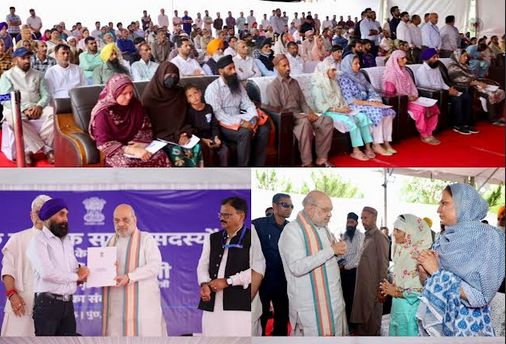
In a strong political and military message aimed at both domestic audiences and Pakistan, Union Home Minister Amit Shah on Friday this week declared that the Border Security Force (BSF) had destroyed more than 118 Pakistani posts and dismantled their surveillance network during Operation Sindoor—India’s retaliatory strike following unprovoked shelling by Pakistan on civilian areas in Jammu and Kashmir’s Poonch district. Speaking at an emotionally charged event in Poonch, Shah distributed government job appointment letters to the families affected by Pakistan’s cross-border firing, a gesture that went beyond compensation and entered the realm of political symbolism. Flanked by Lieutenant Governor Manoj Sinha and senior security officials, Shah used the moment to underline India’s new strategic posture under Prime Minister Narendra Modi’s leadership—swift, precise, and punitive responses to provocations.
Retaliation Redefined; BSF’s Role Beyond The Borders: Amit Shah’s revelation that BSF troops had eliminated Pakistan’s surveillance infrastructure along the Jammu and Rajasthan frontiers, and even in the remote Kutch sector, marks a rare acknowledgment of the paramilitary force’s offensive capabilities. Traditionally regarded as India’s first line of border defense, the BSF has often operated in the shadows of the Army. But Shah’s praise recast them as key players in India’s kinetic response matrix. “Whenever there is an attack on India’s borders, it is the chest of a BSF jawan that absorbs the first blow,” Shah said, adding that their valor during Operation Sindoor ensured that damage to Indian civilian infrastructure was minimized. This public acknowledgement of BSF’s aggressive posture during a retaliatory operation could signal a doctrinal shift in how India uses its paramilitary forces in grey-zone conflict scenarios. Unlike previous cross-border exchanges that ended in mutual ceasefires or UN complaints, Operation Sindoor appears to have been a calibrated escalation—one that avoided striking Pakistan’s civilian or military institutions directly but inflicted heavy damage on terrorist camps and surveillance networks.
The Pahalgam Catalyst; Turning Point in India’s Security Doctrine: The political and military backdrop to Shah’s address is critical. On April 22, 2025, a coordinated terrorist attack in Pahalgam killed 28 civilians, including foreign tourists and children. This attack triggered a wave of national outrage and drew fierce condemnation internationally. According to Shah, that assault served as the final threshold for India’s shift toward what he described as “promptness and severity” in counterterrorism response—echoing the Balakot doctrine but with greater operational depth. “Under Prime Minister Modi’s leadership, we demolished the terrorist headquarters located not only in Pakistan-Occupied Kashmir but deep within Pakistan itself,” Shah said, suggesting that Indian forces had carried out strikes beyond traditional operational limits. He added that Pakistan’s reaction—firing on Indian civilian areas—was not just retaliatory but a confession of guilt. “They mistook our strike on terrorists as a strike on themselves, thereby revealing to the world that Pakistan shelters terrorism,” Shah remarked.
Psychological Warfare; Global Optics, Domestic Resolve:
The messaging was unambiguous: India’s retaliation was surgical and limited to non-civilian targets, but Pakistan’s response exposed its intent by targeting temples, gurudwaras, madrasas, and residential areas in Poonch. By highlighting this contrast, Shah framed India as both militarily superior and morally grounded—two qualities critical in shaping global opinion. The Home minister’s assertion that nine Pakistani airbases were damaged during Indian retaliation adds another layer of intrigue. If accurate, such damage would signify a significant degradation of Pakistan’s forward deployment infrastructure and air capability—achieved without crossing the threshold of full-scale war. Shah also suggested that this show of force forced Pakistan to seek a ceasefire, a claim that positions India as a dominant actor in the conflict-diplomacy dynamic. The larger psychological battle, however, was being fought at home. “The entire country stands with you like a rock,” Shah told the assembled families, reiterating the government’s position that security, not dialogue, is the default mode with Pakistan under current geopolitical realities. “Terror and talks, or terror and trade, cannot go hand in hand. Blood and water cannot flow together,” he said, repeating the government’s long-held stance post-Uri and Pulwama.
Politics of Compensation: Welfare or Statecraft? The distribution of government job letters to the kin of those killed in cross-border firing was presented not merely as relief but as a statement of collective national responsibility. “No compensation can make up for the loss of life,” Shah admitted, “but this is a symbol of the sentiments of the entire nation.” In conflict zones like Jammu and Kashmir, welfare measures often double up as instruments of counterinsurgency and psychological reassurance. The appointment letters served both as a compassionate gesture and as a signal that the Indian state would not abandon those on the frontlines—either soldiers or civilians. Simultaneously, Shah announced that a comprehensive relief package would soon be rolled out for affected families and properties damaged during the shelling. “Many homes and commercial establishments in Poonch have suffered. The Government of India will stand by every citizen,” he declared, further strengthening the state’s commitment to post-conflict rehabilitation.
Strategic Infra, Civil Defence: Bunkers as Political Capital: Shah also used the platform to showcase the government’s civil defense preparedness, particularly the construction of over 9,500 bunkers along the border since 2014. These bunkers, he said, played a vital role in minimizing civilian casualties during the latest round of hostilities. More such bunkers will be constructed, Shah promised, emphasizing that infrastructure development in conflict zones is not just about roads and schools, but about saving lives in times of war. In effect, these bunkers serve as physical manifestations of India’s national security doctrine—defensive structures with strategic implications. This infrastructure push also fits into the broader political narrative of development under duress. “The pace of development in Jammu and Kashmir, which began in 2014, will not stop or slow down,” Shah asserted, hinting that India’s long-term approach to the region hinges on a combination of security, development, and strategic resolve.
Unity In Adversity: Nationalism As A Strategic Resource: Perhaps the most telling remark came when Shah spoke of the “spirit of patriotism” that had emerged across Jammu and Kashmir—from the Valley to Poonch and Kathua—following the Pahalgam attack. By linking emotional unity with military action, the Union Home Minister turned public grief into a form of strategic nationalism. This serves two purposes: first, it underlines the narrative that Kashmiris are stakeholders in India’s war on terror; and second, it challenges Pakistan’s claim of representing Kashmiris. “The people of Jammu and Kashmir have stood shoulder to shoulder with our forces and administration,” Shah noted, stressing that the state machinery had moved swiftly to evacuate civilians and reduce casualties. Even the tone of his address to the BSF personnel was woven with this patriotic fervor. “Your dedication, courage, and sacrifice are on the lips of every child in India,” he said, reinforcing the image of border guards as the personification of national pride.
“The emotional and psychological healing of affected regions like Poonch, along with the morale boost from such national solidarity, is as vital as any military success. Equally important is the role played by the BSF, whose vigilance and sacrifice earned praise as the true first line of defense. Shah’s speech not only honored their courage but placed the BSF at the heart of India’s border resilience, emphasizing their peacetime readiness and wartime efficacy. In regions like Jammu, Rajasthan, and the remote Kutch border, their actions during Operation Sindoor prevented further escalation and demonstrated exemplary tactical coordination. As India looks ahead, the strategic implications of Operation Sindoor necessitate both consolidation and evolution.”
Strategic Messaging Wrapped In Humanitarian Gesture: Amit Shah’s address in Poonch was more than a ceremonial visit. It was a deliberate act of strategic storytelling—merging military achievements with emotional outreach, and combining tactical disclosures with broader political signaling. Operation Sindoor was presented not just as a retaliatory strike, but as a template for how the Modi government envisions security: bold, precise, and unflinchingly patriotic. By highlighting BSF’s role, foregrounding civil-military coordination, and reiterating the central government’s commitment to the people of Jammu and Kashmir, Shah painted a comprehensive picture of a state that is both responsive and resolute. The emphasis on destroying Pakistani surveillance infrastructure, damaging airbases, and forcing a ceasefire shifts the narrative from reactive victimhood to active deterrence. As the dust settles in Poonch and the region awaits further diplomatic ripples, one thing is clear: the Modi government has redefined the rules of engagement, and Shah’s Poonch visit served as its political and strategic articulation.
Kashmir Horizon View: Operation Sindoor marks a pivotal moment in India’s counter-terrorism strategy and border defense posture. The swift and decisive response to the unprovoked shelling of civilian areas in Poonch by Pakistani forces demonstrated not only military might but also the evolving strategic doctrine under Prime Minister Narendra Modi’s leadership. Union Home Minister Amit Shah’s revelation that over 118 Pakistani posts were destroyed and their surveillance infrastructure dismantled showcases the effectiveness of precision-led, intelligence-driven operations conducted by Indian forces, particularly the BSF. The message is clear: India will not passively absorb acts of aggression against its civilians, religious places, or sovereign territory. Furthermore, the Indian response refrained from targeting civilian or military institutions in Pakistan, underlining its commitment to ethical warfare and international norms, even while exercising the right to self-defense. That restraint, paired with overwhelming force on terrorist infrastructure, has earned global recognition and placed the burden of accountability squarely on Pakistan’s shoulders. Shah’s statements have laid bare Pakistan’s duplicity—harboring terrorists while crying foul when those terror bases are struck. At home, the government’s outreach to affected families, including job appointments and promises of relief packages, reinforced the narrative that the Indian state stands shoulder to shoulder with its citizens during times of crisis. The emotional and psychological healing of affected regions like Poonch, along with the morale boost from such national solidarity, is as vital as any military success. Equally important is the role played by the BSF, whose vigilance and sacrifice earned praise as the true first line of defense. Shah’s speech not only honored their courage but placed the BSF at the heart of India’s border resilience, emphasizing their peacetime readiness and wartime efficacy. In regions like Jammu, Rajasthan, and the remote Kutch border, their actions during Operation Sindoor prevented further escalation and demonstrated exemplary tactical coordination. As India looks ahead, the strategic implications of Operation Sindoor necessitate both consolidation and evolution. First, it is imperative that India institutionalize rapid-response doctrines that combine military precision, real-time intelligence, and diplomatic prudence. The BSF, Army, and intelligence agencies must continue to integrate advanced surveillance technologies, AI-driven reconnaissance, and drone warfare capabilities to remain several steps ahead of state-sponsored terrorism. Second, civil-military synergy must be strengthened further. The immediate evacuation of civilians, construction of bunkers, and restoration efforts show a blueprint for disaster mitigation in conflict-prone zones. Going forward, a permanent infrastructure protection plan—encompassing schools, hospitals, and religious places near the LoC—should be prioritized with central and state collaboration. Third, while the military and diplomatic fronts remain vigilant, India must also wage a sustained information war. The narrative that Pakistan shelters terrorists must continue to be amplified globally, using verified intelligence dossiers and targeted diplomatic engagements. Platforms like the UN and bilateral forums can be leveraged to expose and isolate state actors enabling terrorism. Finally, the emotional resilience of the people of Jammu and Kashmir must be nurtured. Continued development, education access, and youth engagement programs are key to denying terrorism the socio-political space it thrives in. The Modi government’s assertion that “terror and talks cannot go together” must now evolve into a doctrine of “terror-free development,” where no act of violence can derail the democratic, social, and economic aspirations of Kashmir and the rest of India.
(In commitment to continuous improvement the “Team Kashmir Horizon” invites it’s valuable readers to share their valuable feedback and suggestions with the “Team Kashmir Horizon”. The insights of readers will surely play a vital role in improving the content quality of “Kashmir Horizon” and contribute more for the empowerment of people. Please feel free to reach out to us at editor@ thekashmirhorizon.com. Team “Kashmir Horizon” eagerly anticipates thoughts and ideas of it’s readers, which will help us serve people and even more effectively. The inputs of valuable readers are highly valued as “Kashmir Horizon” strives to provide it’s readers the best possible experience.)