

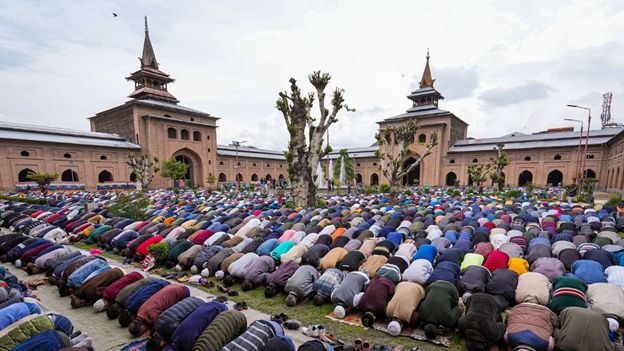
The mosque has always been the heart of a Muslim community, serving as a sanctuary of unity, learning, and spiritual rejuvenation. From the humble structures of early Islam to the grand masjids of today, the essence remains unchanged: drawing humanity closer to Allah. The first mosque in the world, Masjid al-Haram, holds unparalleled sanctity. Allama Iqbal beautifully encapsulates its significance in his couplet:
“Duniya ke butkadon mein, pehla woh ghar Khuda ka,
Hum us ke pasbaan hain, woh pasbaan hamara.”
(Among the idol houses of the world, the first is the house of Allah al-Haram,
We are its guardians, and it is our protector.)
This profound verse highlights the reciprocal relationship between believers and the mosque. It reminds us of our role as custodians, emphasizing that protecting and honoring this sacred trust safeguards our faith and identity.
A Space Of Unity And Equality: Mosques are sacred spaces where worldly distinctions dissolve, and believers stand shoulder to shoulder in devotion to Allah. Allama Iqbal eloquently reflects this egalitarian spirit in his couplet:
“Ek hi saf mein kharay ho gaye Mahmood o Ayaz,
Na koi banda raha aur na koi banda nawaz.
Banda o sahib o mohtaj o ghani ek hue,
Teri sarkar mein pohanche to sabhi ek hue.”
(Sultan Mahmood and his servant Ayaz stood together in the same row.
No servant remained, nor did any master.
The servant, the king, the needy, and the wealthy became one.
When they came into Your presence, all became equal.)
This imagery underscores Islam’s emphasis on equality, where the only distinction in Allah’s sight is righteousness, as stated in the Quran:
“Indeed, the most noble of you in the sight of Allah is the most righteous of you.” (Surah Al-Hujurat: 13).
Rights Of The Mosque: Yet, an important question arises: Are we, as believers, fulfilling the rights of our mosques and valuing their sacred role?
While the mosque provides us with tranquility and ease—clean water for ablution, lights for clarity, and carpets for comfort and during winters hot water while masjid hamaam provides comfort, warmth (A Hamam in Kashmiri refers to a heated room with limestone slabs over a hollowed floor, warmed by a fire beneath, traditionally used in mosques and shrines for warmth and ablution in winters.)
These blessings come with the obligation to ensure their sustenance.
—how often do we consider our responsibilities toward it? A mosque is not anyone’s personal property; it is our collective heritage. Its protection, maintenance, and cleanliness are responsibilities that rest upon all of us.
Here are key areas where believers can contribute:
Financial Support: Every worshiper should contribute a fixed monthly amount to the mosque, no matter how small. Consistent donations collectively ensure the mosque’s upkeep.
Maintenance And Cleanliness: Participating in cleaning and maintaining the mosque is as important as monetary contributions.
Support For The Mosque Team: Those who dedicate their time to administrative and fundraising efforts deserve the community’s wholehearted support. Just as we budget for household expenses like electricity, internet, and school fees, the mosque should be part of our financial priorities. The services we enjoy—water, electricity, and cleanliness—require resources. It is our shared duty to provide them.
“May Allah Almighty grant us the understanding that the mosque is not just a building but an integral part of our spiritual and communal life. May He guide us to fulfill this sacred responsibility with sincerity, enabling us to prioritize Salah, revive the essence of mosques in our daily lives, and strive for spiritual and moral transformation.”
A Call To Action: A mosque is not merely a place of worship but the foundation for strengthening community and society. It serves as a spiritual haven, a center of learning, and a hub for unity and support. However, its upkeep often goes unnoticed, depending entirely on the contributions of the faithful. Supporting the mosque is not limited to financial contributions. Volunteering time and skills, organizing community events, and teaching younger generations the value of the mosque are equally important. Together, these efforts ensure that the mosque continues to enrich the lives of future generations.
The Mosque’s True Beauty: Despite all these efforts, the true adornment of a mosque lies in the establishment of prayer, as emphasized by our beloved Prophet (PBUH) in the hadith: ‘The beauty of a mosque is through prayer, not its structure.’
Salah is undeniably the cornerstone of faith, establishing a direct and unbroken connection between a believer and Allah. It is described as the defining characteristic of a believer, where deliberately neglecting it equates to an act of disbelief (kufr). The importance of Salah is profoundly emphasized in the Hadith:
Sunan al-Tirmidhi (Hadith 2620): “The covenant that distinguishes between us and them (disbelievers) is prayer; whoever neglects it has committed disbelief.”
Sunan Ibn Majah (Hadith 1079): “Between a person and disbelief is abandoning the prayer.”
The detachment of Muslims from their mosques signifies a distance from Allah’s mercy. This estrangement is one of the reasons why oppressor nations have gained dominance over us. Reflecting on the condition of Muslims and their relationship with mosques, Allama Iqbal poignantly remarked:
‘Masjid to bana di shab bhar mein imaan ki hararat walon ne,
Mann apna purana papi hai, barson mein namazi ban na saka.’
“Though the mosque was built overnight by the passionate believers,
Their hearts, tainted by old sins, could not become devout even after years.”
This verse captures the irony of building magnificent mosques while neglecting the spiritual transformation that true devotion and prayer bring.” May Allah Almighty grant us the understanding that the mosque is not just a building but an integral part of our spiritual and communal life. May He guide us to fulfill this sacred responsibility with sincerity, enabling us to prioritize Salah, revive the essence of mosques in our daily lives, and strive for spiritual and moral transformation . Only through such efforts can we hope to regain the honor and dignity that Allah has promised to those who adhere steadfastly to His commandments. May He guide us to take this responsibility seriously and enable us to serve the mosque in every possible way.
(The author is a freelancer. The views, opinions and conclusions expressed in this article are those of the author and aren’t necessarily in accord with the views of “Kashmir Horizon”)
Aubaid Ahmad Akhoon
[email protected]





