

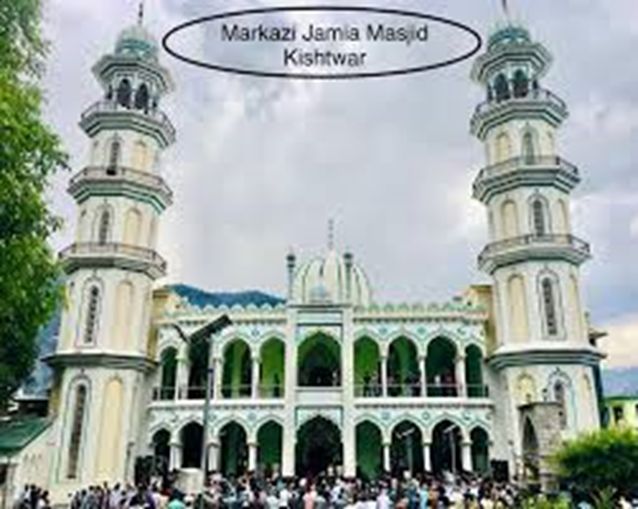
Jamia Masjid is a historic and towering structure at the heart of the city. It was first constructed in 1650 A.D .Rebuilt in the year 2000 after being gutted by fire, it serves not only as a mosque but also as a symbol of unity and faith. The mosque was constructed by the general public of that era and is flanked by three opening gates and two floors and a large basement. The mosque is adorned with two highly elevated minarets ,which provide a sweeping view of Kishtwar town. One day, accompanied by my uncle, I ventured up to the minarets to experience the height. He encouraged me to not show fear in going high upstairs. I climbed to the upper parts of the minaret and was captivated by the breathtaking view of the town.
There are various mosques besides the Jamia Masjid such as Bazar Masjid, Abu Bakr Masjid, Kamgaar Masjid, Asrariya Masjid, Faridiya Masjid etc denoting some old memories and religious legacy. The mosque’s charm does not end with its minarets. The main functional floor, located above the basement, is surrounded by ten pillars and also reflects Kashmir’s cultural and spiritual heritage. I particularly enjoy performing Friday prayers on this floor whenever I visit.
“The mosque’s charm does not end with its minarets. The main functional floor, located above the basement, is surrounded by ten pillars and also reflects Kashmir’s cultural and spiritual heritage.”
However, it’s not always possible due to large crowds on such occasions, I move to the basement, my secondary choice. This time Khatib of Jamia Masjid is Jenab
Farooq Ahmed Kichloo, a well respected professional who is upholding legacy of Khatib of the Masjid in admiring manner for at least two decades. It is beautifully surrounded by flowers and a large ground covered with turf for the worshippers. Its significance extends beyond its role as a place of worship, showcasing the dedication and efforts of our constructive labourers. At last, we can say that this is the place where everyone is equal in their status “Ek hi saf mein khade ho gaye Mahmood-o-Ayaz Na koi banda raha aur na koi banda-nawaz”. We need to cleanse our hearts and to purify our intention. We are performing worship at religious places and we should consider everyone as our brother and sister and should also think about the poors and tend to be sympathetic— also a kind of worship dearest to God.
(The author is a freelancer. The views, opinions and conclusions expressed in this article are those of the author and aren’t necessarily in accord with the views of “Kashmir Horizon”)
Ayaan Saroori






