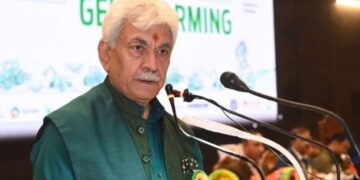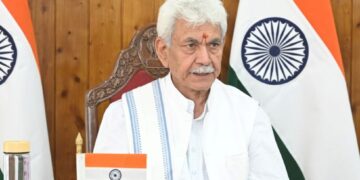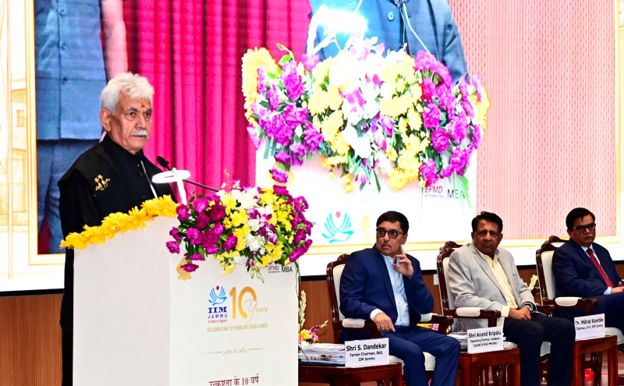
“LG Sinha’s remarks in Sunderbani put particular emphasis on the idea that security and development cannot be treated as responsibilities belonging exclusively to the government….”
Mohammad Irfan
 Jammu and Kashmir Lieutenant Governor Manoj Sinha’s recent visits to Rajouri and Kathua have offered a window into the administration’s larger pitch for the Union Territory: development must reach the last household, border communities must become active partners in national growth, and the fight against terrorism, narco-terrorism, substance abuse and corruption cannot be left to security agencies alone. The message came through two separate engagements spread over August 20 and 21. In Dharpur, Sunderbani, in Rajouri district, LG Sinha laid the foundation stone of the Amriteshwar Sarovar under the Jan Sanchay Jan Bhagidari initiative and linked the project with community participation, spirituality and social responsibility. A day earlier, in Karol Krishna, a border village in Kathua district, he spoke at length about the transformation of villages located along the international border, describing them not as the “last villages” of India but as the country’s “first villages”—places where development, national security and the aspirations of ordinary families intersect.
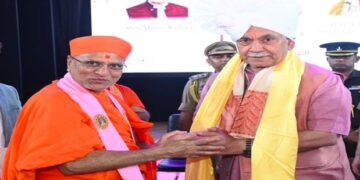
A Sarovar, A Temple And A Larger Social Message: At Dharpur, Sunderbani, the Lieutenant Governor laid the foundation stone of the Amriteshwar Sarovar, a project being taken up under the Jan Sanchay Jan Bhagidari initiative. Before addressing the gathering, he paid obeisance at the Shri Amriteshwar Shiv Temple and prayed for peace, prosperity and the well-being of people. The setting was significant to the message he delivered. Rather than presenting the project merely as an infrastructure initiative, Sinha placed it within a wider framework of community ownership and social participation. He commended the local community as well as the Shri Amriteshwar Shiv Mandir Vikas Samiti for their collective efforts in establishing and developing the sacred site. The Lieutenant Governor used the occasion to argue that social cohesion has a role that goes well beyond religious or cultural activities. In his view, communities that remain united and alert are better positioned to confront challenges ranging from terrorism and drug abuse to corruption, while also contributing to economic development.
Why Community Participation Matters: Sinha’s remarks in Sunderbani put particular emphasis on the idea that security and development cannot be treated as responsibilities belonging exclusively to the government. He highlighted what he described as the vital role of community solidarity in eliminating terrorism, substance abuse and corruption and in creating conditions for economic development and what he called a spiritual renaissance in Jammu and Kashmir. “India is going through a great spiritual revival. This cultural wave is felt across Jammu Kashmir, bringing people closer together and strengthening our community bonds,” he said. The argument reflects an increasingly prominent strand in the administration’s messaging: that social institutions, local communities and civil society have a role in strengthening resilience against extremist networks and social problems. The Lieutenant Governor urged people to remain vigilant against what he described as the “nefarious designs” of anti-national elements, report suspicious activities and isolate those who support terrorism.
‘Security Forces Alone Cannot Defeat Terrorism’: One of the strongest points in Sinha’s Sunderbani address was his assertion that terrorism cannot be defeated through security operations alone. “Security forces alone cannot defeat terrorism,” he said, calling for a “whole-of-society approach” involving residents alongside police and security agencies. He specifically referred to the need for collective efforts to dismantle the financial and logistical networks associated with narco-terrorism. His remarks come against the backdrop of the administration’s continued emphasis on the link between drugs, illicit financing and terrorism in Jammu and Kashmir. The Lieutenant Governor said the combined efforts of the Army, security forces, J&K Police, civil administration and residents had contributed to a significant degradation of terrorism and a transformation of the region’s security landscape. He also invoked the changing public environment around the national flag. It was once predicted, he said, that the Tricolour would find no willing hands to carry it in Jammu and Kashmir. Today, he said, it is being held high with pride by people across the region. The statement sought to underline the administration’s argument that a shift in public participation and sentiment is as important to the security landscape as operations conducted by forces on the ground.
From security To Spirituality: The Sunderbani event also carried a distinctly cultural and spiritual dimension. By placing the Amriteshwar Sarovar project alongside the temple visit and the community’s role in developing the site, the Lieutenant Governor presented cultural spaces as potential platforms for social cohesion. The emphasis on spirituality was not presented separately from development. Instead, Sinha linked the two, arguing that stronger community bonds can contribute to a wider social transformation. The idea is particularly relevant in areas where local institutions, religious sites and community organisations often become focal points for collective activity. The administration’s challenge, however, remains to ensure that such initiatives translate into broad-based public participation and tangible benefits for residents beyond the immediate project.
‘Development And Security Are Not Separate’: The Lieutenant Governor argued that development and security should not be viewed as separate objectives. “Development and security are not separate goals but they are two pillars of the same goal,” he said. The logic is straightforward: a village with reliable roads, communications, healthcare, education and employment has greater capacity to retain its population and withstand external pressures. At the same time, a secure environment is essential for investment, tourism, education and economic activity. Sinha therefore described the two as mutually reinforcing, saying only a secure village can become prosperous and only prosperous villages can contribute to a self-reliant India.
The bunker And The Border Family: Security infrastructure remains a visible part of life along the border. During the Kathua visit, Sinha said more than 2,000 individual and community bunkers had been constructed for the safety of border families. For residents living close to areas vulnerable to cross-border firing, bunkers are not abstract infrastructure. They are part of everyday survival and a reminder that development in these villages takes place under a different set of security realities than in much of the country. The challenge for policymakers is therefore to ensure that security infrastructure develops alongside ordinary civilian infrastructure. A family needs protection during a security emergency, but it also needs a school, healthcare centre, reliable electricity, connectivity and a livelihood when there is no emergency.
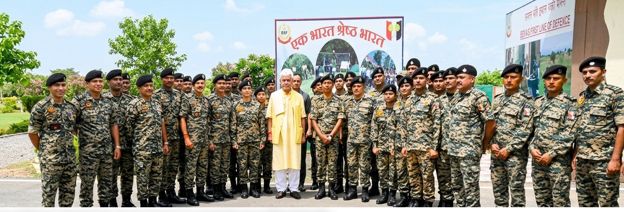
Meeting The Soldiers At The Frontline: The Lieutenant Governor also visited the Karol Krishna Border Out Post and interacted with BSF personnel deployed there. He commended the jawans for their commitment to securing the nation’s borders and their service during Operation Sindoor. Sinha stressed the importance of continued vigilance to disrupt and neutralise hostile attempts by the enemy. The visit to the BOP reinforced the central theme of the Kathuaprogramme: border security does not exist in isolation from border communities. The soldier stands at the frontline, but behind that frontline are families, villages, schools, roads and local economies.
The Political Geography Of Border Development: The villages covered under the Vibrant Villages Programme occupy a strategic position in Jammu and Kashmir’s geography. For decades, the border belt has frequently been viewed through the narrow lens of security. The policy shift represented by the Vibrant Villages Programme seeks to widen that lens. Instead of seeing residents primarily as populations requiring protection, the programme seeks to position them as participants in development and as stakeholders in national security. That change in approach is politically significant as well as economically important. When Sinha called these settlements India’s “first villages”, he was effectively reframing their geographic disadvantage as strategic importance.
A Message To The Next Generation: The Lieutenant Governor directly addressed young people from Karol Krishna and neighbouring villages, telling them that their generation now has resources and opportunities that were not available to their ancestors. He said their predecessors had held on to the land through difficult decades after Independence and that the responsibility had now shifted to the younger generation to take the villages forward. The question, he suggested, was no longer whether development would reach these villages but what their residents would do with the opportunities available to them. Would Karol Krishna remain known simply as a border village, he asked, or would it become known as a border village producing some of the country’s finest young people? That is perhaps the most ambitious part of the administration’s message.
From Beneficiaries To Participants: Both the Rajouri and Kathua engagements placed people at the centre of the government’s narrative. In Sunderbani, community members and the Shri Amriteshwar Shiv Mandir Vikas Samiti were praised for taking an active role in developing the site. In Kathua, residents of border villages were asked to become participants in shaping their economic future. The common thread is the idea of public participation. Government schemes can provide funding, infrastructure and institutional support, but the administration is increasingly presenting local communities as partners who must help determine how those resources are used.
Grievances Remain Part Of The Equation: While the speeches focused heavily on development and national security, local grievances were also acknowledged. During both engagements, the Lieutenant Governor assured residents that their demands and infrastructure-related issues would receive attention and that sincere efforts would be made to address public concerns. Such assurances are important because the success of large development programmes is ultimately judged at the local level. A new road matters only if it reduces travel time. A telecom tower matters if residents can actually access reliable services. A self-help group matters if women can sell their products. A school upgrade matters if students receive better learning outcomes. The gap between official announcements and lived experience remains the real test.
“Strong action has been taken with surgical firmness against the terror ecosystem and the conflict entrepreneurs who were working to keep terrorism alive in Jammu and Kashmir,” the LG Sinha said…..”
A Larger Transformation Story: Taken together, Sinha’s visits to Rajouri and Kathua point towards a broader narrative the administration is attempting to establish for Jammu and Kashmir.
One part of that narrative is about the security environment and the claim that terrorism has been significantly weakened through sustained operations and greater public cooperation. The second is about economic and social development, particularly in areas that have historically remained distant from major growth centres. The third is about changing the relationship between the state and local communities—from one in which people are primarily recipients of government programmes to one in which they are expected to become active partners. The fourth is cultural, with spirituality, community institutions and social cohesion being presented as elements of a broader revival. What happens after the foundation stones? The real measure of these initiatives will come after the ceremonies. For the Amriteshwar Sarovar, the challenge will be completing the project and ensuring that it becomes a meaningful public and community asset. For the Vibrant Villages Programme, the challenge is considerably larger: sustaining employment, reducing migration, improving education and healthcare, connecting producers to markets and ensuring that security infrastructure keeps pace with evolving threats. The administration has laid out an ambitious vision. Its success will depend on implementation at the village level.
Kashmir Horizon View: Jammu and Kashmir’s border villages occupy a unique space in India’s development story. They are geographically distant from major urban centres but strategically close to the country’s most sensitive frontiers. That dual reality means development cannot be approached in the same way as in ordinary rural areas. Roads and electricity are necessary, but not sufficient. Young people need jobs. Women need markets for their enterprises. Farmers need reliable buyers. Students need quality education. Families need healthcare. And communities need security. At the same time, the social fabric must remain strong enough to resist terrorism, drugs, corruption and attempts to exploit local vulnerabilities. That is why the two messages delivered by the Lieutenant Governor in Rajouri and Kathua converge at a larger point. The future of Jammu and Kashmir, as presented by the administration, is not simply a question of how much infrastructure is built or how many security operations are conducted. It is also about whether communities become stronger, whether young people find reasons to stay and succeed, whether women gain greater economic independence and whether residents of remote areas begin to see themselves not as people living at the edge of the country but as participants in its growth. In Dharpur, that message was expressed through a sarovar, a temple and a call for social solidarity. In Karol Krishna, it was expressed through roads, electricity, bunkers, self-help groups, schools and the presence of soldiers at the border. Different settings, but one underlying proposition: development and security are inseparable, and the people living closest to the challenges must also become central to the solution.
For Jammu and Kashmir, particularly its border belt, the next phase will be about turning that proposition into measurable change on the ground. And for villages such as Karol Krishna, the question now is not merely whether they will remain on India’s map. It is whether they can become examples of what the administration says a modern, secure and self-reliant border village should look like.
(“Team Kashmir Horizon” is committed to continuous improvement and invites feedback and suggestions from readers and its followers on social media sites. Reader insights are considered vital for enhancing content quality and empowering the community. The team encourages open communication and values the thoughts and ideas of its audience, believing that such input will enable them to serve the public more effectively. The initiative aims to ensure that readers have the best possible experience with “Kashmir Horizon”. Interested individuals can reach out to us via email at [email protected].)