“The launch of India’s first hydrogen-powered train and the unveiling of ₹14,700 crore worth of development projects represent more than a series of inaugurations, they signal the direction in which India’s infrastructure, energy and economic policies are headed…”
In what could mark a defining moment in India’s transition towards cleaner transportation and next-generation infrastructure, Prime Minister Narendra Modi on Friday launched the country’s first hydrogen-powered train while inaugurating and laying the foundation stone for development projects worth around ₹14,700 crore in Haryana’s Jind district. The projects, spanning railways, highways, healthcare, culture and sports, reflected the government’s attempt to integrate green technology with economic expansion and regional development.
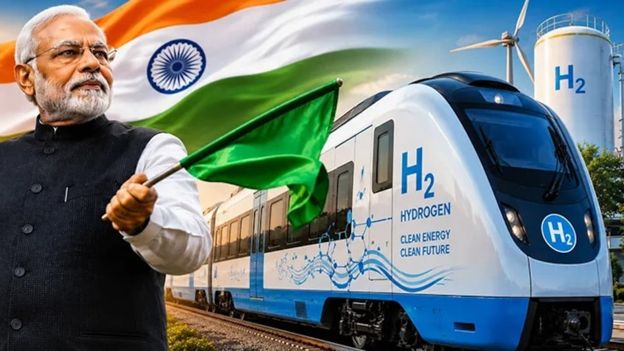
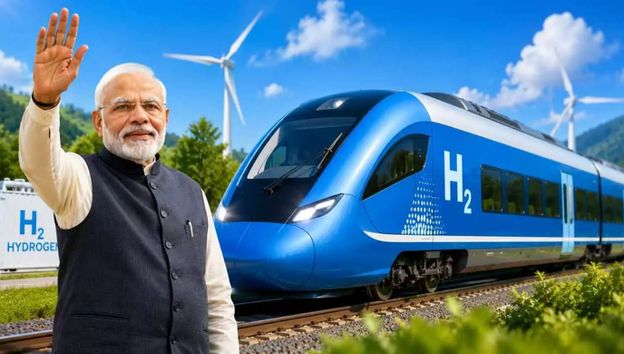
A Historic Beginning For Hydrogen Mobility: The centrepiece of the day was undoubtedly the launch of India’s first hydrogen-powered train—an achievement the Prime Minister described as a historic milestone that permanently places Jind and Haryana in the country’s development narrative. Calling it a “new chapter” in Indian Railways, Modi said future generations would remember the Jind-Sonipat hydrogen corridor much like the first railway journey between Bombay and Thane is remembered today. The announcement carried significance beyond symbolism. Hydrogen-powered rail transport is widely regarded as one of the cleanest alternatives to diesel locomotives, producing only water vapour as emissions. With countries across Europe and Asia experimenting with hydrogen mobility, India’s successful deployment of a ten-coach hydrogen train demonstrates an ambitious leap into advanced railway technology.
Make In India Powers Green Innovation: Unlike hydrogen trains currently operating in several countries with three or four coaches, the Indian version has been introduced with ten coaches and nearly 3,200 horsepower, making it among the most powerful hydrogen-powered passenger trains in the world. Prime Minister Modi described the hydrogen train as a successful example of the Make in India initiative, noting that Indian engineers designed the system while domestic manufacturers executed its construction. The project, he said, demonstrated that India is increasingly capable of developing sophisticated technologies without depending heavily on foreign suppliers.
A New Industrial Ecosystem: Beyond technological achievement, the hydrogen initiative is expected to generate a wider industrial ecosystem. Specialized hydrogen production facilities, storage systems, maintenance infrastructure and manufacturing units will become essential as the network expands, creating fresh opportunities for engineering firms, component manufacturers and skilled workers. The Prime Minister suggested that Haryana stands to benefit significantly from this transition, with new industries and employment opportunities likely to emerge alongside hydrogen infrastructure.
₹14,700 Cr Infra Push : The hydrogen launch formed part of a much larger development package worth approximately ₹14,700 crore covering transportation, healthcare, highways, education and cultural preservation. Among the major healthcare initiatives, the Prime Minister dedicated Pandit Neki Ram Sharma Medical College in Bhiwani and Maharishi Chyavan Medical College along with Rao Tularam Hospital in Narnaul. These institutions are expected to substantially strengthen medical education capacity while expanding healthcare access across the region.
Roads, Railways Driving Growth: The transportation component extended beyond railways. Modi inaugurated sections of the Delhi-Amritsar-Katra Expressway, the Jind-Gohana National Highway and the Ambala-Kala Amb four-lane highway project. Improved highway connectivity is expected to reduce travel time, lower transportation costs and strengthen trade networks. The Prime Minister noted that Jind is now connected through five national highways, providing improved market access for farmers, dairy producers and industries.
Rail Electrification, Energy Security: PM Modi highlighted the transformation of Indian Railways over the past twelve years, particularly the near-complete electrification of the national railway network. Referring to geopolitical tensions affecting global fuel supplies, he argued that electrification has insulated Indian Railways from international oil disruptions and strengthened India’s energy security.
Cleanliness As A People’s Movement: The Prime Minister appreciated Haryana’s “Swachhta Se Swagat” initiative organised before his visit and urged people to make cleanliness a permanent habit rather than an occasional campaign.
Sports Vision Beyond Medals: Referring to the new National Sports Policy, Khelo Bharat and schemes such as Khelo India and TOPS, Modi said India is investing heavily in athlete development. He urged young sportspersons to prepare for the 2036 Olympic Games, which India aims to host.
“The ₹14,700 crore development package also illustrates the government’s continued reliance on infrastructure-led growth as a driver of employment, investment and regional development.…”
Global Partnerships For Indian Athletes: The Prime Minister revealed that sports cooperation featured prominently during his recent visits to Indonesia, Australia and New Zealand. He said India intends to collaborate with these countries on sports science, coaching, athlete training and sports industry development to prepare Indian athletes for international competition.
Governance, Transparent Recruitment: Prime Minister Modi praised Haryana’s governance model, highlighting transparent recruitment practices and merit-based employment, which he said have reduced corruption and nepotism in government appointments.
Agriculture Remains Central: Reaffirming support for farmers, Modi said Haryana has received nearly ₹8,000 crore under the PM-Kisan Samman Nidhi scheme, including over ₹600 crore transferred directly to farmers in Jind district. He added that better road and railway connectivity would reduce transportation costs and improve farmers’ access to larger markets.
Preserving India’s Cultural Heritage: Alongside infrastructure development, the Prime Minister announced the foundation stone for a Sikh Museum in Kurukshetra. He said the museum would preserve the legacy of the Sikh Gurus while strengthening awareness of India’s civilisational heritage among future generations.
Kashmir Horizon View: The launch of India’s first hydrogen-powered train and the unveiling of ₹14,700 crore worth of development projects represent more than a series of inaugurations—they signal the direction in which India’s infrastructure, energy and economic policies are headed. While the projects announced in Haryana have immediate regional significance, their broader importance lies in the policy framework they reinforce: combining technological innovation, sustainable development, connectivity, healthcare expansion and human capital development into a unified growth model. Among all the announcements, the hydrogen train is perhaps the most significant from a long-term perspective. Around the world, governments are searching for cleaner alternatives to fossil fuel-based transportation as they strive to meet climate commitments and reduce carbon emissions. India has already invested heavily in railway electrification, renewable energy and electric mobility. Hydrogen-powered railways represent the next logical step in this transition, particularly for routes where conventional electrification is either technically difficult or economically unviable. However, the success of hydrogen rail technology will depend not only on the train itself but also on the ecosystem built around it. Dedicated hydrogen production plants, storage facilities, refuelling stations, safety standards, maintenance infrastructure and skilled manpower will all be required before hydrogen trains can become a regular feature of the Indian Railways network. The pilot project launched in Haryana therefore serves as a testing ground for technologies, operational systems and commercial viability before wider expansion. The Make in India dimension also assumes considerable importance. Developing indigenous capabilities in hydrogen technology could reduce dependence on imported equipment while creating opportunities for Indian manufacturers to become suppliers of components, engineering solutions and railway technologies for domestic as well as international markets. If supported through sustained investments in research, innovation and industrial partnerships, hydrogen mobility could emerge as a new manufacturing sector contributing to employment generation and technological self-reliance. Infrastructure development announced during the programme also points towards a broader strategy of integrating highways, railways, logistics and industrial corridors. Better connectivity reduces travel time, lowers transportation costs and expands market access for agriculture, manufacturing and services. Haryana’s strategic location between the National Capital Region and northern states positions it to benefit from such investments, but similar models are increasingly being replicated across the country as India seeks to strengthen multimodal transport networks. Prime Minister Narendra Modi’s address in Jind was not confined to announcing infrastructure projects; it sought to present a broader vision of India’s future development trajectory. The inauguration of the country’s first hydrogen-powered train symbolised India’s willingness to embrace emerging technologies while reinforcing the principles of sustainability, innovation and self-reliance. Simultaneously, investments in highways, healthcare, agriculture, sports and cultural infrastructure reflected an integrated approach to nation-building where economic growth is supported by improvements in public services and social infrastructure. The hydrogen train stands out as the day’s defining announcement because it places India among a select group of countries experimenting with advanced green railway technology. While its long-term success will depend on technological scalability, commercial viability and supporting infrastructure, the initiative marks an important milestone in India’s transition towards cleaner transportation systems.
(“Team Kashmir Horizon” is committed to continuous improvement and invites feedback and suggestions from readers and its followers on social media sites. Reader insights are considered vital for enhancing content quality and empowering the community. The team encourages open communication and values the thoughts and ideas of its audience, believing that such input will enable them to serve the public more effectively. The initiative aims to ensure that readers have the best possible experience with “Kashmir Horizon”. Interested individuals can reach out to us via email at [email protected].)