“PM Modi strengthened ties with the US, Canada, the UK and the European Union on trade, technology and defence. On the other, he reinforced strategic engagement with the UAE, African nations and Asian partners, while continuing to advocate for the Global South.”
Mohammad Irfan
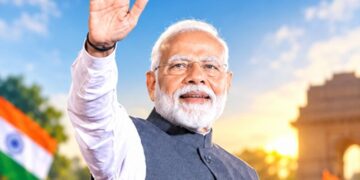
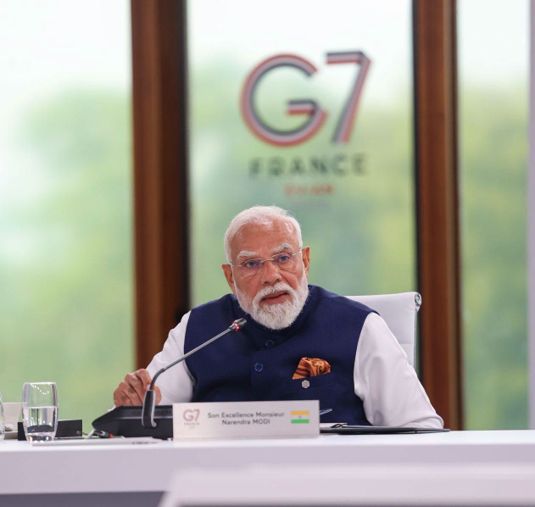 This week Prime Minister Narendra Modi’s high-profile diplomatic outreach on the sidelines of the G7 Summit in Evian, France, has underlined India’s growing strategic importance in an increasingly fragmented global order, with New Delhi positioning itself as a key player in trade, security, connectivity and global governance. Over two days of intense diplomacy, Prime Minister Modi held bilateral meetings with leaders from the United States, Canada, the United Kingdom, Germany, the United Arab Emirates, Japan, South Korea, Kenya, Egypt and the European Union, reflecting India’s expanding engagement across major geopolitical blocs. The meetings came at a time of heightened global uncertainty marked by conflict in West Asia, continuing Russia-Ukraine tensions, global supply chain disruptions, debt distress in developing economies and the race for technological dominance in areas such as artificial intelligence. Diplomatic observers described Modi’s engagements at the summit as one of India’s most significant multilateral outreach exercises in recent months, with discussions spanning trade agreements, maritime security, energy cooperation, defence partnerships and reform of global institutions.
India’s Multi-Alignment Strategy On Display: The G7 outreach once again highlighted India’s evolving foreign policy doctrine of strategic multi-alignment—maintaining strong ties simultaneously with Western powers, Gulf nations, emerging economies and Global South partners. Unlike traditional alliance structures, India’s approach seeks flexibility and issue-based cooperation across competing geopolitical camps. At Evian, this balancing act was clearly visible. On one hand, Modi strengthened ties with the US, Canada, the UK and the European Union on trade, technology and defence. On the other, he reinforced strategic engagement with the UAE, African nations and Asian partners, while continuing to advocate for the Global South. This positioning increasingly makes India a bridge power between advanced economies and developing nations.
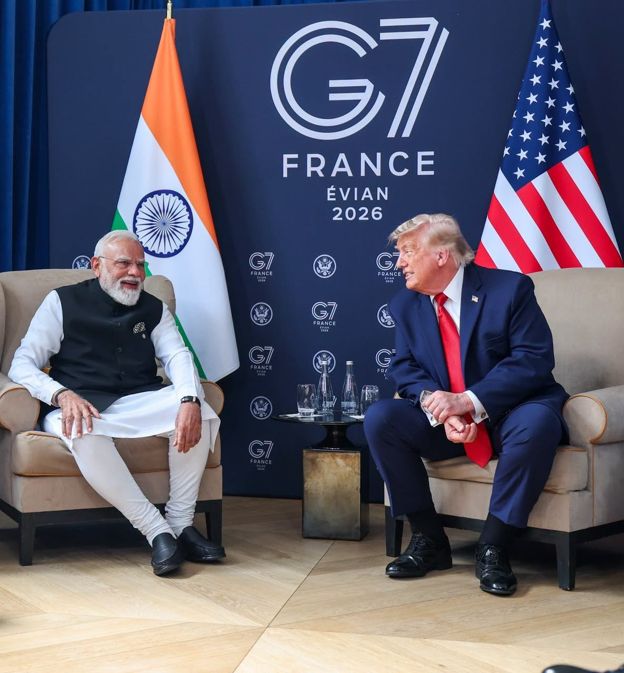
India-US Talks Dominated By West Asia Concerns: One of the most consequential meetings at the summit was Prime Minister Modi’s bilateral engagement with US President Donald Trump. The talks focused heavily on the deteriorating situation in West Asia, particularly concerns surrounding maritime security and the Strait of Hormuz—one of the world’s most critical oil transit chokepoints. PM Modi stressed that keeping the Strait of Hormuz open is vital for the global economy and emphasized the importance of ensuring freedom of navigation. The Prime Minister highlighted that lakhs of Indian seafarers serve in maritime trade routes worldwide, making their safety a strategic priority for India. His remarks reflect India’s urgent energy security concerns. Any disruption in the Strait of Hormuz could sharply impact global oil prices and directly affect India, which imports a substantial portion of its crude oil requirements from the Gulf region. PM Modi also welcomed ongoing peace efforts in West Asia and expressed hope for durable regional stability. On bilateral trade, the Prime Minister noted that India-US trade negotiations were progressing smoothly, signaling continued momentum in economic engagement despite political uncertainties.
Reset In India-Canada Ties: Among the most notable diplomatic developments was the thaw in India-Canada relations. Prime Minister Modi and Canadian Prime Minister Mark Carney welcomed improving momentum in bilateral ties and committed to building a forward-looking strategic partnership. This meeting was closely watched given the tensions that had strained relations between the two countries in recent years. Both leaders reviewed cooperation in energy trade, including Liquefied Natural Gas (LNG), Liquefied Petroleum Gas (LPG) and metallurgical coal.
Economic Engagement Appears To Be Driving The Reset: The two countries also expressed satisfaction over negotiations for a Comprehensive Economic Partnership Agreement, aiming to conclude the pact this year. The agreement could significantly boost trade volumes, diversify energy cooperation and deepen investment flows. In a major strategic move, both sides agreed to begin negotiations on a General Security of Information Agreement to strengthen defence and security cooperation. India also supported Canada’s candidature as a Dialogue Partner in the Indian Ocean Rim Association, signaling broader geopolitical trust.
India-UK Partnership Gathers Momentum: Prime Minister Modi’s meeting with British Prime Minister Keir Starmer reinforced the growing depth of India-UK relations under Vision 2035. The leaders reviewed progress across trade, defence, education and technology. A key focus was the early implementation of the Comprehensive Economic and Trade Agreement. This agreement is expected to become one of the most important post-Brexit economic partnerships for the United Kingdom while giving India greater access to advanced markets, capital and technology. Education emerged as another strong pillar. The leaders welcomed progress in establishing British university campuses in India, including the University of Liverpool in Bengaluru and the Universities of York and Bristol in Mumbai. This reflects India’s broader strategy of internationalizing higher education and reducing outbound educational migration.
UAE The India’s Key Gulf Partner: Modi’s meeting with UAE President Sheikh Mohamed bin Zayed Al Nahyan reinforced one of India’s strongest strategic partnerships in West Asia. The leaders focused on regional security, trade, investment, energy and defence. The discussions were particularly significant given rising tensions in the Gulf. Both leaders emphasized dialogue, diplomacy and respect for sovereignty as essential to ensuring regional peace. They jointly called for free and unimpeded navigation through the Strait of Hormuz. This reflects shared concerns over energy security and trade disruptions. India and the UAE have significantly expanded ties over the past decade, with bilateral trade, infrastructure investment and strategic cooperation witnessing rapid growth. Modi’s invitation to the UAE President for the upcoming BRICS Summit further underscored the growing importance of the relationship. This marked the third meeting between the two leaders this year, highlighting unusually high engagement.
“Prime Minister Modi also used the summit to reinforce ties in the Indo-Pacific region.His meetings with Japanese Prime Minister SanaeTakaichi and South Korean President Lee Jae-myung focused on trade, investment and future technologies”
India Strengthens Indo-Pacific Partnerships: Prime Minister Modi also used the summit to reinforce ties in the Indo-Pacific region. His meetings with Japanese Prime Minister SanaeTakaichi and South Korean President Lee Jae-myung focused on trade, investment and future technologies. Japan remains central to India’s infrastructure and manufacturing ambitions, while South Korea is a critical partner in electronics, semiconductors and industrial cooperation. These engagements reinforce India’s Indo-Pacific strategy, where economic resilience and strategic deterrence increasingly overlap. The growing alignment among India, Japan and South Korea reflects shared concerns over supply chain vulnerabilities and regional security.
Global South Advocacy Remains Central: Despite intensive engagement with advanced economies, Modi continued to champion the concerns of developing nations. At a high-level G7 session on inclusive and sustainable growth, he called for international financial institutions to develop mechanisms that strengthen economic resilience in developing countries. This is consistent with India’s long-standing demand for reform of global financial governance. Modi also proposed ambitious connectivity projects linking Africa, Latin America and Pacific Island nations. His proposal for International Mobilization Partnership for Accelerating Connectivity and Trade (IMPACT) aimed to combine G7 capital, Indian talent and Global South ownership. This proposal reflects India’s attempt to position itself as a development partner rather than merely a strategic power. It also reinforces New Delhi’s efforts to become the principal voice of the Global South.
Debt Crisis In Developing World: A major outcome of the summit was the G7’s commitment to intensify efforts to address rising debt burdens in developing countries. This issue has emerged as one of the biggest economic threats to vulnerable economies. In a joint declaration with guest countries including India, Brazil, Kenya, Egypt and South Korea, G7 leaders acknowledged that traditional aid alone is insufficient. They called for reforms, debt restructuring and greater private-sector investment. This aligns with India’s repeated argument that development financing needs structural reform. India’s participation in these discussions is increasingly important because it is seen as both a major emerging economy and a credible representative of developing nations.
AI Governance Enters Centre Stage: Another major area of focus was artificial intelligence. PM Modi participated in a working lunch on safe, rapid and effective AI deployment with G7 leaders and CEOs of leading AI companies. This discussion highlighted the rapidly growing global importance of AI governance. India’s presence in these conversations is strategically significant. As one of the world’s largest digital economies with vast talent pools in IT and software, India is expected to play a critical role in shaping AI regulation, innovation and deployment. New Delhi’s emphasis remains balancing innovation with ethics, safety and equitable access.
Strategic Implications For India : PM Modi’s diplomatic outreach in Evian signals three major shifts in India’s global role. First, India is no longer seen merely as a regional power but as a central actor in global crisis management. Second, economic diplomacy is increasingly becoming the core of India’s foreign policy, with FTAs, supply chains and investment now as important as traditional diplomacy. Third, India is strengthening its identity as a bridge between developed and developing worlds. Whether the issue is debt, climate, AI or connectivity, New Delhi increasingly seeks to shape—not just respond to—the global agenda.
Kashmir Horizon View: Prime Minister Modi’s engagements at the G7 Summit demonstrated India’s expanding diplomatic bandwidth at a time of major geopolitical flux. From trade negotiations with Europe and North America to strategic discussions on West Asia, maritime security and artificial intelligence, India projected itself as a confident and indispensable global stakeholder. The summit also reinforced a larger reality: in an era defined by fractured alliances, supply chain realignments and emerging technological disruption, India is increasingly viewed as a stabilizing power capable of engaging all sides. For New Delhi, the message from Evian was clear—India is not merely participating in global conversations anymore; it is actively shaping them.
(“Team Kashmir Horizon” is committed to continuous improvement and invites feedback and suggestions from readers and its followers on social media sites. Reader insights are considered vital for enhancing content quality and empowering the community. The team encourages open communication and values the thoughts and ideas of its audience, believing that such input will enable them to serve the public more effectively. The initiative aims to ensure that readers have the best possible experience with “Kashmir Horizon”. Interested individuals can reach out to us via email at [email protected].)