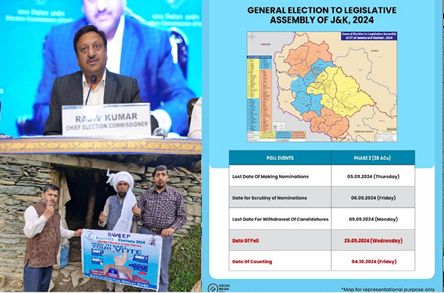
“Voter Helpline App offers voters a range of conveniences, including finding their names in the electoral roll, submitting online forms, checking application statuses, filing complaints, and receiving replies directly on their mobile devices. The app also provides contact details for booth-level officers, electoral registration officers, and district election officers. Voters can access these services through the vsp.in portal or by calling the 1950 helpline number.”

The Election Commission of India (ECI) has unveiled a set of comprehensive guidelines to govern media coverage for the forthcoming General Elections to the Legislative Assemblies of Jammu & Kashmir, scheduled for September and October 2024. This move aims to ensure that media practices remain fair and transparent throughout the election period.
Guidelines For 48-Hour Silence Period: One of the key aspects of the ECI’s guidelines is the enforcement of the 48-hour “silence period,” as defined by Section 126 of the Representation of the People (R.P.) Act, 1951. During this period, which commences 48 hours before the end of polling, the ECI mandates that no election-related content be displayed via television, cinematograph, or similar apparatus. This restriction is put in place to prevent any potential influence on voters in the crucial moments leading up to the conclusion of the voting process.
Prohibition On Displaying Election Matter: The ECI’s statement clarifies that displaying any “election matter” by means of cinematograph, television, or similar apparatus is strictly prohibited in any polling area during the last 48 hours of the election period. “Election matter” is defined as any content designed to sway the election results. The penalty for violating this provision includes imprisonment for up to two years, a fine, or both.
Restrictions On TV, Radio, And Cable Networks: The guidelines also extend to TV, radio channels, and cable networks. These media outlets are required to ensure that their programming during the 48-hour silence period does not feature material or views that could be perceived as promoting or prejudicing any political party or candidate. This includes avoiding content that could influence or affect the election results.
Prohibition Of Political Advertisements: Political advertisements are also restricted during the silence period. The ECI has made it clear that such advertisements cannot be aired, even if they are disguised as news items or headlines. This measure is designed to maintain neutrality and prevent any undue influence on voters during the final stages of the election.
Conduct Of Exit Polls: The ECI has reiterated the restrictions on exit polls as outlined in Section 126A of the R.P. Act. Exit polls and their results are prohibited from being conducted or disseminated from the start of polling until half an hour after the conclusion of polling across all states and Union Territories. This prohibition helps avoid influencing voter perceptions and maintains the integrity of the electoral process.
Guidelines For Print And Electronic Media: In addition to electronic media, the ECI has issued specific instructions for print media. Print media outlets are required to adhere to the guidelines established by the Press Council of India. Electronic media must follow the “Guidelines for Election Broadcasts” set by the News Broadcasting Standards Authority (NBSA). These guidelines are designed to ensure that all media coverage remains impartial and balanced.
Social Media Compliance: Social media platforms are also under scrutiny. The ECI has reminded these platforms to comply with the “Voluntary Code of Ethics” created by the Internet and Mobile Association of India (IAMAI). This code aims to uphold the integrity of the electoral process by regulating content and preventing the spread of misinformation or biased reporting on social media.
Pre-Certification Of Advertisements: On polling day and the day before, political parties, candidates, and other entities are prohibited from publishing any advertisements in print media unless these have been pre-certified by the Media Certification and Monitoring Committee (MCMC) at the State or District level. This requirement is intended to prevent last-minute attempts to influence voters through unregulated advertisements.
ECI’s Call For Strict Adherence: The ECI has called upon all media outlets to strictly observe these guidelines to ensure that the electoral process remains free, fair, and transparent. By following these comprehensive rules, the ECI aims to uphold the democratic values of the election and ensure that every voter’s decision is made based on impartial and balanced information. These guidelines reflect the ECI’s commitment to a fair electoral process and its ongoing efforts to address the evolving challenges in media coverage during elections.
CEO Pole Encourages Voters To Use ECI Mobile Apps For Assembly Election 2024: Chief Electoral Officer (CEO) Jammu and Kashmir, Pandurang K Pole, has called on voters in the region to take full advantage of the technological features introduced by the Election Commission of India (ECI) for the upcoming Assembly Election 2024. By utilizing mobile voter-friendly applications, voters can ensure a more active and informed participation in the electoral process.
Introduction Of ECI Mobile Apps: The ECI has rolled out several mobile applications designed to enhance the voting experience nationwide. These include cVIGIL, Know Your Candidate (KYC), Suvidha, and Voter Helpline App, among others. These apps aim to make the voting process easier and more efficient for over 88.03 lakh voters in Jammu and Kashmir. The apps are available on both Android and iOS platforms.
Reporting Violations With cVIGIL: To address any violations during the Assembly Election 2024, voters are encouraged to use the cVIGIL app. This innovative application allows citizens to report Model Code of Conduct (MCC) and expenditure violations with evidence-based proof through live photos and videos, complete with auto-location data. Complaints can be lodged directly via the app, after which flying squads will investigate and take action within 100 minutes. This tool is crucial for maintaining election integrity and accountability.
Accessing Candidate Information With KYC App: To promote transparency, the ECI has introduced the Know Your Candidate (KYC) app. This app enables voters to access detailed information about the candidates, including their affidavits and criminal antecedents. Voters can view a list of nominations by selecting the election type and Assembly Constituency or by directly searching for a candidate’s name. The app provides comprehensive details on any criminal cases filed against candidates, including the status and nature of these cases, making it a valuable resource for informed voting.
Simplifying Campaign Permissions With Suvidha: The Suvidha app is designed to streamline the process for candidates and political parties to apply for various permissions needed for campaign activities. This single-window system facilitates the application process for meetings, rallies, vehicles, temporary election offices, loudspeakers, and helicopters & helipads. With its user-friendly interface and robust features, the Suvidha app ensures that all necessary permissions are obtained efficiently, supporting smooth and timely campaign operations.
Enhancing Voter Support With The Voter Helpline App: The Voter Helpline App offers voters a range of conveniences, including finding their names in the electoral roll, submitting online forms, checking application statuses, filing complaints, and receiving replies directly on their mobile devices. The app also provides contact details for booth-level officers, electoral registration officers, and district election officers. Voters can access these services through the www.nvsp.in portal or by calling the 1950 helpline number.
Encouraging Use Of ECI Services: CEO Pandurang K Pole has urged not only voters but also candidates and political parties participating in the 2024 elections to make full use of these technological services. By leveraging these apps, all stakeholders can contribute to a more transparent, efficient, and fair electoral process. Through these technological advancements, the ECI aims to enhance voter engagement and ensure that the electoral process is conducted smoothly and transparently.
“Encourage user feedback through in-app surveys and reviews to make necessary improvements. Focus on enhancing the security features of the mobile applications to protect user data and prevent any potential misuse. Collaborate with cyber security experts to conduct regular security audits. Implement strong encryption protocols and ensure compliance with data protection regulations. Ensure that the mobile applications are accessible to all voters, including those with disabilities.”
Kashmir Horizon View: Launch extensive awareness campaigns to educate voters about the available mobile applications and their functionalities. Use multiple platforms, including social media, local newspapers, and community radio, to reach a broader audience. Organize workshops, webinars, and interactive sessions in collaboration with local educational institutions and community centers. Utilize influencers and local leaders to spread the message and encourage voter participation. Provide comprehensive training for election officials and booth-level staff on how to use the ECI mobile apps effectively. Ensure they are well-versed in addressing voter queries related to these applications. Conduct training sessions and simulations to prepare officials for real-time scenarios. Create user manuals and quick reference guides for easy access during elections. Establish a dedicated technical support team to assist voters with any issues related to the mobile applications. Ensure prompt resolution of technical problems to avoid hindrances in the voting process. Set up a helpline or chat support service specifically for app-related queries. Provide clear instructions and troubleshooting tips within the apps and on official websites. Ensure that the mobile applications are regularly updated to address any bugs, improve functionality, and incorporate user feedback. Implement a robust system for continuous monitoring and updates. Encourage user feedback through in-app surveys and reviews to make necessary improvements. Focus on enhancing the security features of the mobile applications to protect user data and prevent any potential misuse. Collaborate with cyber security experts to conduct regular security audits. Implement strong encryption protocols and ensure compliance with data protection regulations. Ensure that the mobile applications are accessible to all voters, including those with disabilities. Provide support in multiple languages and formats. Integrate accessibility features into the apps, such as voice commands and text-to-speech options. Offer multilingual support and ensure compatibility with assistive technologies. Work closely with local communities and organizations to facilitate the use of mobile apps and address any specific concerns or barriers faced by voters in different regions. Partner with community leaders and NGOs to conduct outreach programs. Address local issues and adapt strategies to meet the unique needs of various communities. Implement a system for monitoring the effectiveness of the mobile apps and the overall voter engagement process. Evaluate the impact of the technological tools on voter participation and satisfaction. Develop metrics and key performance indicators to assess the success of the apps. Conduct post-election surveys and analysis to identify areas for improvement and implement necessary changes for future elections. Establish a feedback mechanism where voters can share their experiences and suggestions regarding the use of the mobile applications. Create dedicated channels for collecting and analyzing feedback. Use this information to make iterative improvements to the apps and enhance user experience. By following these suggestions and strategies, stakeholders can ensure that the technological tools provided by the ECI are effectively utilized, leading to a more transparent, efficient, and inclusive electoral process. The collaboration between voters, election officials, and technological platforms will be crucial in achieving a successful Assembly Election 2024 in Jammu and Kashmir.
(In commitment to continuous improvement the “Team Kashmir Horizon” invites it’s valuable readers to share their valuable feedback and suggestions with the “Team Kashmir Horizon”. The insights of readers will surely play a vital role in improving the content quality of “Kashmir Horizon” and contribute more for the empowerment of people. Please feel free to reach out to us at editor@ thekashmirhorizon.com. Team “Kashmir Horizon” eagerly anticipates thoughts and ideas of it’s readers, which will help us serve people and even more effectively. The inputs of valuable readers are highly valued as “Kashmir Horizon” strives to provide it’s readers the best possible experience. Thank you for being a part of the reader community!)