- “Rs 11, 11,111 Cr for Infra Dev aimed at 3.4% of GDP.”
- GST Collections soar, no Change in tax rates, direct tax demands withdrawn, benefitting over a crore taxpayers
- FM emphasizes ‘Sab ka Saath’ , Focu on ‘Garib,’ ‘Mahilayen,’ ‘Yuva,’ ‘Annadata
- Plans rolled out to make India a developed nation, prioritise empowerment
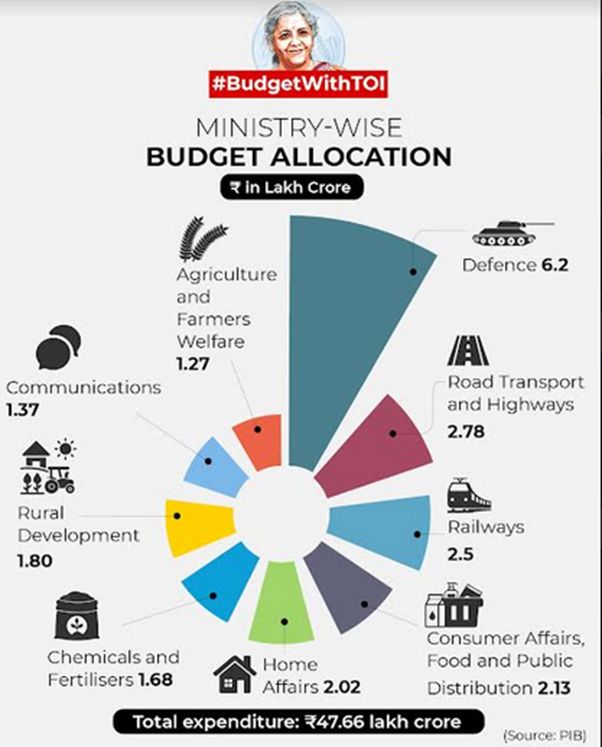
The Finance and Corporate Affairs Minister, Nirmala Sitharaman, delivered a comprehensive Interim Union Budget for the fiscal year 2024-2025 in Parliament today, unveiling a significant 11.1% increase in the capital expenditure outlay. The allocation for the upcoming year amounts to a staggering Rs 11,11,111 crore, equivalent to 3.4% of the GDP. This announcement reflects the government’s commitment to bolster economic growth and employment through strategic capital investments. Sitharaman focused on the continuation of the substantial growth in capital expenditure over the past four years, a move that has resulted in a considerable multiplier effect on economic growth and employment creation. According to the First Advance Estimates of National Income for the fiscal year 2023-24, India’s Real GDP is anticipated to grow at an impressive 7.3%, aligning seamlessly with the upward revision in growth projections by the Reserve Bank of India (RBI) in its December 2023 Monetary Policy Committee meeting. Despite facing formidable global economic challenges, the Indian economy has displayed remarkable resilience, maintaining robust macro-economic fundamentals. he International Monetary Fund (IMF) revised its growth projection for India in its World Economic Outlook (WEO) in October 2023, marking an upward shift to 6.3% from the 6.1% projected in July 2023. This revision underscores the increasing global confidence in India’s economic prowess at a time when the global growth projection for 2023 remains unchanged at 3%. Further solidifying India’s economic standing, various international agencies, including the World Bank, IMF, OECD, and ADB, project the country’s growth to range between 6.1% and 6.7% in the fiscal year 2024-25. The Finance Minister highlighted the strong growth in economic activity, contributing to buoyant revenue collections. Notably, GST collection reached ₹1.65 lakh crore in December 2023, marking the seventh time that gross GST revenues crossed the ₹1.6 lakh crore benchmark. Looking ahead to the fiscal year 2024-25, Sitharaman outlined the estimated total receipts, excluding borrowings, and total expenditure at Rs 30.80 lakh crore and Rs 47.66 lakh crore, respectively. Tax receipts are projected at Rs 26.02 lakh crore. The Finance Minister made a significant announcement regarding the continuation of a fifty-year interest-free loan scheme for capital expenditure to states, with a total outlay of Rs 1.3 lakh crore. Addressing fiscal consolidation, Sitharaman affirmed the commitment to reduce the fiscal deficit below 4.5% by 2025-26, with an estimated fiscal deficit of 5.1% of GDP in 2024-25. The projections for gross and net market borrowings for 2024-25 stand at Rs 14.13 lakh crore and Rs 11.75 lakh crore, respectively, both lower than the figures for the previous fiscal year. The Finance Minister emphasized some positive economic indicators, including Revised Estimates showing total receipts other than borrowings at Rs 27.56 lakh crore and tax receipts at Rs 23.24 lakh crore. Stressing the government’s all-encompassing development approach, she expressed the vision to make India a ‘Viksit Bharat’ by 2047, underscoring the importance of people’s empowerment and capability improvement. Sitharaman concluded her speech by announcing profound positive transformations in the Indian economy over the past ten years, with efforts focused on eradicating multi-dimensional poverty and empowering people. The government’s commitment to ‘Sab ka Saath’ and the pursuit of ‘Viksit Bharat’ by 2047 were reiterated, with a detailed roadmap expected in the full budget in July. In the realm of taxation, no changes were proposed in the Interim Budget, maintaining existing rates for direct and indirect taxes. However, certain tax benefits for Start-Ups and investments by sovereign wealth or pension funds have been extended by one year up to March 31, 2025. Sitharaman also announced the withdrawal of outstanding direct tax demands up to Rs 25,000 for the period up to the financial year 2009-10 and up to Rs 10,000 for financial years 2010-11 to 2014-15, benefitting around a crore taxpayers.
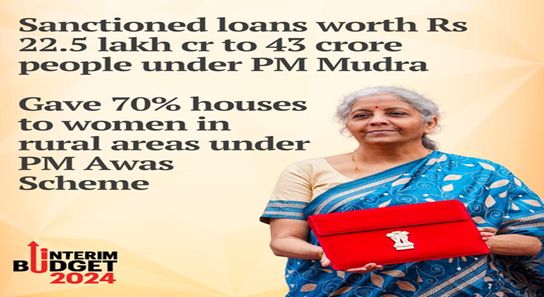
“The responsibility to mend the economy step by step and to put the Governance systems in order was enormous. The Government successfully followed its strong belief of ‘nation-first’. The economy has been put firmly on a high sustainable growth path with all-round development. Government will come out with a white paper, on ‘where we were then till 2014 and where we are now, only for the purpose of drawing lessons from the mismanagement of those years’”
Appreciating the support of taxpayers, the Finance Minister highlighted the remarkable tripling of direct tax collections over the last decade and improvements in tax-payer services, including a simplified filing process and faster refunds. On indirect taxes, the Union Minister for Finance & Corporate Affairs Smt. Nirmala Sitharaman said that GST has reduced the compliance burden on trade and industry by unifying the highly fragmented indirect tax regime in India. Mentioning about a recent survey conducted by a leading consulting firm, she said that 94% of industry leaders view the transition to GST as largely positive. In her Interim Budget speech, the Minister highlighted the fact that tax base of GST has more than doubled and average monthly gross GST collection has almost doubled to Rs. 1.66 lakh crore this year. States too have benefited. States’ SGST revenue, including compensation released to states, in the post-GST period of 2017-18 to 2022-23, has achieved a buoyancy of 1.22. The Minister said that the biggest beneficiaries are the consumers as reduction in logistics cost and taxes have brought down prices of most goods and services. Mentioning about a number of steps taken in customs to facilitate international trade, Sitharaman said the import release time declined by 47 per cent to 71 hours at Inland Container Depots, by 28 per cent to 44 hours at air cargo complexes and by 27 per cent to 85 hours at sea ports, over the last four years since 2019. Laying of White Paper On the status of Indian economy, the Union Minister said that in 2014 the responsibility to mend the economy step by step and to put the Governance systems in order was enormous, which she said was done by the Government sucessfully following its strong belief of ‘nation-first’. She assured that the crisis of those years has been overcome and economy has been put firmly on a high sustainable growth path with all-round development. She announced that the Government will come out with a white paper, on ‘where we were then till 2014 and where we are now, only for the purpose of drawing lessons from the mismanagement of those years’.
“The announcement of schemes like Pradhan Mantri Kisan Sampada Yojana and Pradhan Mantri Formalisation of Micro Food Processing Enterprises Yojana reflects a commitment to boosting agriculture and generating employment in rural areas. These benefits outlined in the Interim Budget signify a holistic and inclusive approach towards fostering economic growth, creating employment opportunities, and enhancing the overall well-being of the people of India.”
Kashmir Horizon View: The Interim Union Budget for the fiscal year 2024-2025, presented by Finance and Corporate Affairs Minister Nirmala Sitharaman, outlines several major benefits aimed at improving the lives of the people of India. The substantial 11.1% increase in the capital expenditure outlay to Rs 11,11,111 crore is a major investment in infrastructure and development projects. This increased spending is expected to have a significant multiplier effect on economic growth and job creation. The budget focuses on sustaining and accelerating economic growth, with a projected Real GDP growth of 7.3% for the fiscal year 2023-24. This growth is anticipated to contribute to employment creation, addressing one of the critical needs of the population. Despite global economic challenges, the Indian economy has demonstrated resilience and maintained healthy macro-economic fundamentals. This stability is crucial for the overall well-being of the citizens. She highlighted the buoyancy in revenue collections, particularly in Goods and Services Tax (GST). The reduction in compliance burden, simplification of the tax filing process, and continuity of tax rates contribute to a more taxpayer-friendly environment. Sitharaman reiterated Prime Minister Shri Narendra Modi’s commitment to four major castes – ‘Garib’ (Poor), ‘Mahilayen’ (Women), ‘Yuva’ (Youth), and ‘Annadata’ (Farmer). The government’s priority lies in addressing the needs, aspirations, and welfare of these sections, aiming for progress at both individual and societal levels. The Finance Minister emphasized the government’s shift towards an all-encompassing, humane, and inclusive approach to development. The focus on household and individual-targeted programs, such as ‘housing for all,’ ‘hargharjal,’ and financial inclusion, reflects a commitment to uplift all sections of society. The vision of making India a ‘Viksit Bharat’ by 2047 underscores the commitment to improving people’s capabilities and empowering them. The government aims to move beyond mere provision to a model that actively enhances the capabilities of individuals and households. The budget allocates funds for crucial infrastructure projects, including economic railway corridor programs, port connectivity corridors, and enhancements in rail and air travel facilities. This is expected to improve connectivity, safety, and comfort for citizens. The announcement of schemes like Pradhan Mantri Kisan Sampada Yojana and Pradhan Mantri Formalisation of Micro Food Processing Enterprises Yojana reflects a commitment to boosting agriculture and generating employment in rural areas. These benefits outlined in the Interim Budget signify a holistic and inclusive approach towards fostering economic growth, creating employment opportunities, and enhancing the overall well-being of the people of India.
( In commitment to continuous improvement the “Team Kashmir Horizon” invites it’s valuable readers to share their valuable feedback and suggestions with the “Team Kashmir Horizon”. The insights of readers will surely play a vital role in improving the content quality of “Kashmir Horizon” and contribute more for the empowerment of people. Please feel free to reach out to us at editor@ thekashmirhorizon.com. Team “Kashmir Horizon” eagerly anticipates thoughts and ideas of it’s readers, which will help us serve people and even more effectively. The inputs of valuable readers are highly valued as “Kashmir Horizon” strives to provide it’s readers the best possible experience. Thank you for being a part of the reader community!)