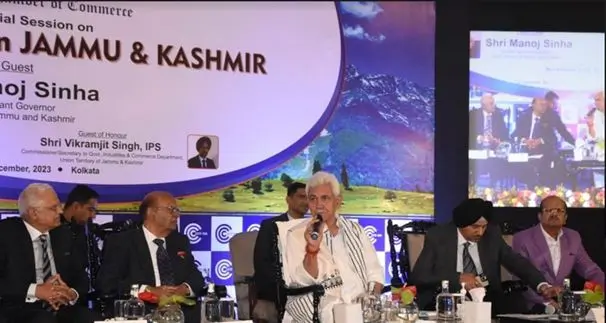
Lieutenant Governor Manoj Sinha the Lt Governor spearheading the ongoing movement of transformation in Jammu and Kashmir is experiencing a significant improvement in its security landscape since the abrogation of Article 370. Stating that an era of unprecedented growth development has begun in Jammu & Kashmir the Lt Governor Manoj Sinha while speaking at an event organized by the Calcutta Chamber of Commerce in Kolkata recently highlighted positive transformations in the region since the momentous decision made by Parliament on August 5, 2019—a move validated by the Supreme Court. The program, focusing on the ‘Scope of Industry in Jammu Kashmir,’ provided LG Sinha with an opportunity to shed light on the current state of affairs in the region. He emphasized that the revocation of Article 370 has not only stabilized the situation but has also led to notable signs of improvement, paving the way for progress and development. Discussing the security situation, Sinha made a noteworthy comparison, stating that it is now better than the security conditions prevailing in Bengal. However, he cautioned against misinterpreting his remarks for political purposes, clarifying that his intention was to draw a parallel between the two regions. LG Sinha’s address delved into the multifaceted opportunities emerging across diverse sectors, elucidating on investor-friendly policies and outlining the Union Territory’s potential for substantial economic growth and employment generation. Underlining the overarching mission of robust economic growth championed by Prime Minister Narendra Modi, LG Sinha articulated a steadfast commitment to leveraging abundant resources, fostering industrial competitiveness, and encouraging collaborative initiatives. He extended a warm invitation to industry leaders and potential investors, urging them to explore the lucrative avenues for investment and economic advancement in J&K. Pledging a departure from bureaucratic red tape, he emphasized the adoption of a red-carpet approach, prioritizing the safety and growth of investments, ease of doing business, ease of living, and establishing a robust government-to-business interface to facilitate enduring investments across sectors. LG Sinha also shed light on the holistic approach undertaken by the UT Administration through a novel industrial scheme.
“Supreme Court verdict is not just a legal judgment but a beacon of hope, a promise of a brighter future, and a testament to the collective resolve to build a stronger and more united India”.
The scheme aims to create a conducive and dynamic environment for growth in key sectors, including Agriculture, Health & Pharmaceuticals, Manufacturing, Tourism & Hospitality, Education & Skill development, Handicraft & Handloom, and IT & Electronics. “Digitalization emerged as a top priority for the government, with a commitment to building an e-society and ensuring long-term prosperity. The pivotal role of Research & Development, expressing a vision to position J&K as one of the country’s most dynamic R&D hubs while strengthening the symbiotic link between industry and academia,” he said. “The event served as a platform for meaningful discourse, facilitating collaboration and providing a glimpse into the transformative vision steering the industrial landscape of Jammu and Kashmir,” he said. LG Sinha also stated that militancy was in decline in the valley and described the recent Poonch terror attack as “unfortunate.” The attack, which occurred on Thursday, resulted in the killing of four soldiers and left two others injured. Expressing dismay over the incident, he condemned the violence, stating, “Our neighbor has persistently engaged in such actions to disturb peace in the valley. However, these efforts are futile, as militancy is on the decline in Kashmir.” Regarding the security situation in Kashmir, LG Sinha clarified that his comments were not intended for political manipulation and emphasized that he meant to convey a comparison with the security situation in Bengal. LG Sinha highlighted that the decision to revoke Article 370, made by Parliament on August 5, 2019, has received validation from the Supreme Court. He expressed confidence in the region’s positive trajectory, emphasizing that Jammu and Kashmir is moving ahead on the path of peace and development. “J&K UT now adheres to the norm of a red carpet and not red tape to ensure safety & growth of investment, ease of doing business, ease of living & a robust government-to-business interface for long-term future for investments in different sectors,” he said. In a related context, Prime Minister Narendra Modi, in one of his recent statements reiterated that Article 370 was history, and no power on earth could restore it now. Commenting on the Supreme Court’s judgment on the revocation of Article 370, the PM, in an interview, asserted that it is a historic decision, and Article 370 is now a thing of the past. He urged people to move forward and focus on their routine work. He also hailed the Supreme Court’s verdict on the abrogation of Article 370 as historic and constitutionally upholding the decision taken by Parliament on August 5, 2019. PM Modi described the verdict as a resounding declaration of hope, progress, and unity for the people in Jammu, Kashmir, and Ladakh. He assured the people of the government’s unwavering commitment to fulfilling their dreams and ensuring that the benefits of progress reach the most vulnerable and marginalized sections of society. The Prime Minister concluded by stating that the Supreme Court verdict is not just a legal judgment but a beacon of hope, a promise of a brighter future, and a testament to the collective resolve to build a stronger and more united India.
“Support initiatives that showcase the region’s cultural diversity and heritage. Continue efforts to maintain and enhance security, ensuring the safety of residents and visitors. Strengthen community policing initiatives to build trust between law enforcement and the local population. Implement effective communication strategies to inform and engage the public about development initiatives. Foster a sense of ownership and pride among the local population regarding the region’s progress. Implementing these suggestions requires sustained efforts, collaboration among various stakeholders, and a commitment to inclusive and sustainable development.”
Kashmir Horizon View: Moving forward in Jammu and Kashmir requires a comprehensive and inclusive approach that addresses the diverse needs and aspirations of the region’s population. There is a need to prioritize socio-economic development to improve living standards and create employment opportunities. Implement targeted policies in key sectors such as agriculture, healthcare, education, tourism, and infrastructure development. Promote inclusive governance by involving local communities in decision-making processes. Encourage the active participation of women and minorities in political and economic spheres. Attract investments by showcasing the region’s potential and implementing investor-friendly policies. Develop and promote sectors with competitive advantages, such as tourism, handicrafts, and IT. Enhance educational infrastructure and quality to ensure access to quality education for all. Focus on skill development programs to empower youth with the skills needed for the modern job market. Invest in critical infrastructure projects, including roads, bridges, and energy, to facilitate economic growth and connectivity. Prioritize rural development to reduce disparities between urban and rural areas. Preserve and promote the rich cultural heritage of Jammu and Kashmir to strengthen local identity. Support initiatives that showcase the region’s cultural diversity and heritage. Continue efforts to maintain and enhance security, ensuring the safety of residents and visitors. Strengthen community policing initiatives to build trust between law enforcement and the local population. Implement effective communication strategies to inform and engage the public about development initiatives. Foster a sense of ownership and pride among the local population regarding the region’s progress. Implementing these suggestions requires sustained efforts, collaboration among various stakeholders, and a commitment to inclusive and sustainable development.
( In commitment to continuous improvement the “Team Kashmir Horizon” invites it’s valuable readers to share their valuable feedback and suggestions with the “Team Kashmir Horizon”. The insights of readers will surely play a vital role in improving the content quality of “Kashmir Horizon” and contribute more for the empowerment of people. Please feel free to reach out to us at
editor@ thekashmirhorizon.com. Team “Kashmir Horizon” eagerly anticipates thoughts and ideas of it’s readers, which will help us serve people and even more effectively. The inputs of valuable readers are highly valued as “Kashmir Horizon” strives to provide it’s readers the best possible experience. Thank you for being a part of the reader community!)