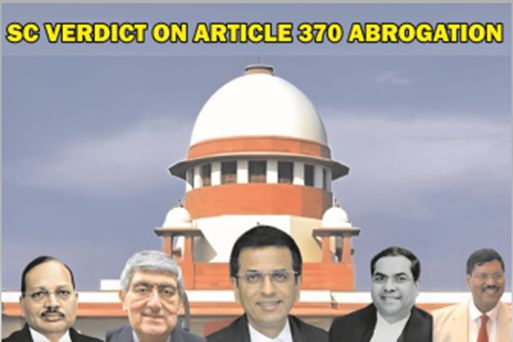
In a watershed moment for India’s constitutional landscape, the Supreme Court has delivered a resounding affirmation of the constitutional authority wielded by Parliament in its enactment of the Jammu and Kashmir Reorganisation Act 2019. This historic legislation resulted in the abrogation of Article 370, the removal of Article 35A, and the consequential bifurcation of the erstwhile Jammu and Kashmir state into two Union Territories. The apex court’s meticulously considered judgment serves as a robust defense of the intricate and sacrosanct processes associated with legislative endeavors, especially those of such monumental constitutional significance. While acknowledging the inherent vulnerability of lawmaking to judicial scrutiny, the court emphatically stated that the authority vested in Parliament and state assemblies should not be capriciously subjected to questioning. At the heart of the court’s pronouncement is a recognition of the exhaustive and scrupulous drafting process that precedes the presentation of any bill in Parliament. Renowned jurists, esteemed as some of the nation’s foremost constitutional experts, play an integral role in meticulously crafting and rigorously reviewing proposed legislation. These legal luminaries, often retained by the Union Law Ministry, bring to bear their profound understanding of the complexities inherent in legal and constitutional matters. The Supreme Court’s decision underlines the indispensability of these constitutional experts, whose deep expertise ensures that the legislative landscape is fortified against potential constitutional challenges. Notably, the experts are engaged in the Union Law Ministry, underscoring the government’s commitment to upholding the highest standards of legality and constitutionality. This ruling, far from merely validating the constitutional amendments made through the J&K Reorganisation Act 2019, serves as a broader testament to the robustness of India’s legislative processes. It affirms the diligence with which bills are crafted, reviewed, and ultimately presented in Parliament, leaving little room for the judiciary to question their constitutional integrity. In essence, the Supreme Court’s judgment is not just a legal pronouncement; it is a reaffirmation of the democratic ethos and a testament to the profound care and scrutiny invested in shaping the legislative foundations of the nation. As India navigates the complexities of governance, this decision stands as a landmark, solidifying the constitutional authority of Parliament and reinforcing the meticulous frameworks that underpin the country’s democratic edifice.

________________________________________________________________
“After Bakshi Ghulam Mohammad’s ousting, a series of significant changes were implemented in the nomenclature within Jammu and Kashmir. This included the transformation of Sadr-e-Riyasat to Governor and Prime Minister to Chief Minister, facilitated through a constitutional amendment in 1965. These modifications marked a larger trend of integration with mainstream Indian governance practices that had been gradually evolving. This process of integration had commenced earlier with the extension of All India Services in 1958, followed by the extension of the Comptroller and Auditor General’s authority in the same year. Subsequent years witnessed further alignment with Indian constitutional norms, including granting full authority to the Supreme Court in 1960 and empowering the Election Commission of India in the same year.”
Jammu & Kashmir plunged into political upheaval in June 2018, marked by the BJP’s withdrawal from its alliance with the PDP. With Assembly polls conspicuously absent, the Centre sought to address the political void through the establishment of District Development Councils. The majority of parties within the Opposition alliance harbored little optimism regarding the Supreme Court overturning the annulment of the special status previously accorded to the erstwhile state, as per the now-abolished law. A prevailing sentiment among them was that this matter was a fait accompli. Despite this acknowledgment, there remained a hopeful anticipation that the court would advocate for the reinstatement of statehood in Jammu and Kashmir, coupled with a directive for the prompt conduct of elections. In it’s decisive ruling, the court mandated the Election Commission (EC) to organize Assembly elections in Jammu and Kashmir by September 30, 2024, while also instructing the Centre to expedite the restoration of J&K’s statehood.

Lessons from the Past: Until 1975, Sheikh Abdullah refrained from contesting the decision to abolish the positions of Prime Minister and Sadr-e-Riyasat. Instead, he promptly accepted the constitutional alterations that were implemented prior to 1975 under the leadership of G. M. Sadiq and Syed Mir Qasim. After Bakshi Ghulam Mohammad’s ousting, a series of significant changes were implemented in the nomenclature within Jammu and Kashmir. This included the transformation of Sadr-e-Riyasat to Governor and Prime Minister to Chief Minister, facilitated through a constitutional amendment in 1965. These modifications marked a larger trend of integration with mainstream Indian governance practices that had been gradually evolving. This process of integration had commenced earlier with the extension of All India Services in 1958, followed by the extension of the Comptroller and Auditor General’s authority in the same year. Subsequent years witnessed further alignment with Indian constitutional norms, including granting full authority to the Supreme Court in 1960 and empowering the Election Commission of India in the same year.
“In the crucible of change, Jammu and Kashmir has the opportunity to redefine its narrative. The Supreme Court’s decision, while settling legal disputes, also serves as a catalyst for a new era in the region. It beckons leaders to look beyond historical grievances and work collectively for the growth and development of this Himalayan territory, steering it towards a future that reflects the aspirations of its people”.
Way Forward: In a pivotal moment for the political landscape of Jammu and Kashmir, leaders, including National Conference’s Omar Abdullah, Mehbooba Mufti of the People’s Democratic Party (PDP), Syed Mohammad Altaf Bukhari of Jammu & Kashmir Apni Party(JKAP), Sajad Lone of Jammu & Kashmir Peoples Conference (J&K PC) and Gh Nabi Azad of Democratic Progressive Azad Party (DPAP) find themselves in a new scenario where they have to move beyond the discourse of restoring Article 370 and channelise their energy towards the development and progress of the region. The recent Supreme Court decision, reflecting a departure from the past, has prompted a call for a collective shift in focus. As the legal and constitutional battle over the abrogation of Article 370 almost concludes with the Supreme Court’s decision, stakeholders are now in search of a new political narrative for Jammu and Kashmir. The call is particularly directed towards leaders like Omar Abdullah , Mehbooba Mufti,Altaf Bukhari and Sajad Lone who represent the younger generation and play a crucial role in shaping the future trajectory of the region. The plea emphasizes the need for a pragmatic approach, urging these leaders to accept the new reality and redirect their efforts towards the welfare of the people. It acknowledges the importance of leaving behind the historical debates and engaging in proactive measures for the development and prosperity of the newly configured Jammu and Kashmir. While some political entities like Apni Party, led by Altaf Bukhari, and Peoples Conference have already embraced the changing dynamics, there is a call for a more widespread acceptance of the current situation. The focus has shifted towards constructive initiatives that can uplift the region, rather than dwelling on past political ideologies. The rallying cry is for unity among young leaders, transcending party lines, to collaboratively work towards restoring the pristine glory of the region. As the Supreme Court decision paves the way for a new era, the onus is on the emerging leaders to forge ahead, leaving behind the political baggage of the past and steering Jammu and Kashmir towards a future marked by growth, development, and prosperity. The call to action resonates for unity among young leaders, transcending political affiliations, as they collectively strive to revive the former splendor of the region. With the Supreme Court’s decision opening the door to a new era, the responsibility now lies on the shoulders of emerging leaders to move forward, shedding the political burdens of the past and guiding Jammu and Kashmir toward a future defined by progress, growth, and prosperity. Critical attention is required to address the extensive damage inflicted on public infrastructure by the 2005 earthquake and the massive floods of 2014 in Jammu and Kashmir. Collaborative efforts are essential to reshape the region, acknowledging a new reality and working towards fostering peace and prosperity in the Himalayan area. It is imperative to join forces and build a better environment that reflects the aspirations of the community.
Kashmir Horizon View: In the unfolding narrative of Jammu and Kashmir, the Supreme Court’s judgment stands as a cornerstone, emphasizing the strength and resilience of India’s constitutional framework. It not only affirms the authority of Parliament in enacting significant legislative changes but also underscores the meticulous processes that precede such landmark decisions. As the region grapples with the aftermath of political transformations, the court’s directive for elections and the restoration of statehood creates a path forward. The leaders of Jammu and Kashmir, especially the younger generation, are urged to pivot from past debates and embrace a future marked by development and progress. The call for unity resonates not only in political spheres but also in addressing the pressing issues of public infrastructure damaged by natural disasters. Collaborative efforts are key to reshaping the region and fostering a climate of peace and prosperity. In the crucible of change, Jammu and Kashmir has the opportunity to redefine its narrative. The Supreme Court’s decision, while settling legal disputes, also serves as a catalyst for a new era in the region. It beckons leaders to look beyond historical grievances and work collectively for the growth and development of this Himalayan territory, steering it towards a future that reflects the aspirations of its people.
( In commitment to continuous improvement the “Team Kashmir Horizon” invites it’s valuable readers to share their valuable feedback and suggestions with the “Team Kashmir Horizon”. The insights of readers will surely play a vital role in improving the content quality of “Kashmir Horizon” and contribute more for the empowerment of people. Please feel free to reach out to us at
editor@ thekashmirhorizon.com. Team “Kashmir Horizon” eagerly anticipates thoughts and ideas of it’s readers, which will help us serve people and even more effectively. The inputs of valuable readers are highly valued as “Kashmir Horizon” strives to provide it’s readers the best possible experience. Thank you for being a part of the reader community!)