• Statehood unresolved, one lakh jobs pledge falls short
• Key welfare and reservation promises remain pending
Srinagar| Oct, 21: Two years after the National Conference (NC) formed the government in Jammu and Kashmir, the gap between its electoral promises and their implementation remains pronounced, with several headline commitments still awaiting fulfilment.
From restoration of statehood and special status to one lakh jobs, revision of the reservation policy and financial assistance for women, the NC’s 2024 election manifesto offered a broad set of assurances. But as the government completes two years in office, many of these promises remain unresolved, raising questions over the pace of delivery on its electoral agenda.
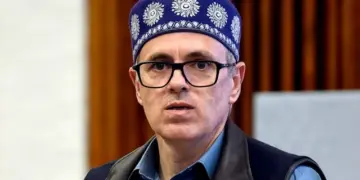
Omar Abdullah took oath as Chief Minister on October 16, 2024, after the JKNC emerged victorious in the first Assembly elections held since the abrogation of Article 370 and Article 35A in August 2019 and the reorganisation of the erstwhile state into two Union Territories.
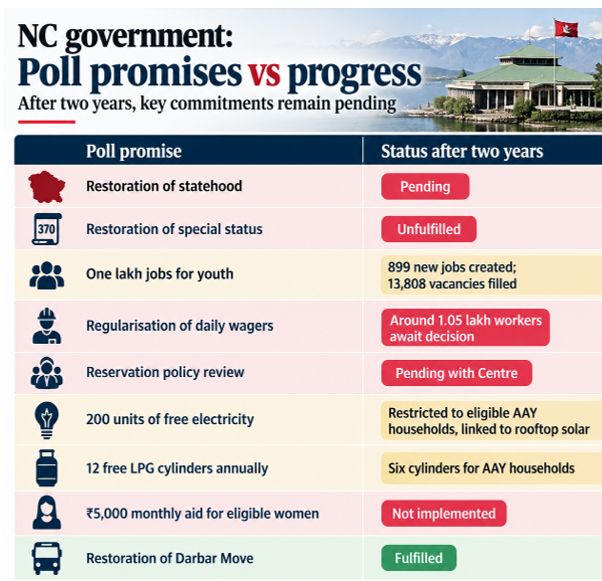
Restoration of Jammu and Kashmir’s statehood remains among the most prominent unfinished commitments. The NC had also promised restoration of special status and implementation of the 2000 Autonomy Resolution.
The Assembly passed a resolution seeking restoration of special status in its first session, but the government’s subsequent efforts have focused largely on statehood. The Cabinet and Assembly have adopted resolutions on the issue, and Omar Abdullah has raised it with Prime Minister Narendra Modi and Union Home Minister Amit Shah.
Yet, the Centre has not announced a timeline for restoration. The delay underscores the limits of the elected government’s authority over a question that requires action at the national level.
The employment commitment presents a different challenge because it concerns recruitment and administration as well as the broader availability of jobs. The NC had promised one lakh jobs for young people and filling all government vacancies within 180 days of assuming office.
Against that pledge, the figures cited in the report show that 899 new government jobs were created and 13,808 vacant posts were filled during the first two years. The distinction between newly created posts and vacancies filled is significant, but both figures fall within a much wider employment challenge facing the government.
The regularisation of around 1.05 lakh daily-wage and casual workers also remains pending. The unresolved issue affects a large workforce that continues to await clarity on its employment status.
The NC’s promise to review the reservation policy has also failed to reach a conclusion. The file remains pending with the Centre, leaving the issue unresolved for aspirants seeking changes to the existing arrangement.
Candidates from the open merit category have expressed concern over the share of opportunities available to them in government recruitment. The delay has kept the debate alive over how reservation benefits and open-category opportunities should be distributed.
The government must navigate competing demands while seeking a policy outcome that can address the concerns raised by different groups.
The gap between the manifesto and implementation is also visible in the welfare sector. The promise of 200 units of free electricity for every household has been restricted to Antyodaya Anna Yojana families and linked to rooftop solar installations.
Similarly, the commitment of 12 free LPG cylinders annually has been narrowed to six cylinders for AAY households. The proposed monthly assistance of Rs 5,000 to women heading economically weaker households remains unimplemented.
Other commitments awaiting action include the release of political prisoners, a review of employee terminations, protection of local employment rights and repeal of the Public Safety Act. The detention of Aam Aadmi Party MLA Mehraj Malik under the PSA last year highlighted the constraints confronting the elected government on the issue.
The restoration of the half-yearly Darbar Move between Srinagar and Jammu remains a notable promise the government has fulfilled. The practice had been discontinued by the previous administration.
As the NC government enters its third year, its political challenge is to show measurable progress on commitments that fall within its administrative reach while continuing to press the Centre on statehood and other issues requiring decisions beyond the Union Territory government.
For voters who backed the party on promises of political restoration, employment and economic relief, the coming year will be an important test of whether pending guarantees begin translating into concrete outcomes.