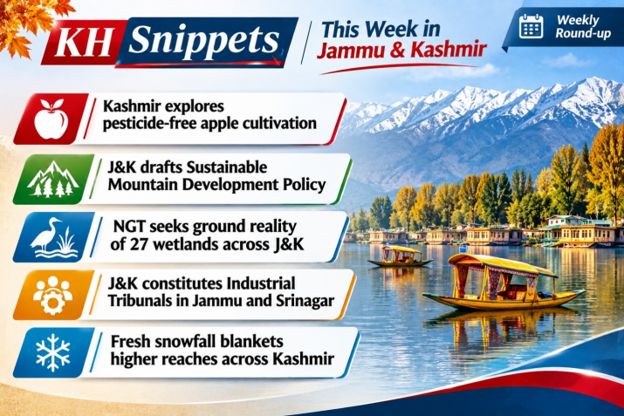
Srinagar| Nov, 14: From a promising breakthrough in pesticide-free apple cultivation to a proposed policy for protecting fragile mountain ecosystems, Jammu and Kashmir witnessed several significant developments this week. Environmental conservation, agricultural innovation, institutional reforms and changing weather conditions remained among the key highlights. Here are five stories that captured the week’s important developments.
1. Kashmir Explores Pesticide-Free Apple Cultivation: Sher-e-Kashmir University of Agricultural Sciences and Technology of Kashmir (SKUAST-K) has successfully produced apples without chemical pesticides on a limited experimental scale at two locations. The initial trial involving the Gala variety showed promising results, with the university planning to expand the programme next year. Vice-Chancellor Prof. Nazir Ahmad Ganai also disclosed that a proposal has been submitted to the government for mandatory pesticide-residue monitoring of fruits and vegetables entering Kashmir, with laboratory facilities capable of testing residues of 55 pesticides. The initiative could mark an important step towards safer horticulture, healthier farming practices and improved market credibility for Kashmir’s apple industry.
2. J&K Drafts First-Of-Its-Kind Sustainable Mountain Development Policy: SKUAST-K has submitted the draft Jammu and Kashmir Sustainable Mountain Development Policy-2026 to the government, warning that continued unregulated development could cause irreversible damage to fragile mountain ecosystems. The proposal envisages a three-tier institutional framework, including a Mountain Development Council, Mountain Development Authority and district-level committees. It also proposes four ecological sensitivity zones, visitor limits at major tourist destinations, restrictions on private vehicles in fragile areas and stronger safeguards for glaciers, springs and wetlands.
3. NGT Seeks Ground Reality Of 27 Wetlands Across J&K: The National Green Tribunal has directed the Jammu and Kashmir Pollution Control Committee to provide the actual existing area of 27 identified wetlands and compare it with their recorded revenue area. The tribunal flagged gaps in the assessment, including pending information from Jammu and Kupwara. Water-quality testing also revealed that several wetlands failed to meet prescribed standards for outdoor bathing.
4. J&K constitutes Industrial Tribunals in Jammu, Srinagar: The Jammu and Kashmir Government has constituted Industrial Tribunals at Jammu and Srinagar under the Industrial Relations Code, 2020, strengthening the institutional mechanism for adjudication of industrial disputes. Through separate notifications, Deputy Labour Commissioners of Jammu and Kashmir divisions have been appointed as Enquiry Officers, while the Labour Commissioner, J&K, has been designated as the Appellate Authority. The move is expected to provide a structured mechanism for addressing industrial disputes, statutory enquiries and appeals involving establishments across the Union Territory.
5. Fresh Snowfall Blankets Higher Reaches As Kashmir Prepares For Winter: Several higher-altitude areas of Kashmir, including Gurez, Sonamarg, Zojila, Machil and parts of Kupwara, witnessed fresh snowfall as a Western Disturbance affected the region. The Meteorological Department forecast widespread rain in the plains and snowfall in higher reaches, prompting district administrations to issue advisories for tourists, travellers and farmers. Authorities cautioned that snowfall could disrupt traffic on mountain roads and important passes, while farmers were advised to protect harvested crops and avoid outdoor agricultural operations during adverse weather.