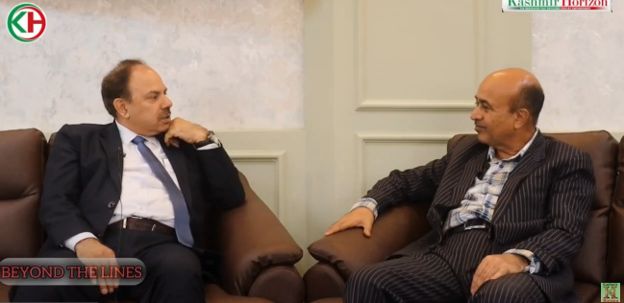
In an exclusive Podcast with Editor-in-Chief of Kashmir Horizon Shafqat Bukhari, IUST Vice-Chancellor Prof Shakeel Ahmad Romshoo discusses climate change, unplanned construction education reforms and the need to strengthen school education
Jammu and Kashmir must strengthen urban planning, strictly enforce building regulations and promote earthquake-resistant, energy-efficient housing to reduce its vulnerability to natural disasters, renowned earth scientist and Islamic University of Science and Technology (IUST) Vice-Chancellor Prof Shakeel Ahmad Romshoo has said. Romshoo received his early education in Kashmir, completed his undergraduate studies in Ranchi, Jharkhand, pursued a master’s degree in Space Technology and Applications at the Asian Institute of Technology in Bangkok, Thailand, and obtained a PhD in water resources engineering from the University of Tokyo, Japan. After working as a scientist at the Japan Aerospace Exploration Agency (JAXA), he joined the University of Kashmir in 2004, where he established a Department of Geoinformatics. He subsequently headed the Department of Earth Sciences for around 11 years, focusing on hydrology, glaciology and climate change. He said his interest in Himalayan research developed through his scientific work on glaciers, snow and water resources. During his academic career of nearly 38 years, he has worked on environmental and Earth science issues and supervised 31 PhD scholars.
‘Climate Change Requires Global Action’
Shafqat Bukhari: You have devoted much of your research to the Himalayas, particularly glaciers and water resources. What inspired this journey, and how do you assess the climate challenges facing Jammu and Kashmir?
Prof Shakeel Ahmad Romshoo: I have always been interested in the natural sciences. After completing my PhD at the University of Tokyo, I joined JAXA as a scientist. My research group worked on glaciers, water and hydrology, and I developed a particular interest in the Himalayas. When I joined the University of Kashmir in 2004, I established a Department of Geo- informatics. The discipline applies space technology, satellite data and information technology to address problems in Earth and environmental sciences. Over time, I concentrated on hydrology, glaciology and climate change. Climate change is a global phenomenon. The people of the Indian Himalayas, including Jammu and Kashmir and Ladakh, contribute relatively little to global greenhouse gas emissions but face significant consequences. Responsibility for addressing climate change rests with governments across the world, although local governments and citizens can also take meaningful initiatives. People in poorer countries are often among those most severely affected despite contributing less to the emissions driving the problem. The 2014 floods in Jammu and Kashmir demonstrated our vulnerability. Although much of the damaged infrastructure was subsequently restored, the larger question is whether we have adequately addressed the underlying risks.
‘Master Plans Must Be Implemented, Not Merely Prepared’
Shafqat Bukhari: Governments issue construction permissions, and municipal bodies approve buildings. What changes are required in housing policies and urban planning?
Prof Romshoo: Urban planning is a major concern in Kashmir, Jammu and across South Asia. Srinagar, Jammu, Anantnag, Baramulla and smaller towns are expanding, but the implementation of master plans leaves much to be desired. Preparing a master plan is not enough. Its implementation must be a government priority. Every major settlement should have a comprehensive plan identifying where residential construction can take place, where parks and open spaces should be maintained, and where public shelters and other essential infrastructure should be located. A house is a long-term investment. People may live in the same building for 100 years. We must therefore ask whether our homes will remain safe during floods, earthquakes or other disasters. Unfortunately, people often overlook these risks. Building regulations exist, but some people attempt to circumvent them. In several places, houses have been constructed close to, or almost on, riverbeds. Kashmir has a long history of flooding. Major floods occurred in the early twentieth century, in 1953 and in 2014. The region experienced flooding again last year. We cannot assume that another major flood will not occur for 50 or 100 years simply because one has already taken place. Thirty or forty years ago, people were generally more cautious about purchasing land in flood-prone areas. That distinction has weakened, and more people are willing to build in vulnerable locations.
‘Earthquakes Cannot Be Predicted Precisely’
Shafqat Bukhari: There is considerable public discussion about earthquake risks in Jammu and Kashmir, particularly after the 2005 earthquake. Can science predict when another major earthquake will strike?
Prof Romshoo: Kashmir is vulnerable to several natural hazards, including floods, earthquakes, landslides and cloudbursts. Our geographical and geological setting contributes to these risks. However, science cannot currently tell us precisely when an earthquake will occur, where exactly it will strike or what its magnitude will be. We must distinguish between understanding earthquake risk and predicting the precise timing of an earthquake. The risk existed in the past, exists today and will continue to exist. We cannot say when the next major earthquake will occur, but we can take measures to reduce the damage it may cause. The most important steps include safer construction, compliance with building codes and greater public awareness. The issue is not simply whether a building has five storeys or more. What matters is whether it has been properly designed and constructed according to appropriate safety standards. Our traditional architecture offers valuable lessons. Many old shrines, mosques and other structures were built using techniques suited to local conditions. Although modern houses must provide contemporary amenities, we can still learn from traditional construction practices.
‘Earthquake-Resistant, Energy-Efficient Houses Are Essential’
Shafqat Bukhari: Should responsibility for safer housing rest with the government or individual homeowners? Have you proposed an alternative construction model?
Prof Romshoo: The first responsibility lies with individuals to protect their families. Suppose someone spends ₹1 crore purchasing land and another ₹1 crore constructing a house. Spending an additional amount on appropriate earthquake-resistant measures can be a worthwhile investment if it improves the safety of the building. However, the government also has a major responsibility to enforce building codes. We must ask why people fail to follow regulations in letter and spirit and why some attempt to bypass them. There must be effective enforcement, and citizens must recognise their own responsibility. I have advocated developing modern housing models that combine earthquake resistance with energy efficiency. When I joined IUST, I suggested that we work towards a model house incorporating both features. Many houses in Kashmir are not energy-efficient. During winter, families often depend on a single warm room, such as a hamam, while other rooms remain cold. Better designs can improve heat retention, reduce energy consumption and provide more comfortable living conditions.
‘31 Scholars Awarded Phds Under My Supervision’
Shafqat Bukhari: You have also played an important role in developing a new generation of researchers. How do you assess the contribution of your PhD scholars?
Prof Romshoo: So far, 31 scholars have been awarded PhDs under my supervision. Their research has covered issues of direct relevance to society, including wetlands, glaciers, climate change, environmental science and disaster-related subjects. Apart from supervising doctoral research, I have undertaken externally funded research projects supported by various government agencies, including the Department of Science and Technology and the Ministry of Environment. Several of my former scholars have received international fellowships, while others are working in international organisations, national institutions and Jammu and Kashmir. I feel proud and satisfied that I have contributed to knowledge generation and the educational empowerment of young people. As Vice-Chancellor, I continue to see this as an important responsibility.
‘AI Can Transform Scientific Research’
Shafqat Bukhari: Artificial intelligence is changing almost every field. How do you see its role in research and higher education?
Prof Romshoo: Artificial intelligence is revolutionary. It is changing how we solve problems, innovate, conduct research and make discoveries. From an academic perspective, its potential is enormous. Research that previously took several years can now be accelerated considerably with appropriate AI tools. Work that might traditionally have required five years could potentially be completed much faster, depending on the research question and the methods involved. AI can help researchers achieve things that might otherwise have taken a decade or longer. However, the accuracy and validity of the results must always be assessed carefully. At IUST, we have introduced programmes in Artificial Intelligence and related emerging technologies, including a four-year undergraduate BTech programme and postgraduate courses in associated fields.
‘Students Should Not Have To Leave J&K For Every Course’
Shafqat Bukhari: You have said that student admissions at IUST have doubled over the past three years, even as many colleges elsewhere are facing declining enrolment. What strategy helped achieve this?
Prof Romshoo: When I joined the university five years ago, we asked why so many students from Jammu and Kashmir were leaving the region for higher education. We found that students were travelling to Bengaluru and other parts of North and South India to pursue courses that were not sufficiently available locally. Families were spending ₹20 lakh to ₹25 lakh on certain programmes. We therefore decided to expand our academic offerings in fields such as Computer Science Engineering, Artificial Intelligence, Data Science, Robotics and Space Technology. This strategy has helped us in two ways. It has improved the university’s financial position and enabled more students to pursue their preferred courses closer to home. Our admissions have doubled, and we have also doubled our hostel capacity, from around 700 to approximately 1,500 students. Demand for transport has increased as well, particularly among students travelling from distant areas.
‘University Consortium Can Expand Access’
Shafqat Bukhari: Could a consortium of universities help accommodate more students? And what is your view on the establishment of private universities in Jammu and Kashmir?
Prof Romshoo: There is considerable demand for programmes such as Artificial Intelligence, Data Science, Robotics and Computer Science Engineering. If a programme has 100 seats and receives applications from 2,000 students, an institution cannot admit everyone. We may be able to increase our capacity from 100 to 200 seats, but that still leaves many applicants without an opportunity. A consortium of universities could help address this problem. Universities across Jammu and Kashmir could coordinate their academic offerings so that students have access to similar programmes at institutions such as Baba Ghulam Shah Badshah University, cluster universities and other institutions. As for private universities, their entry could create a more competitive academic environment. However, establishing and running a university is a major challenge. Institutions require proper infrastructure, qualified faculty, adequate resources and a sustainable student base.
‘Quality And Placements Will Determine Success’
Shafqat Bukhari: Some argue that private universities do not always deliver better outcomes than government institutions. How should their performance be assessed?
Prof Romshoo: Competition can be healthy, but universities must demonstrate their quality through performance. Institutions should offer relevant academic programmes, recruit excellent teachers and establish effective placement mechanisms. One important indicator of a good university is whether its graduates find suitable employment. If students consistently secure good jobs after graduating from an institution, its reputation will grow, and more students will seek admission. Private universities often place considerable emphasis on placements, but their long-term success must also be assessed. Attracting students is not enough; institutions must demonstrate that they provide quality education and meaningful career opportunities. The focus should be on contemporary courses, strong faculty and graduates who are employable and capable of contributing to the economy.
‘Government Must Review Declining College Admissions’
Shafqat Bukhari: What explains the decline in admissions at degree colleges, and what can be done to reverse it?
Prof Romshoo: One factor is the mushrooming of colleges in different areas without sufficient consideration of student demand, infrastructure and faculty requirements. The Government needs to review the situation and determine how these institutions can be strengthened. A committee has been constituted to examine declining admissions in colleges, and I am chairing it. We are looking at ways to arrest the decline and improve the functioning of these institutions.
‘School Education Needs Comprehensive Reform’
Shafqat Bukhari: Does the school education system need to change to ensure that students remain interested in higher education and develop the skills required by universities and industry?
Prof Romshoo: The National Education Policy 2020 has brought significant changes to higher education. Traditionally, universities were largely seen as degree-awarding institutions. Students enrolled, completed their courses and received degrees. That model is no longer sufficient. Many graduates struggle to find jobs, which is why greater emphasis is now being placed on creativity, innovation and entrepreneurship. Students must be encouraged to develop ideas, establish start-ups and explore opportunities beyond government employment. India is a growing economy, and its industries need skilled and innovative graduates. However, school education needs much greater attention. The National Education Policy devotes substantial space to school-level reforms, but its recommendations need to be implemented more effectively. Schools must be connected to the broader educational ecosystem, and children’s creativity and independent thinking must be nurtured from an early age. We need comprehensive reforms in school education so that students develop the foundations required for higher studies, research and innovation.
‘99 Per Cent Marks Have Become A Status Symbol’
Shafqat Bukhari: Are we placing too much emphasis on marks and examination results at the expense of creativity and learning?
Prof Romshoo: Exactly. Securing 99 per cent marks has become a status symbol. Education should not be measured only by examination results. We must also assess whether students can think independently, solve problems, innovate and apply their knowledge in practical situations. These abilities must be developed at the school level. If we want universities to produce capable graduates, researchers and entrepreneurs, schools must nurture curiosity, creativity and a genuine interest in learning. Only then can we build a stronger higher education system that prepares young people to address the challenges facing Jammu and Kashmir and the country.
Shafqat Bukhari: Thank you, Professor Romshoo, for sharing your insights with our viewers.
Prof Romshoo: Thank you